
Quick Answer: How Do Customer Marketing and Customer Success Differ?
Customer marketing typically creates communication and programs for groups of existing customers. Customer success typically helps accounts reach agreed outcomes and resolves account-specific barriers with other teams. Give each shared workflow one owner for the next action.
| Function | Typical responsibility | Evidence to check |
|---|---|---|
| Customer marketing | Segment communication, education and advocacy programs | Relevant customers received and used the resource. |
| Customer success | Account outcomes, adoption barriers and coordinated follow-up | The account completed the agreed work or got the right help. |
Titles vary across companies. Write the handoff so customers know who will respond.
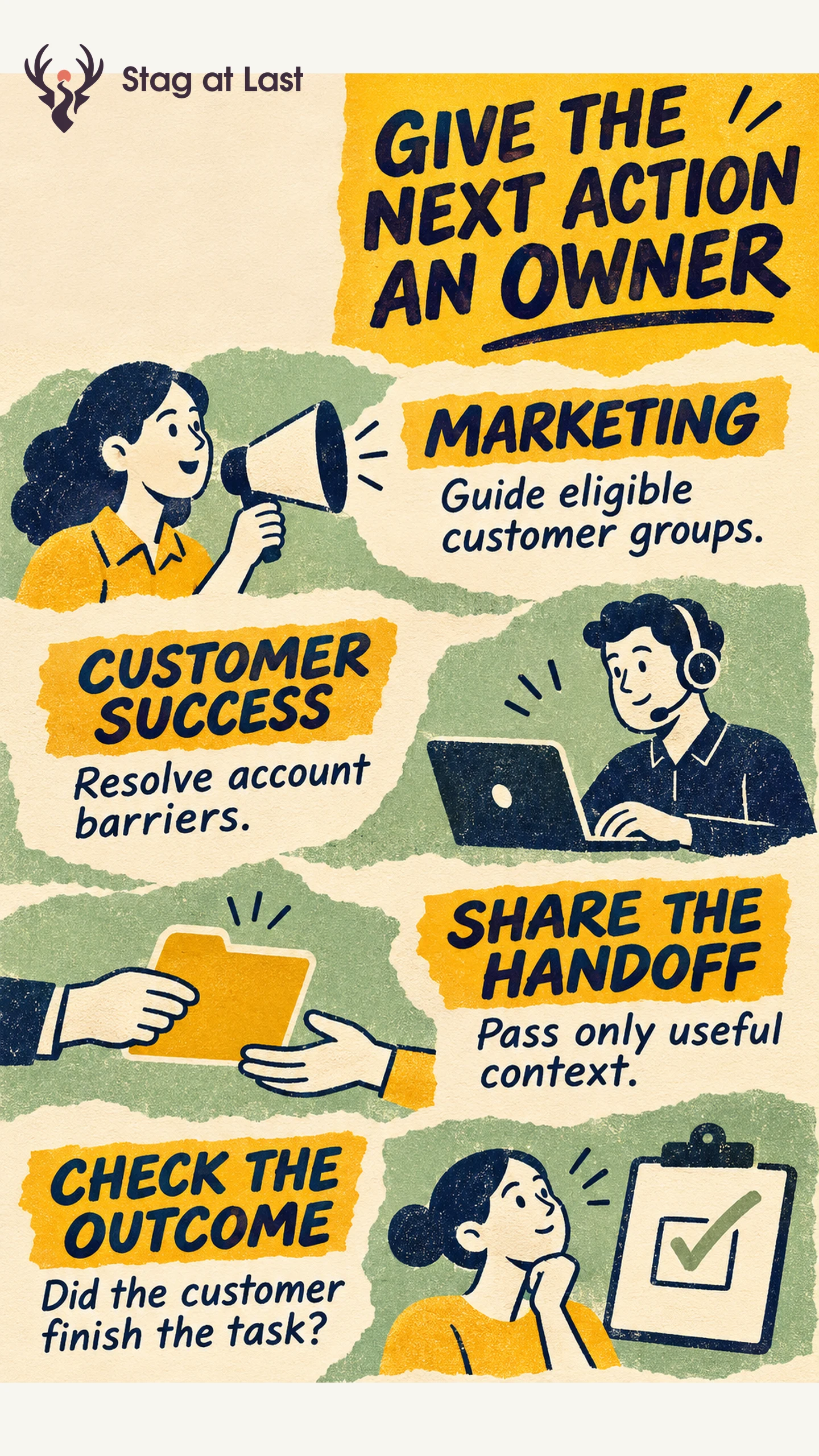
A customer receives a webinar invitation while waiting for permission to use the feature it covers. The campaign owner can fix the audience rules. The account owner can help with the permission. Both can work toward adoption if the handoff says who acts and which accounts need a different route.
Define the Job Each Function Does
Customer marketing often plans messaging and programs that serve a segment. Examples include a release guide, customer education content and an invitation to a community event. Customer success often owns a plan with a specific account, including the customer’s goals, blockers and next milestone. A scaled success team may also run group outreach.
Gainsight describes a historical structure where a one-to-many function in customer success shared customer engagement responsibilities with customer marketing. [1] Treat that as an example of overlap. Your allocation can be different. Write one delivery owner per action and one contact for exceptions.
Assign an Owner at the Moment of Handoff
Name the event that transfers the work and the minimum context the receiving team needs. Use account state and customer preference to decide whether a campaign can continue. A support issue goes to the person who can resolve it, with the success owner informed when it affects a milestone.
| Situation | Who leads the next action | Context to pass |
|---|---|---|
| A release helps an eligible segment | Marketing prepares the message and guide. | Eligible plans, roles, exclusions and the action to measure. |
| An account cannot complete setup | Success coordinates the account plan and routes technical issues to support. | The intended outcome, blocker, owner and next check. |
| A customer offers to share a story | The advocacy owner checks interest and approval. | Activity scope, account timing and the customer’s preferences. |
Imagine a reporting company promoting scheduled delivery. Marketing invites eligible accounts to learn the feature. Success identifies accounts awaiting administrator approval and sends a separate route to resolve it. If a customer has an open delivery problem, suppress the optional promotion until the responsible team reviews the issue. Use product-led routing when behavior can indicate a need for human help.
Use the Same Outcome Without Combining the Measures
Agree on the product result both teams care about, such as an account successfully delivering its first scheduled report. Marketing tracks who received the campaign and followed its steps. Success tracks progress against the account plan, including unresolved barriers. Product events can show whether the account reached the shared milestone. Keep message reach, help provided and task completion separate.
Define the eligible cohort and follow-up before comparing results. Retention and expansion may matter to both teams, but a change after a campaign does not isolate its effect. For shared feedback programs, choose the question and scale that match the decision the receiving team can make.
Review Exceptions Before the Next Campaign
Review a few cases where the handoff was late, duplicated or unclear. Check that the receiving owner acknowledged the task and that the customer got a useful response. Before the next campaign, confirm the eligible audience, who can suppress the message and who will follow up on replies.
For advocacy requests, keep one contact history across teams. The person who manages the relationship can check timing and preferences. The program owner can confirm the specific activity and publication terms.
Check Shared Customer Pages Across Languages
If marketing and success share multilingual WordPress pages, evaluate StagLingo on a task guide and customer announcement. Check that both point to the same support route and product terms in each language.
FAQs About Customer Marketing and Customer Success
Can one person do both jobs?
Yes. A small team may combine roles. Keep the campaign decision and the account decision separate so the owner knows when to switch from a group message to individual help.
Who owns renewals or expansion?
It depends on the organization and agreement. Assign the commercial decision to an explicit owner and give that person the account’s outcome and risk context.
Who should manage a reference invitation?
Use the reference program owner to coordinate the request. Ask the relationship owner to check fit and timing, and confirm that the customer wants to participate.
Sources
[1] Gainsight. The Intersection of One-to-Many and Customer Marketing