Write integrity
The Import must complete its validation, backup, transaction, and storage read-back checks. A failed or unproven write cannot pass merely because part of the page looks translated.

Audit the rendered translation, identify application failures separately, keep unfinished language URLs out of search, and remove temporary noindex records only after the live page is ready.
A production release combines protected write evidence, rendered-language review, real front-end inspection, and a deliberate search-visibility decision.
The Import must complete its validation, backup, transaction, and storage read-back checks. A failed or unproven write cannot pass merely because part of the page looks translated.
Review the rendered page for accuracy, completeness, native fluency, terminology, tone, headings, lists, tables, and visible reading order.
Confirm the exact target-language URL in a private window after cache clearing. Active-string, dynamic-block, or stale-cache failures are separate from translation quality.
Scoring examines the rendered page through the AI provider configured in AI Models. Configure and test that connection before running an audit.
Open StagLingo → Scoring.
Enter a default-language URL to score every derived target language, or enter one translated URL to score that locale only.
Click Score translation quality and wait for the rendered-page audit.
Read the language score, composition score, release signal, application-failure column, and summary together.
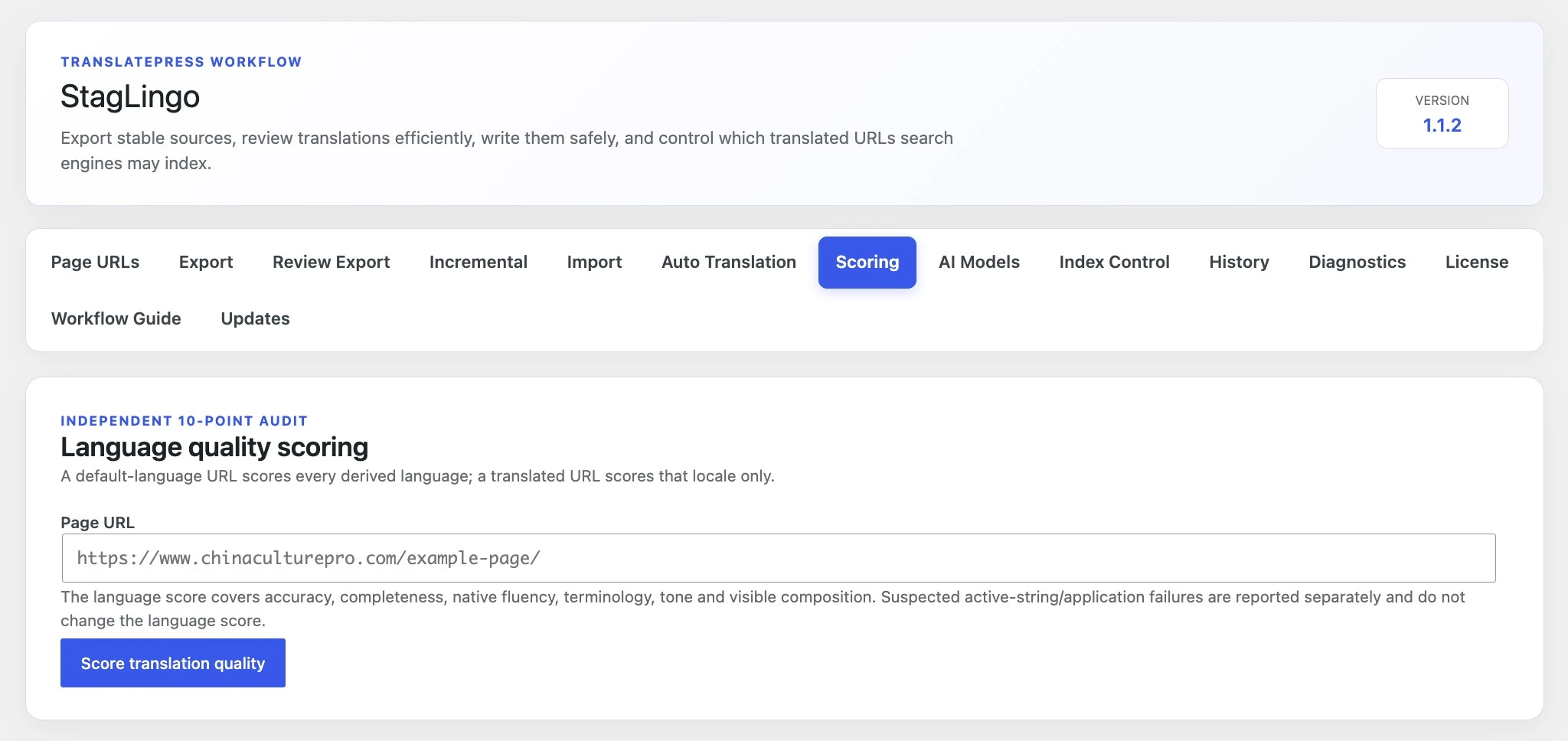
The scoring report prevents an old English string, inactive owner, or application failure from being misrepresented as a purely linguistic problem.
Covers semantic accuracy, completeness, native fluency, terminology consistency, audience-appropriate tone, and visible composition.
Reports the visible structural quality of the rendered result as a separate composition score.
Returns publishable or needs_revision. Treat this as audit evidence, not an automatic publishing command.
Counts suspected active-string or application problems separately so they do not unfairly reduce the language score.
Reports clear or suspected. A suspected result should be verified against the actual page and storage evidence.
Provides a concise English explanation to help decide whether the next action is language revision or technical troubleshooting.
Repeatedly importing the same correction cannot solve every issue. First decide whether the problem is the wording, the protected write, the active string, the rendered owner, or the cache.
Use Review Export to inspect complete rendered copy and create a targeted correction package.
Import only the validated sparse correction ZIP. Keep unchanged cells blank or / so approved translations are not overwritten.
If application status remains suspected, inspect Import results, active-string behavior, caches, Diagnostics, and History and Troubleshooting.
Clear caches, open the exact target URL, and score again only after the visible page reflects the new correction or technical fix.
Bulk page noindex creates temporary page-language records while translations are being prepared, reviewed, corrected, or technically verified.
Select the translated languages that should receive temporary noindex records.
Choose All published pages or only checked published pages. Future pages are not automatically added; run the bulk action again after publishing new content.
Click Add noindex. This enables Index Control without changing translations or whole-language defaults.
Remove one page-language pair, one complete page record, or selected records only after those translated URLs pass release checks.
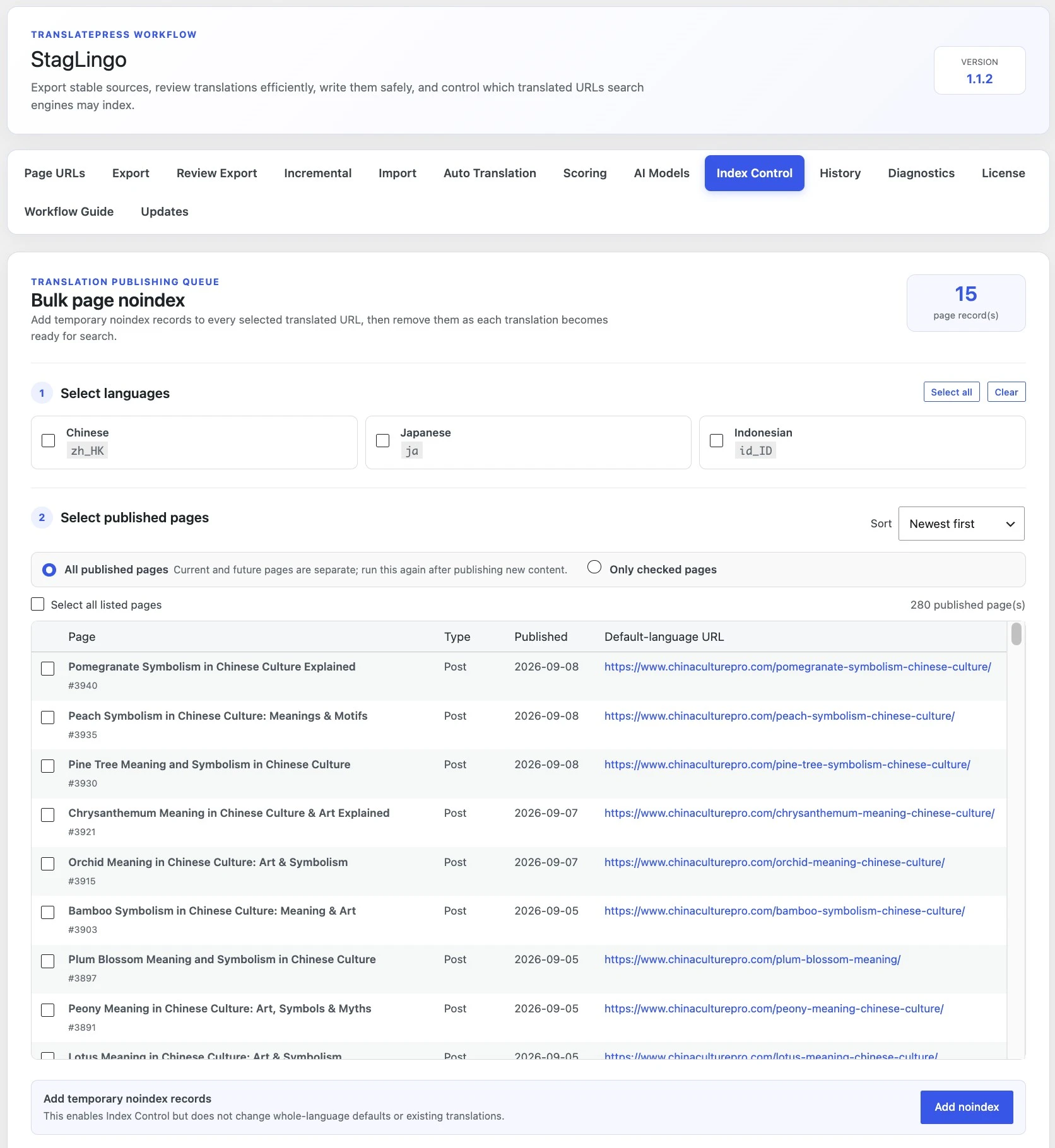
Bulk temporary records fit ordinary publishing queues. Advanced rules are for broader language policy or page-specific exceptions that must remain stable across translated URLs.
Saved defaults and overrides affect the front end only while Index Control is enabled. Saving rules also clears relevant page and SEO caches.
Use a language default when every public URL in that translated language should remain noindexed.
An exact page rule overrides the whole-language default. It can noindex weak pages or explicitly allow verified pages inside a noindexed language.
noindex, followMatching pages remain accessible and links can still be followed.Removing a temporary record should follow a completed translation workflow. It should not be used merely because the page exists or contains some translated text.
The latest write passed package validation, protected checks, backup, transaction, and storage read-back.
The page has completed the required Review Export or equivalent native-language review, including visible structure and linked sentences.
The exact target-language URL was inspected in a private window after WordPress, server, and CDN caches were cleared.
Any suspected active-string or application failure has been resolved or verified as a conservative visibility-only warning.
Check the translated title, description, URL slug where supported, canonical behavior, and intended hreflang relationships.
Remove only the verified page-language pair, save the rule state, clear caches, and confirm that the live page no longer outputs noindex.
History, backups, and Diagnostics help separate package validation, storage, active-string ownership, cache, and public-rendering problems.