
Quick Answer: How do you test whether customers can use website navigation to accomplish a task?
Test website navigation by giving customers a realistic task and watching how they reach the right destination. Capture where they start, what they choose and whether they can finish independently.
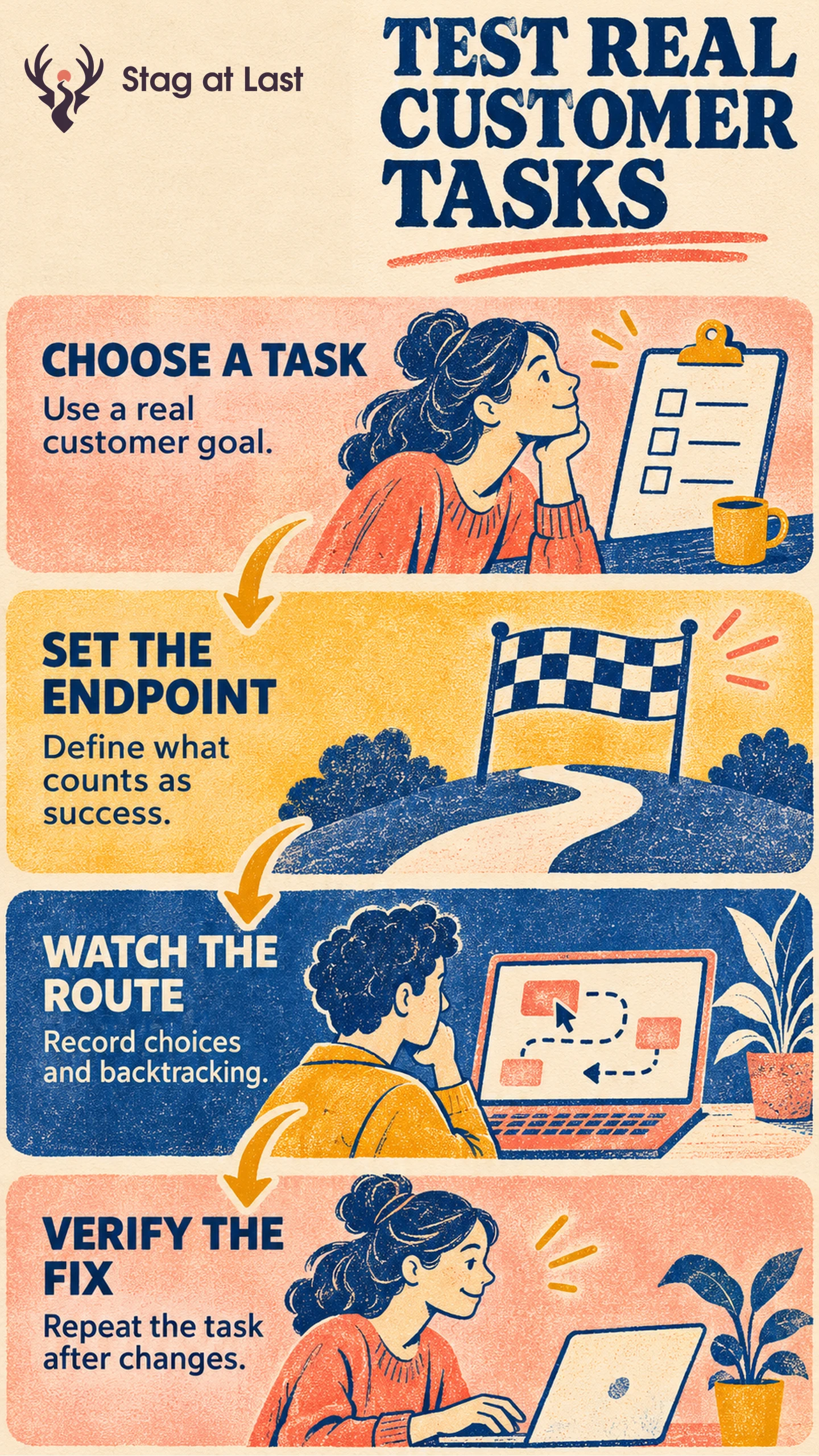
- Define a task and acceptable endpoints.
- Let participants choose their own route.
- Record choices, wrong turns and recovery.
- Fix the observed obstacle and run the task again.
Use shortcuts such as tree testing or first-click testing when you need to isolate one part of the journey.
A visitor who reaches a returns page may still leave without knowing how to start a return. A navigation test can show whether the trouble lies in what the menu calls the page, where the link appears or what the destination actually contains.
Choose the Test That Answers Your Question
Use a hands-on usability session when participants need to navigate a working site or a realistic prototype, including search, filters or in-page links. GOV.UK’s guide describes observing likely users completing tasks and listening to what they expect to happen. [1] If you need to isolate labels and hierarchy, use tree testing. If the immediate question is where people would start on a rendered page, use first-click testing.
Recruit people who face the task and use the devices it commonly involves. Include participants using assistive technologies when their paths are in scope. Start where customers plausibly begin, such as a product page or help article, and record which entry point you supplied.
Write the Task Without Giving Away the Route
Use a goal the participant can recognize. Nielsen Norman Group advises writing realistic scenarios that invite an action without exposing the interface’s solution. [2] Keep menu labels out of the prompt when those labels are what you want to study.
For example, give shoppers this task: “The jacket you ordered last week is too small. Find out if you can send it back and how to start.” Start everyone on the order-details page for a mock jacket order with the delivery date, purchase channel and item details. Define success as applying the policy correctly and identifying a working next action. Accept any accurate route through the site. Stop before any irreversible action.
Record the Path and the Outcome
Write down the first choice and what the participant expected to find. Track backtracking, changes from menus to search, dead ends and whether the participant reaches a correct destination. When they use search, record the terms and where search helped them recover, including a no-results state if it occurs.
Let the participant work before offering help. Ask neutral questions about what they expected. If you intervene, distinguish independent completion, completion with help, and failure. Record when the participant reaches the right page but misreads its policy or cannot locate the next action.
Change the Cue That Caused the Detour
Tie the fix to the observed problem. If shoppers never open a category because its label implies the wrong content, test an alternative label. If they find the page but assume their order is ineligible because the instructions are unclear, revise the destination. Repeat the task on the corrected design with fresh participants when feasible. Use comparable scenarios and endpoints so you can describe what behavior improved.
Test Navigation in the Customer’s Language
If you publish on WordPress in several languages, evaluate StagLingo on a few sample pages. Run the same tasks with participants who use each language and check that the destination still meets their needs.
FAQs About Website Navigation Testing FAQs
Should you insist that participants use the main menu?
Only if your research question specifically concerns that menu. For an end-to-end task, allow routes customers can actually use.
How do you handle someone who uses search?
Record search as a route. If it reaches a correct endpoint independently, count the task as complete and note how the person got there.
Is a small usability round enough to report a success rate?
Use observed counts to describe that round and diagnose issues. A population-wide success estimate requires a study designed for that inference.
Sources
[1] GOV.UK Service Manual. Using Moderated Usability Testing
[2] Nielsen Norman Group. Turn User Goals into Task Scenarios for Usability Testing