
Quick Answer: How does tree testing show whether a site’s labels and hierarchy work?
Tree testing asks people to find a destination in a text-only version of your site navigation. It shows whether labels and grouping send them toward the right branch before visual design comes into play.
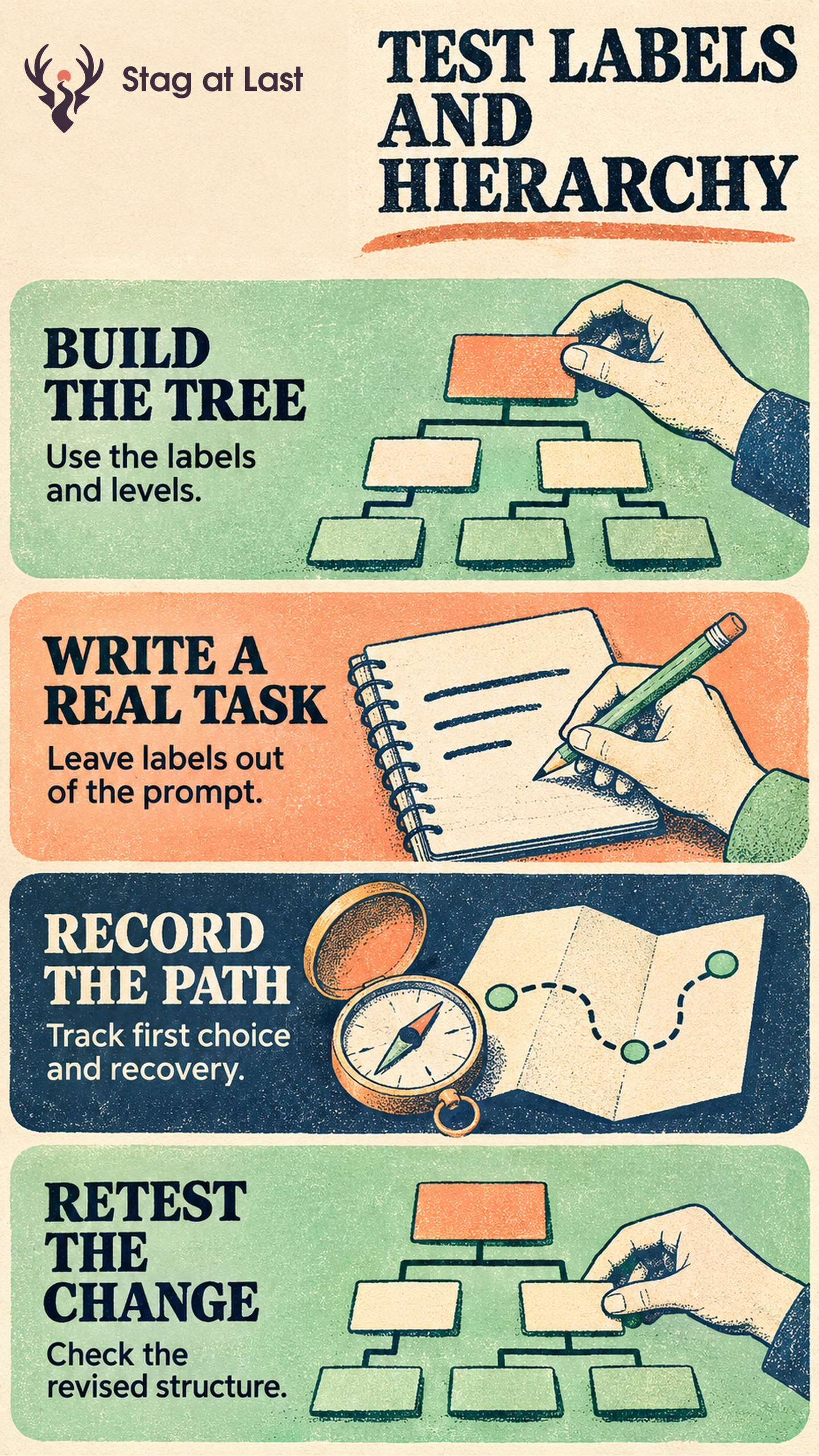
- Build the hierarchy with real labels and plausible alternatives.
- Write goals without naming the correct link.
- Score correct destinations and track backtracking.
- Retest targeted changes before checking the rendered site.
Tree testing measures navigation structure. It cannot tell you whether people will spot the menu or understand the destination page.
If customers say they cannot find warranty information, the menu may be hard to notice or the links may be arranged in a way they do not expect. A text-only test focuses on the second question. Use the result to decide which labels or groupings need work.
Build a Text Version of the Navigation
Represent menu labels and their parent-child relationships. Include realistic neighboring branches so people can make the same choices they face on the site. Nielsen Norman Group describes tree testing as an evaluation of a named navigation hierarchy. [1] Leave out layout, icons, search and in-page links when the goal is to isolate that hierarchy.
Build the current structure as a baseline if you intend to compare it with a proposal. Preserve each design’s actual depth, including any differing number of levels. Keep the intended differences visible and avoid trimming competing branches simply because they are irrelevant to the test tasks.
Give Participants a Task With a Defined Destination
Before recruitment, write which destinations count as successful and why. In an illustrative equipment-site task, ask where a purchaser would check whether a defective handheld scanner is covered two months after delivery. The branches might include “Ordering,” “Product Support” and “Account.” A valid path could be Product Support → Warranty Coverage. If two destinations genuinely contain the needed coverage information, mark both correct.
Recruit likely customers. Pilot the task to ensure it gives participants enough context without repeating the menu wording. When comparing designs, consider separate participant groups or vary order so prior exposure does not hand people the answer.
Read Both Success and the Route to It
For each task, record the first branch, final destination and any backtracking. Define direct success as selecting a prespecified correct destination without backtracking. Record indirect success when the person recovers and still reaches a correct destination. Also distinguish a wrong endpoint from giving up. Optimal Workshop’s paths guidance illustrates how people can use different routes to reach correct or incorrect choices. [2] Report counts by task so one easy task does not hide a harder one.
If many people first choose “Ordering” before finding the answer under “Product Support,” examine what the wording promises. The pattern might justify changing the label, moving content or adding a second valid path. Keep the observation and the proposed explanation distinct.
Retest the Structure and Verify the Interface
Revise the label or grouping linked to the problem. Repeat the task with the same success criteria and comparable participants. Then use first-click testing on a rendered design to see whether people notice the entry point, and end-to-end navigation testing to see whether they can use the information once they arrive.
Test Translated Labels With Their Readers
If the site uses multilingual WordPress menus, evaluate StagLingo on a few sample pages. Test each translated tree with people who read that language and check that its labels describe the actual destinations.
FAQs About Tree Testing FAQs
Does tree testing measure whether people notice the menu?
No. The tree removes visual design. Use an interface test to study visibility and interaction.
Can a task have more than one correct destination?
Yes. Mark each destination as valid before the study if it actually meets the task.
Is tree testing the same as card sorting?
No. Card sorting helps generate labels or groupings. Tree testing evaluates whether people can find destinations in a proposed structure.
Sources
[1] Nielsen Norman Group. Tree Testing: Evaluate Menu Labels and Categories
[2] Optimal Workshop. Tree Testing Paths Tab