
Quick Answer: How should a team measure the effect of a website redesign?
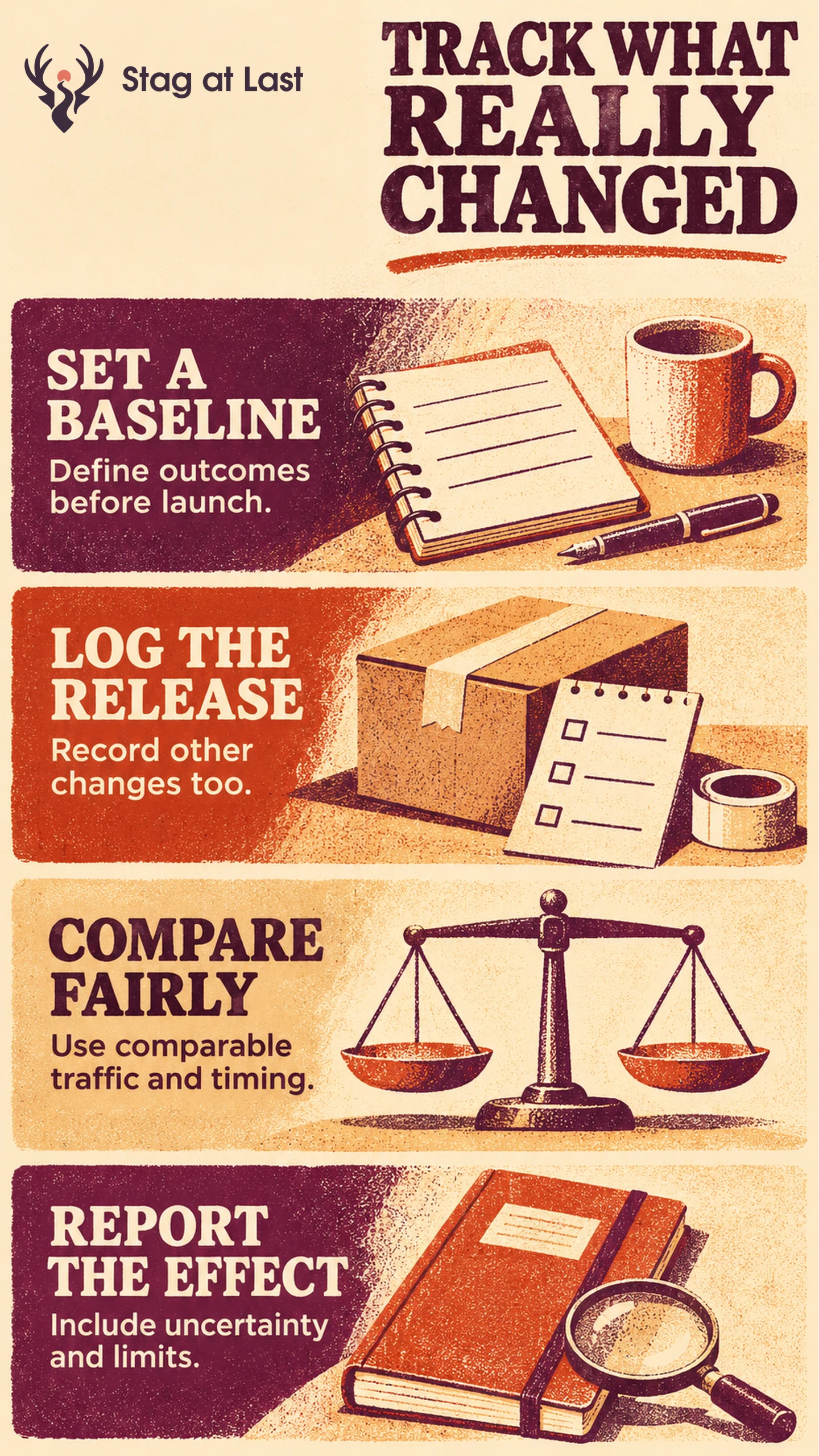
Measure a website redesign against a baseline defined before launch. Compare the same outcomes and eligible visits, and document anything else that could explain the change.
- Verify funnel events and use a business outcome.
- Log release timing, campaigns and tracking changes.
- Use concurrent randomized comparison where feasible.
- Report conversion, volume and guardrails together.
A before-and-after report describes what happened across periods. Stronger attribution needs a comparison that accounts for competing changes.
A redesign launches as the spring campaign ends and a new tracking tag goes live. Traffic falls and the reported lead rate rises. Before declaring success, find out what changed in the visitor mix, the event definition and the experience itself.
Set a Baseline Before the Site Changes
Choose one main outcome and define the eligible population and follow-up. For a lead-generation site, measure the share of eligible visitors who produce at least one sales-qualified request within a set window. Deduplicate both visitors and requests. Keep successful submissions and total qualified leads as supporting figures. Add guardrails such as critical errors and access to help.
Record counts for comparable weeks and for the major entry pages, devices and sources. Run task-based navigation checks on common journeys before release. Where loading or responsiveness matters, collect a field performance baseline too. Record which measurement steps the old and new designs share.
Keep a Release and Measurement Log
Record when each audience sees the new site and when campaigns, offers, stock or tracking change. Verify that the new design records the same outcome at the same point. Microsoft’s experiment guidance calls for checking that metrics and the observed population match the design. [1] Reconcile new event counts with orders or the CRM before joining them to historical data.
If URLs change, map old pages to appropriate new destinations and track redirects and search visibility separately. Google Search Central describes monitoring old and new URL traffic during a move. [2] Keep distinct acquisition and on-site outcomes so a traffic loss does not disappear behind a higher completion rate.
Choose the Strongest Comparison You Can Run
Use a concurrent randomized comparison when visitors can safely receive either design and the site can maintain consistent assignment. Define eligibility before randomization, keep assignment stable across visits and analyze everyone as assigned. This estimates the effect of the redesigned experience as delivered. A phased rollout can support comparison if assignment and calendar effects are handled in the design. Compare groups in overlapping periods where feasible. For a before-and-after comparison, use matched periods and similar groups and describe seasonal, campaign and tracking differences that remain.
Suppose the old site receives 10,000 eligible visitors and 400 qualified leads, while the new site receives 6,000 eligible visitors and 300 qualified leads over comparable windows. In this example, each qualifying lead comes from a distinct eligible visitor. The lead rate rises from 4 percent to 5 percent while the count falls by 100. If paid campaigns changed at the same time, report both facts and investigate the sources and entry pages before attributing either result to the redesign.
Decide What to Fix and When to Review Again
Compare the result with your goal and guardrails. Check whether a decline is concentrated in specific tasks, URLs or devices. A rise in bounce rate needs task context, and a device-specific rate gap needs a mobile diagnosis. Assign each confirmed issue an owner and a review date. Keep the comparison definition and release notes with the decision.
Include Localized Pages in the Baseline
If the redesigned WordPress site has several language versions, evaluate StagLingo on a few sample pages and verify that analytics events and key tasks remain comparable in each language.
FAQs About Website Redesign Measurement FAQs
How long should you wait before evaluating the redesign?
Wait for the defined outcome window to mature and collect enough comparable observations. Monitor major errors and tracking continuity from launch.
Can conversion improve while total orders fall?
Yes. A higher share of visitors can convert while fewer visitors arrive, leaving fewer total orders or leads.
Should you change analytics at the same time?
If both changes must happen together, validate old and new tracking against the same operational record and document where historical comparisons break.
Sources
[1] Microsoft Research. Patterns of Trustworthy Experimentation: Post-Experiment Stage
[2] Google Search Central. Site Moves and Migrations