
Quick Answer: When should a business connect its marketing and sales channels?
Multichannel marketing gives shoppers several places to discover or buy a product. Omnichannel marketing connects selected touchpoints so shoppers can carry an order, offer or service request from one channel to another.
| Need | Multichannel | Omnichannel |
|---|---|---|
| Customer task | Each channel can complete its own sale | A task started in one channel can continue in another |
| Shared data | Product facts and offer terms where relevant | Current order or inventory status, plus identity when the task requires it |
| Main cost | Running and measuring each channel | Maintaining reliable integrations and staffing exceptions |
Keep channels independent when they serve distinct buying tasks. Connect them where repeated work or broken promises cost shoppers and staff time.
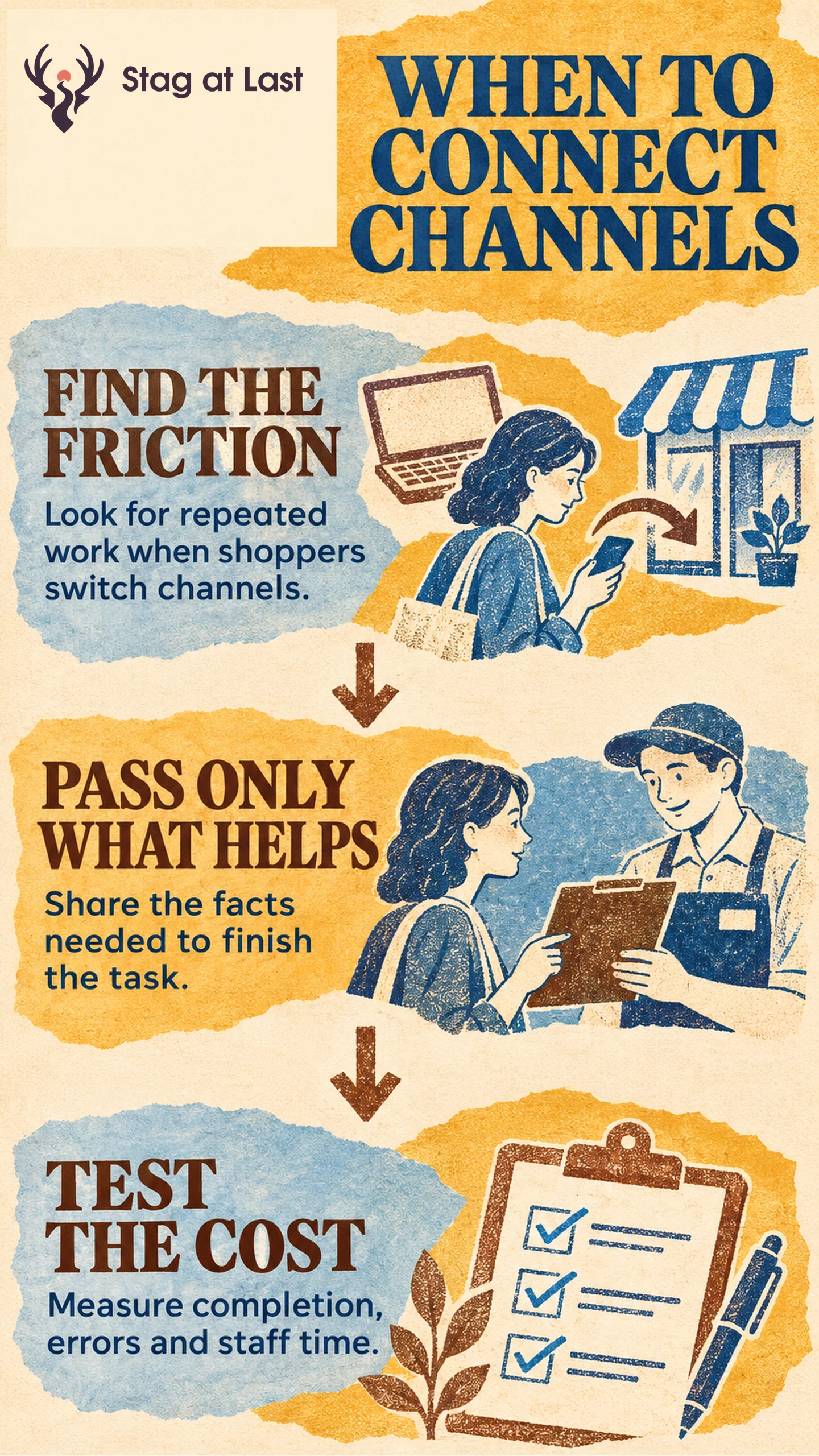
A retailer can sell on its website, on a marketplace and in a store with little operational overlap. The decision changes when a web customer arrives at the store with an online order and expects staff to help. The right model depends on how often that handoff happens, what the customer was promised and how much it costs to handle it well.
Compare What Each Model Requires
A multichannel retailer can use one product catalogue and matching brand standards while giving each channel its own offers, stock commitments and service rules. A marketplace listing can reach shoppers who prefer to buy there. The seller can manage organic placement and sponsored visibility to suit that channel’s economics.
An omnichannel retailer coordinates a journey across touchpoints. A store can see a qualifying web order, act on it and send the new status back to support. Shopify’s comparison frames the choice around independent sales channels and connected experiences. [1] Start by choosing the experience to connect, because that determines the systems and people involved.
Shared product information helps both models. A return needs additional facts, including order reference, purchased item and quantity, current return status and eligibility. A receipt or verified order lookup may provide enough context. Link in-store purchases to ecommerce customer records when a separate use case needs a reliable match.
Find a Handoff Worth Connecting
Review customer messages and ask store staff what they handle manually. Record how often customers bring in web returns, how long staff spend looking for the order and how often a customer has to contact a second team. Check the terms customers saw at checkout before counting an enquiry as an eligible return.
Decide which orders and locations the pilot will cover. Confirm where staff look up eligibility, who can approve a refund and what happens when payment or stock systems disagree. Shopify documents store refunds through its POS app, with requirements for staff permissions and limitations on some third-party orders. [2] Review your own platform and marketplace terms before promising in-store service.
A clear online returns path may satisfy customers in regions without a store. If the first connected use case is viable, write down what each team receives and passes on before asking customers to use it.
Test the Upgrade With One Store Group
Start with two nearby stores and a limited set of eligible ecommerce orders. Use the same definition of an eligible return request before and during the pilot. Example targets are to complete at least 90 out of 100 eligible requests in one visit, cut median staff handling time below six minutes and keep unresolved refund discrepancies at zero. A completed request means staff verify and accept the return and submit any refund during the visit. Track payment settlement separately. Those are pilot targets for this example. Set yours using baseline volumes and failure costs.
Count every eligible request, including requests escalated to support. Use the same return or refund reference to reconcile the POS and ecommerce records. Check the customer-facing status where it is available. If two systems show different return states, stop the second refund attempt and assign one owner to resolve the discrepancy.
Compare the time saved and service improvement with software fees, training and reconciliation work. Expand only when the improvement holds during busy periods and someone owns each common failure. Keep stand-alone channel journeys where connecting them would add little value.
Evaluate Localized Shopping Pages
If your WordPress store serves shoppers in several languages, try StagLingo on a small set of product and help pages. Check that offer eligibility and return instructions still match the service available to each shopper.
FAQs About Multichannel and Omnichannel Marketing
Can a business use both approaches?
Yes. A brand can operate marketplace sales independently and connect its own website and stores for returns or pickup. Each promise should make the eligible channels and locations clear.
Do omnichannel journeys need a single customer database?
No. The teams and systems that handle a task need reliable access to the relevant information and a way to update its status. For a store return, an order lookup and a shared refund state may be enough.
Can different channels have different prices?
Yes. State where the price applies and carry the agreed price into any handoff covered by the offer. Staff should be able to explain eligibility before the shopper makes a trip.
Sources
[1] Shopify. Omnichannel vs. Multichannel: How To Choose
[2] Shopify Help Center. Processing returns and refunds using the Shopify POS app