
Quick Answer: What Should an Ecommerce Marketing Strategy Prioritize?
Prioritize the stage that is holding back profitable orders. Start with a specific buyer and first purchase, then check where discovery, purchase or repeat behavior needs attention.
| What you observe | First question to investigate |
|---|---|
| Few relevant shoppers reach the product | Does the channel match a real buying task? |
| Shoppers browse but seldom order | Which product, delivery or checkout question is unresolved? |
| First orders arrive but few customers return | Is there a relevant reason to buy again? |
Pick one change and define a margin guardrail before testing it.
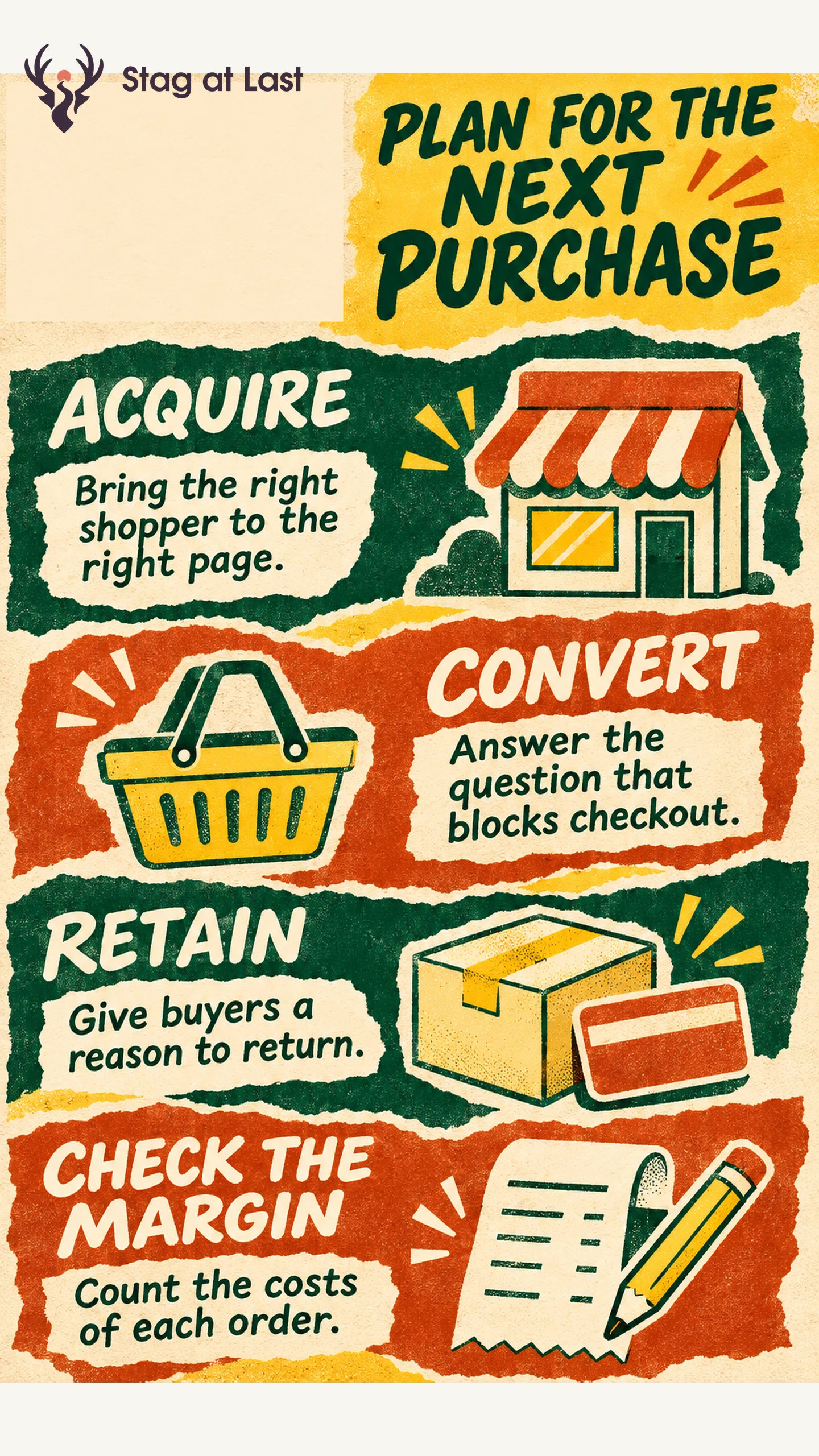
Imagine a small store selling insulated lunch totes. An ad can bring parents to the store, but the product page still needs to show what fits, how the tote closes and whether delivery meets their deadline. The first order then creates another decision. Does this buyer need a compatible container later, or would a generic reminder only add noise?
Choose the Customer and the First Purchase
Write a one-line description of the person, task and product. For example, a parent buying a school lunch tote wants to fit a specific container and have it arrive before term begins. Check the task against search phrases, support questions and buying conversations. Use customer research to find which uncertainty drives the decision.
Choose the first order you can support at the promised price and delivery terms. For that offer, name the product page, available variants and the stock owner. If the buyer is still hypothetical, run a bounded product demand test before committing inventory and campaign spend.
Acquire Traffic the Store Can Convert
Start with one place where the buyer is already looking for an answer. Search may suit someone comparing dimensions. A demonstration may suit someone checking what fits. Give each campaign a page that continues its promise, with the relevant variant available and the next step visible. Use your direct and marketplace channel comparison to account for both discovery and operating costs.
Track where people enter, which product they view and whether they reach checkout. Check the traffic source and audience mix when a new campaign changes your results. Attributed orders can help compare signals within a reporting system. Use order records and a suitable comparison when deciding whether spend created additional profitable orders.
Remove a Specific Reason to Leave
Review the actual page and checkout on a phone. Show dimensions, compatible products and delivery conditions before the buyer needs them. Match the change to observed behavior. If tote shoppers ask whether a particular container fits, add a verified fit photo and dimensions to the relevant variant before redesigning the whole page.
Google Analytics documents separate ecommerce events for checkout starts, purchases and refunds. [1] If you use that setup, verify that a test checkout appears at the expected steps and that purchase records reconcile with orders for the same scope. Review the store growth diagnosis if it is unclear where conversion changed.
Plan for the Second Purchase
Match follow-up to what the product makes useful next. A care guide can help a tote buyer immediately. A compatible accessory suggestion belongs where it serves a real need. For consumables, use the expected replacement cycle and check how actual buyers behave. Give each cohort enough time to reach the repeat window.
Compare second orders among customers acquired in the same period with a common observation window. Inspect returns and support questions alongside repeats. If orders come back damaged or late, fix the experience before increasing follow-up frequency.
Choose the Next Test With Order Economics
In an illustrative order, the tote brings in $50 after discounts and expected refunds, excluding sales tax. Product cost is $18, fulfillment and shipping cost $8, payment fees are $2 and expected return handling adds $4. With those assumptions, the order contributes $18 before acquisition and fixed overhead. Spending $20 to acquire one new customer would put that first order $2 below break-even on these variable costs. Use observed repeat contribution before assuming later orders close the gap.
Write a test brief with the buyer, the suspected constraint, the change, the result you will observe and the minimum contribution you need to protect. If a promotion is the test, use the promotion planning guide to check stock and margin before launch.
Check the Buying Journey Across Languages
If your store runs on multilingual WordPress, test that product availability, delivery information and return instructions remain clear across languages. Include those pages when evaluating a translation workflow.
FAQs About Ecommerce Marketing Strategy
Which ecommerce marketing channel should I start with?
Choose a channel that reaches people with the relevant buying task and that your team can measure and maintain. Send shoppers to a page that can fulfill the campaign promise.
How do I measure repeat purchase?
For a fixed window, divide first-time customers who place a second qualifying order within that window by first-time customers with the full window to do so. Define how you treat cancellations and returns.
What should an ecommerce marketing plan include?
State the target buyer, first offer, priority stage, channel, responsible person, test and margin guardrail. Include the data you will check and the date you will make the next decision.
Sources
[1] Google Analytics. Measure ecommerce