
Quick Answer: What Should Ecommerce Customer Research Find?
Find the specific uncertainty that changed a buying decision. Talk to people about a recent shopping task and compare what they recall with the choices and evidence available at the time.
- Recruit recent buyers, non-buyers and people who returned the item where practical.
- Ask what started the search, which options they considered and what they did next.
- Record product fit, purchase risk and timing separately.
- Turn a recurring concern into one testable change to product evidence or the offer.
Use interviews to identify plausible causes. Check their scope before estimating how common they are.
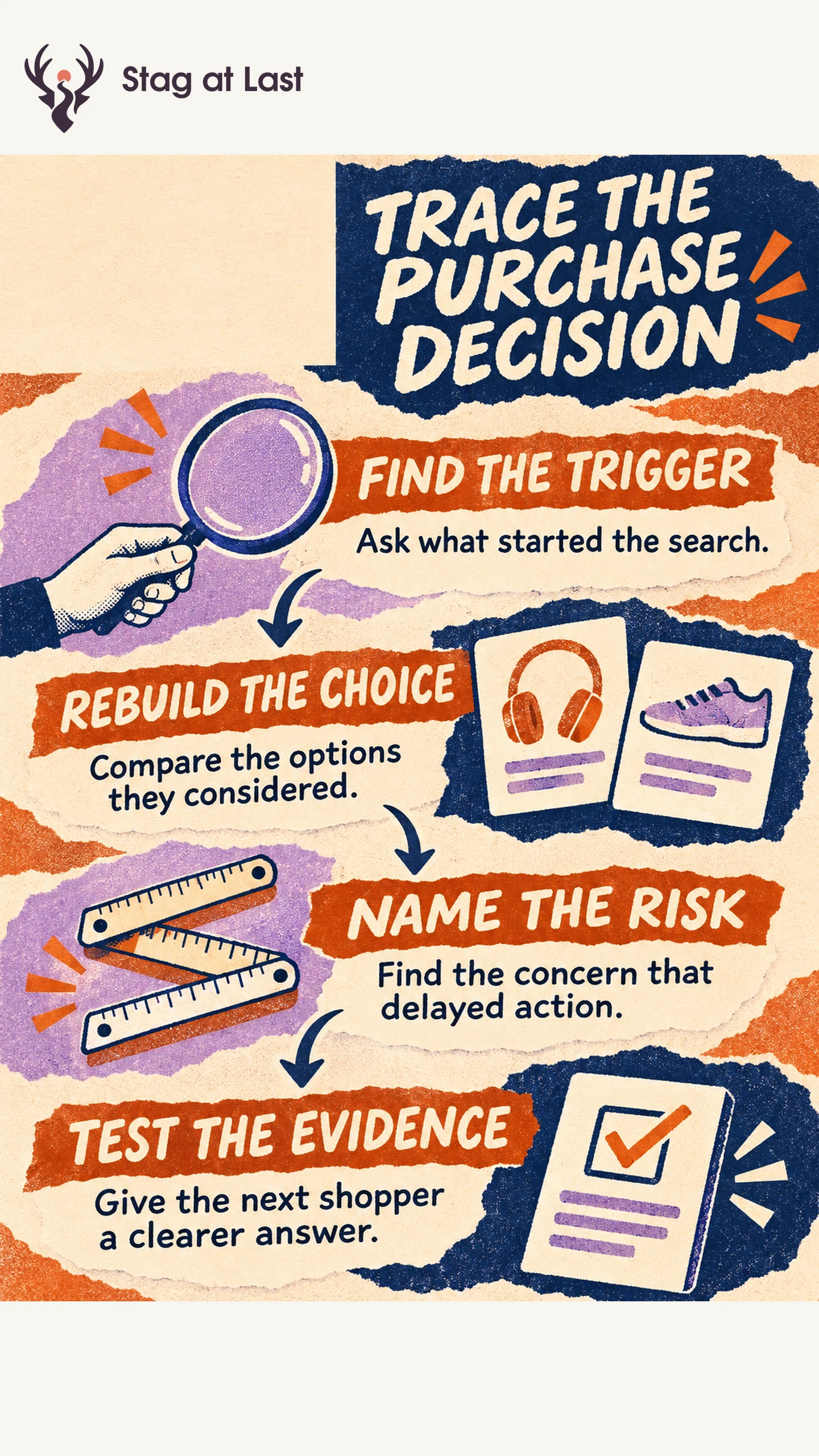
Imagine a store selling desk lamps. A shopper says “I wanted something smaller.” That could mean the base crowded the desk, the arm was too tall for a shelf, or the cord could not reach an outlet. Each answer calls for different product evidence. Research starts by reconstructing the last decision in enough detail to tell those explanations apart.
Choose the Purchase Decision to Study
Pick one product family, audience and moment. “Tell us about the last time you looked for a compact desk lamp” invites people who chose quickly, kept looking or never considered your store. Include people with different outcomes where you can reach them appropriately. Look for a recent buyer, someone who chose an alternative and someone who stopped shopping. If returns are part of the problem, speak to buyers who could not use the product as expected.
Ask for informed consent and explain how the team will use notes or recordings. The GOV.UK interview guide recommends open questions and examples drawn from what participants actually experienced. [1] Use only the details necessary to understand the decision. Keep personally identifying records separate from the notes the project team needs.
Reconstruct the Sequence With Neutral Questions
- Trigger. What was happening when you started looking for a lamp?
- Alternatives. Which products or workarounds did you consider first?
- Evidence. What did you check before you felt ready to choose?
- Hesitation. Was there a point when you put the decision aside? What happened then?
- Outcome. What did you end up buying or doing instead?
Ask the participant to show the relevant product page or an item they compared if they are comfortable. Avoid asking them to log in or show account records. Ask for the order of events before explaining your own hypothesis. A think-aloud product comparison is one way to observe the task alongside the interview. Baymard includes observed task-based usability sessions in its ecommerce research methodology. [2]
Separate Product Fit, Risk and Timing
| What you hear | What to verify | Possible response |
|---|---|---|
| “I could not tell if it fit under the shelf.” | Which dimension was missing or unclear? | Show assembled height and a scale photo |
| “I was worried I could not return it.” | Which policy question did the shopper still have? | Explain the applicable return steps before checkout |
| “I needed it by Friday.” | Could the relevant variant arrive in time? | Show the delivery estimate and stock limit earlier |
For each interview, record the shopping task, alternative, decision moment, evidence and remaining uncertainty. Compare patterns with support messages, product reviews or return reasons. If a participant never wanted a desk lamp in that price range, a clearer dimension diagram may have little effect. Use a demand test if the open question is whether people want the product at the proposed terms.
Turn One Finding Into a Product Page Test
Suppose three interviews identify uncertainty about the height of a fully assembled lamp. Verify that the dimension is missing for the affected variants and that your measurements match inventory. Add an accurate scale photo or diagram near the variant selector. In a follow-up usability session, ask a new shopper to choose a lamp that fits a given shelf without coaching. Compare the answer and the evidence the person used.
If you test on live traffic, compare the two pages under similar conditions and randomly assign eligible visitors where feasible. Compare purchase conversion among eligible visitors and fit-related returns among eligible orders with a full return window. Record the product, traffic source and any stock differences. Use the result to update your ecommerce marketing plan or inform which variants to promote.
Check Product Evidence Across Languages
If your store runs on multilingual WordPress, use research to identify which dimensions, compatibility terms or delivery details need the most careful translation review. Include those details when evaluating a translation workflow.
FAQs About Ecommerce Customer Research
How many ecommerce interviews do I need?
Start with enough participants to compare the important buying paths. Recruit again when you still cannot explain a decision that would change the test. Use a separate method to estimate prevalence.
Can product reviews replace interviews?
Reviews can reveal repeated terms and issues. Interviews let you ask about the sequence, the alternative and the evidence that moved the decision.
Should I interview shoppers who bought from another store?
Yes, when you can recruit them appropriately. Ask what they saw in each option and what made the chosen offer more suitable at the time.
Sources
[1] GOV.UK Service Manual. Using in-depth interviews
[2] Baymard Institute. UI Research Methodology and Data