
Quick Answer: Who Owns Developer Relations and Developer Marketing Work?
Give developer marketing the decisions about audience, positioning and distribution. Give developer relations, or DevRel, ownership of direct developer engagement and the route for technical feedback. Share demos, docs and launches with a named owner for each deliverable.
| Decision | A practical default owner |
|---|---|
| Which audience and promise will the launch use? | Developer marketing |
| How will developers get help and share feedback? | DevRel or the assigned community lead |
| Does the example work as described? | Technical owner, with DevRel and marketing review |
Adapt the ownership to the people you have. For each shared item, name who can approve it and who responds when something fails.
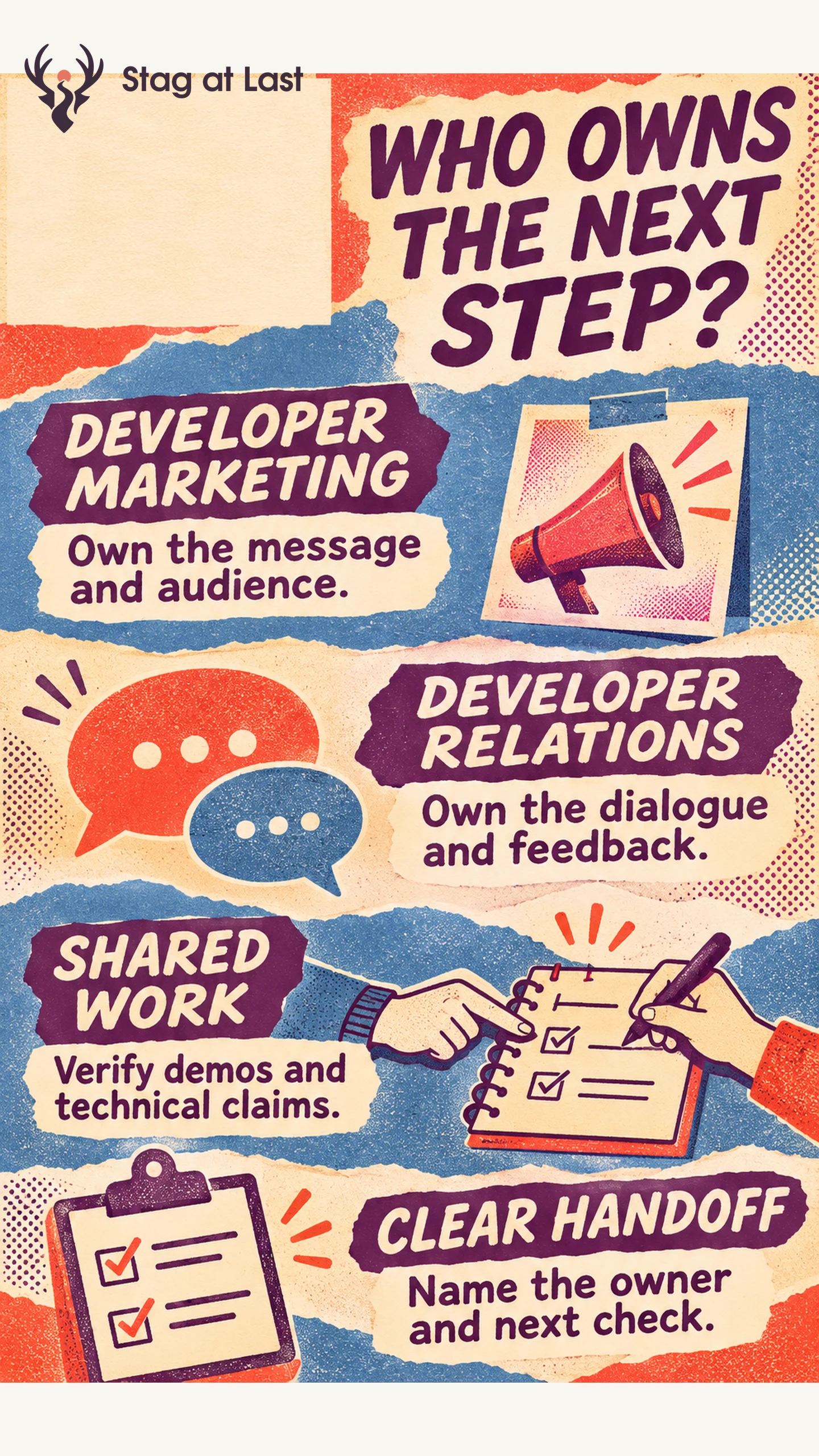
A team preparing an SDK release needs a landing page, a tested demo and someone to answer integration questions after launch. One developer advocate might contribute to all three. The work goes more smoothly when everyone knows who decides the promise, who verifies the demo and who follows up on reports.
Separate the Decisions Each Function Owns
Developer marketing can own the intended audience, the public message and where to reach people working on that problem. Its work might include writing the launch brief, matching channels to developer intent and comparing the response to different messages. A developer marketing plan should point evaluators toward proof they can use.
DevRel can own the ongoing dialogue. It can bring difficult questions into a workshop, help someone reproduce a problem and get recurring issues in front of the right product owner. The titles vary across organizations. GitLab’s Developer Advocacy handbook, for example, describes both content creation and engagement with customers and community members. [1]
Share Technical Work With a Clear Handoff
| Shared work | One way to split the decisions |
|---|---|
| Release announcement | Marketing drafts the promise. Engineering verifies version and limitations. |
| Live demo | DevRel builds and rehearses the scenario. Marketing describes the intended audience. |
| Quickstart | The docs owner maintains it. DevRel reports where new users get stuck. |
| Product feedback | DevRel captures the pattern. Product decides what changes and shares the outcome. |
For the SDK launch, suppose a workshop exposes that the demo needs an account role many attendees lack. The advocate records the prerequisite and offers a supported way to practice. The docs owner adds the requirement to the developer onboarding path. Marketing updates the event description so the next audience arrives prepared.
Route Feedback Without Turning It Into Lead Capture
Agree which details belong in a public issue and which belong in private support. Capture the attempted task, environment, outcome and a minimal reproduction where appropriate. Keep credentials and customer data out of public threads. Assign the issue to an owner who can make a decision and tell the original participant where they can check for an update.
If people ask whether an API supports a specific integration, route the question to the technical owner. After verification, marketing can clarify the commercial message and the API product page can link to the operation or known limitation. Keep optional sales follow-up separate from the route for technical help.
Use Measures That Match the Job
Marketing can track which campaigns brought people into a relevant quickstart, with the audience and attribution rules stated. DevRel can track whether workshop participants finish a selected task or whether a known problem receives a verified response. For a workshop completion rate, define the task and report completions among participants who started it, including how many started. Attendance alone answers a different question.
Use a shared outcome when both groups contribute to it, such as successful completion of the release workflow. Avoid claiming that one team caused every completion. Before the next release, name the owner, technical approver, follow-up owner and evidence of completion for a single shared deliverable.
Assign Owners for Multilingual Technical Content
If your developer-facing site runs on multilingual WordPress, assign one owner for the message and one technical reviewer for the localized workflow. Use that handoff as part of any translation workflow evaluation.
FAQs About Developer Relations and Developer Marketing
Can one person do both jobs?
Yes. Give the person separate time for campaign work, technical verification and community follow-up. Have a qualified reviewer check claims when that person also wrote them.
Who should own developer documentation?
Assign a named maintainer who can verify the published workflow and keep it current. Docs, engineering or DevRel can own the page depending on the team.
Who should run a developer webinar?
Choose the lead based on the session’s purpose. Marketing can own audience and promotion for a launch. DevRel or a technical presenter can own a workshop where attendees need to complete a task.
Sources
[1] GitLab. Developer Advocacy