
Quick Answer: What Should an API Product Page Prove?
An API product page should help a buyer answer three questions. Can it do the job? What will it take to integrate? Which evidence can I rely on when it runs in production?
| Buyer question | Put this evidence on the page |
|---|---|
| Can it handle my workflow? | Sample input, output and one important edge case |
| What work will my team own? | A first test, a production checklist and known limits |
| How reliable is it for my use case? | A defined measure, a time window and the applicable service terms |
Choose one representative workflow and trace it from test data to the first production run before publishing a claim about integration effort.
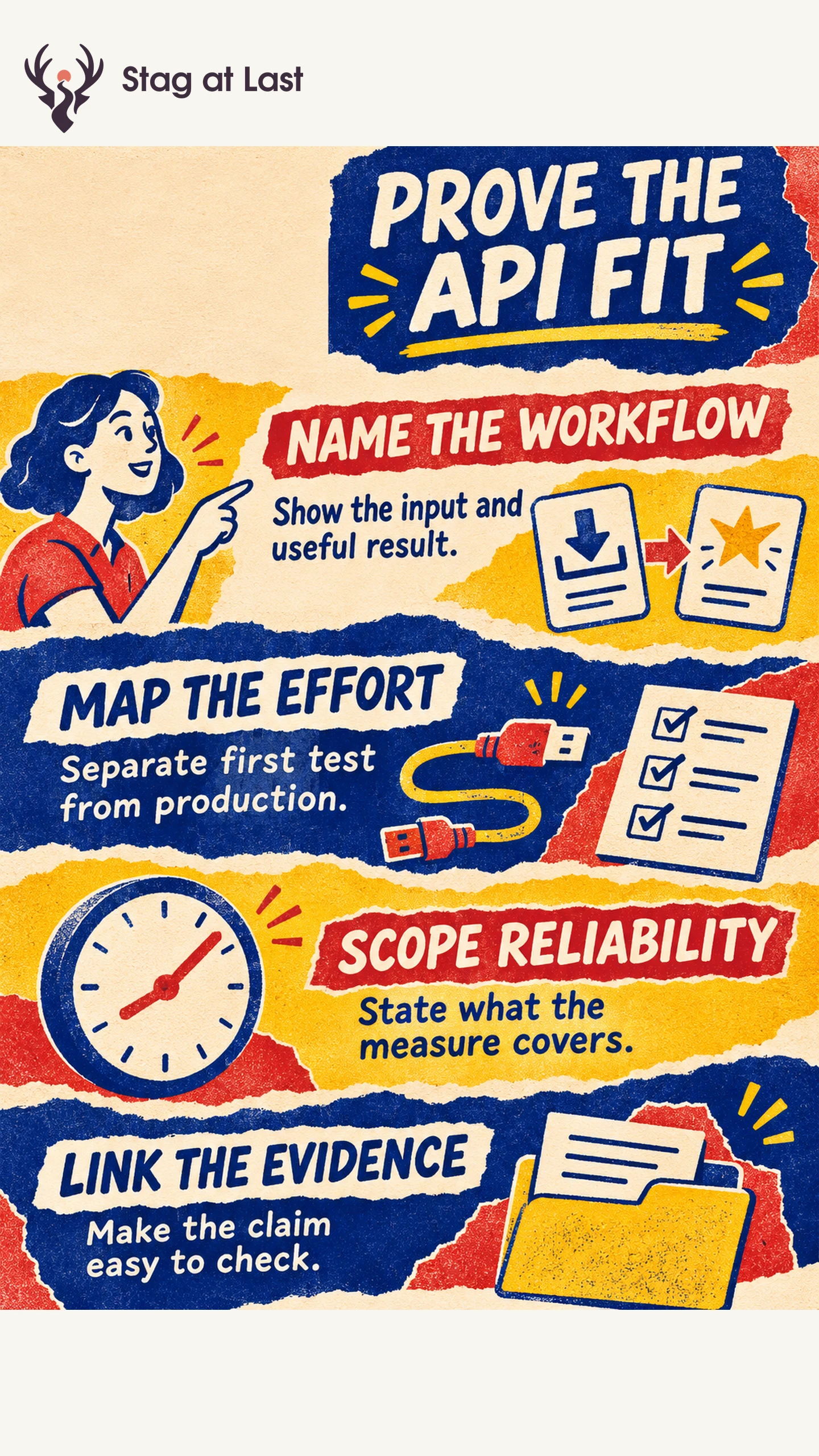
A shipping API page that promises “fast integration” leaves a retailer guessing. Can it return delivery estimates for the retailer’s carriers? How much address data does it need? What happens when a carrier is unavailable? Answer those questions on the page and give engineers a place to verify the details.
Describe the Workflow the API Enables
Open with the buyer’s task, the data it starts with and the result it receives. For a hypothetical delivery estimate API, the input might be destination, service and parcel details. The output might be a delivery window with an explicit “unavailable” response when the service has no estimate. State which regions, services and integrations the example covers.
Put a link to the relevant operation near the example. An OpenAPI description uses a language-independent format for documenting an HTTP API interface. [1] If your team publishes one, check that its version and documented responses match the workflow on the page. Your broader developer marketing strategy can route people to this proof from tutorials, communities and product announcements.
Show Integration Effort in Stages
| Stage | What the evaluator needs to know |
|---|---|
| First sandbox request | Access requirements, fixture data and expected result |
| Working integration | Authentication, error handling, timeouts and one failure case |
| Production readiness | Environment changes, limits, monitoring, support and a fallback |
Walk through the steps in a fresh test environment with synthetic data. Record elapsed time and waiting time separately. In the delivery example, getting one valid response and making checkout resilient when estimates fail are different pieces of work. A useful estimate states the environment, starting point and remaining work. Refer developers to a quickstart that leads to a working integration.
Publish Reliability Evidence With Its Scope
Google’s SRE guidance distinguishes the service level indicator you measure, the service level objective you target and the service level agreement that sets consequences if the terms are missed. [2] On the product page, label an observed result, target and contract separately. Link to the applicable terms if you mention a commitment. State which plans, regions or service components it covers.
For an example availability measure, divide successful eligible estimate requests by all eligible estimate requests in the stated window. Define which outcomes count as success, how timeouts are captured and which traffic is excluded. If a valid unavailable response counts as a technical success, separately report the share of eligible requests that actually return a delivery window. A latency claim should also name the operation, measurement point and percentile. A response from a sandbox proves that a test ran. Use production evidence for production claims.
Give Buyers an Evidence Card They Can Share
| Field | Hypothetical delivery estimate API |
|---|---|
| Task | Return a delivery window before payment |
| Proof | Send a synthetic parcel request and check the returned window |
| Boundary | Confirm carrier and region coverage in the reference |
| Failure check | Force a test failure and verify the checkout fallback |
| Owner and next step | Engineering runs the test, then operations reviews service terms |
Use this card for the product page and technical sales handoff. Have the docs owner run the scenario when authentication, response shapes or coverage changes. Have the service owner review any public reliability numbers before publication. If usage drives billing, pair the card with your billable usage definition so the buyer can estimate cost from the same workflow.
Keep API Product Pages Aligned Across Languages
If the commercial pages for your API run on multilingual WordPress, compare translated plan limits, version labels and references with the technical source. When evaluating a translation workflow, add an engineering reviewer for claims that change the integration decision.
FAQs About API Product Marketing
Should the API reference be the product landing page?
A reference is best for looking up fields and responses. A product page should explain use cases, tradeoffs and how to verify fit, then link into the right reference section.
Can an API page promise a five-minute integration?
One timed run can support a scoped example with its prerequisites. A general claim needs representative evidence. Say “first sandbox request” if that is what you measured, and list the extra work for production.
Should an API publish usage limits before signup?
Publish the limits that materially affect evaluation where you can. Explain how limits apply and where a buyer can confirm plan-specific capacity.
Sources
[1] OpenAPI Initiative. OpenAPI Specification v3.1.1
[2] Google SRE. Service Level Objectives