
Quick Answer: What Should Developer Marketing Help Someone Do?
Developer marketing should help someone recognize a technical problem, verify that your product solves it and decide whether it fits their system. Give a skeptical evaluator enough evidence to try the claim on their own terms.
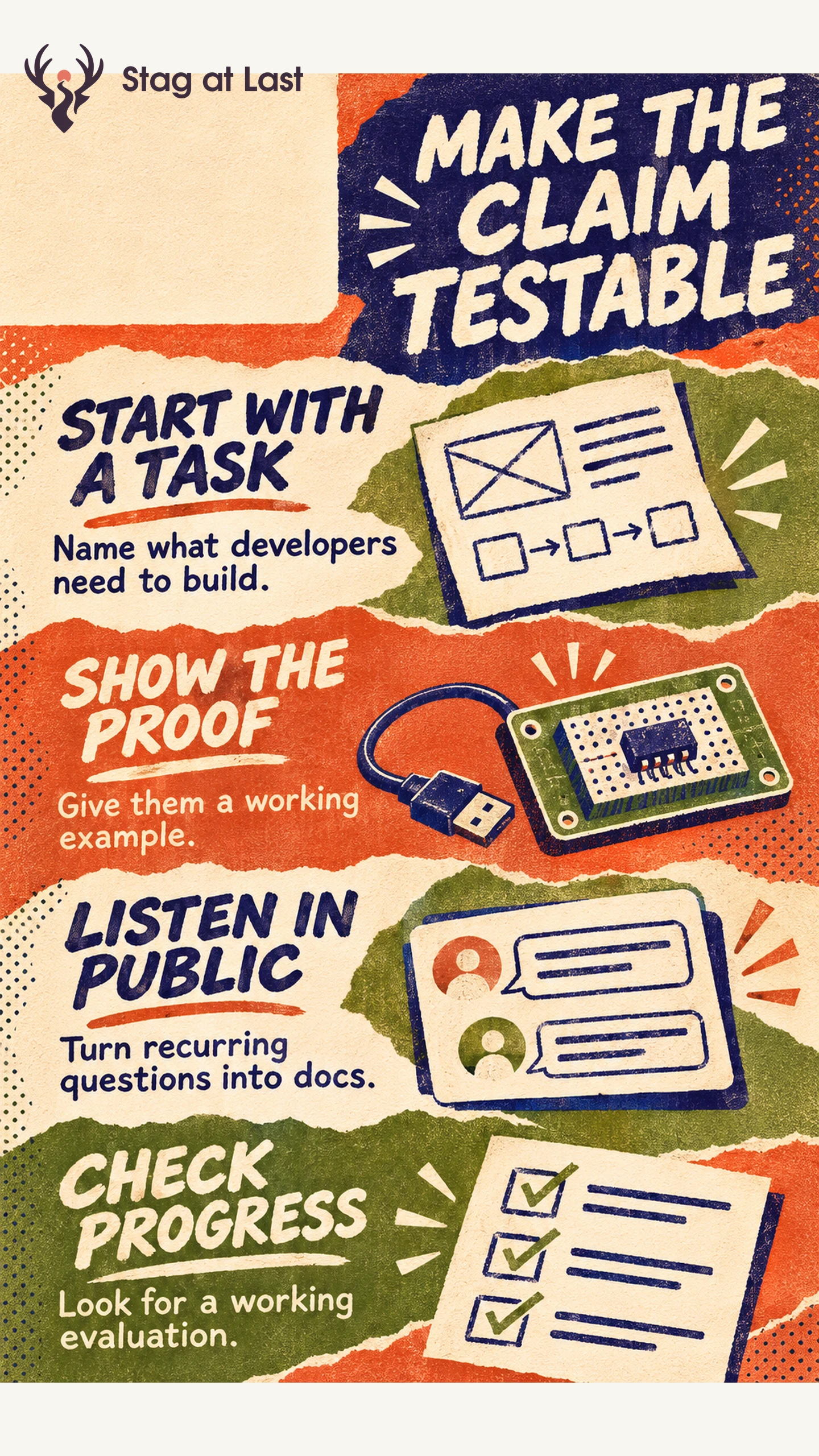
- State the task. Name what the developer needs to build or fix.
- Make it testable. Pair the promise with a working example and a predictable result.
- Maintain the docs. Publish prerequisites, limitations and what to do when the test fails.
- Use community feedback. Give repeated questions an owner and close the loop publicly where appropriate.
Choose one use case first. See how far a new evaluator gets using only the published materials.
A developer deciding how to handle inbound webhooks has specific questions. Can I see what arrived? What happens when my endpoint returns an error? Can I replay an event without processing the same order twice? The landing page can earn attention by naming those problems. The example and docs have to earn confidence by showing what the product actually does.
Start With the Job a Developer Is Trying to Finish
Write the task as an observable result, such as “replay a failed test webhook and see the delivery status.” Identify the person attempting it, the environment they use and the teammate who can approve production access. A developer may verify the workflow while a team lead evaluates support and costs. Give each person a route to the evidence relevant to their decision.
Start with questions from support, sales calls, issue trackers and search queries. Note whether the person is trying to choose a tool, get a working result or operate it in production. This keeps a discovery article from turning into a long reference page and helps you connect the article to the developer onboarding path.
Put Verifiable Proof Beside Each Promise
| What the page promises | Evidence to put nearby |
|---|---|
| Handle a common integration | A maintained quickstart with a sample input and expected output |
| Inspect failed deliveries | A sandbox example with an observable error and recovery path |
| Support production use | Documented limits and links to operational support or service history |
A quickstart guides a first success, while a reference helps a developer look up a specific parameter or response. Diátaxis formalizes that distinction by separating tutorials, how-to guides, reference and explanation. [1] For a concrete example, Stripe’s testing documentation shows how developers can simulate payment scenarios in a sandbox. [2]
For the webhook example, use synthetic events, test credentials and a sandbox endpoint. Show where a failed delivery appears and how the evaluator can confirm a replay. Document whether replay can lead to duplicate processing and what the receiving system must handle. For reliability or integration claims, use the evidence checklist in API product marketing.
Give Community Questions a Path Back to the Product
Choose one place you can maintain for technical questions. State who monitors it, how to report defects and which details belong in private support. Keep production payloads and credentials out of public reports. When multiple developers hit the same ambiguous error, link the existing explanation or give someone the task of improving it. When the product behavior is wrong, route it to engineering with the reproduction steps and follow up once there is a verified outcome.
Define which team owns each handoff before launching a forum or recurring event. A docs owner can maintain examples while a community owner responds and escalates. For a public repository, agree on contributor expectations and triage before inviting attention through an open-source project campaign.
Measure Progress Toward a Working Evaluation
Use one primary event tied to the example, such as receiving and successfully replaying a test webhook within seven days of starting the quickstart. If the workflow can be measured, report successes alongside the number of eligible evaluators who started and had the full seven days. Keep repeat attempts separate from the count of evaluators. If developers work entirely locally, use voluntary walkthroughs or usability sessions to understand where they get stuck.
If more readers arrive but few complete the evaluation, inspect the earliest step they fail. Verify prerequisites, error messages and the time needed to obtain test access. Fix the obstacle and run the same walkthrough again before buying more distribution.
Keep Technical Proof Consistent Across Languages
If your developer product has a multilingual WordPress site, check that prerequisites, version labels and links match the underlying documentation. When evaluating translation for that site, keep code identifiers and commands in your technical review checklist.
FAQs About Developer Marketing
Should a developer tool gate its documentation?
Keep evaluation information open when practical. Put credentials and sensitive customer details behind appropriate access controls, and explain early if a sandbox requires an account.
What belongs in a first developer campaign?
Pick one problem, a landing page that states it clearly, one maintained technical example and a defined success event. Choose a distribution channel where that problem already comes up.
How is developer marketing different from DevRel?
Developer marketing owns how relevant audiences find and understand the product. DevRel often works directly with developers and carries technical feedback back to the team. Assign specific owners for shared docs, events and examples.
Sources
[1] Diátaxis. Diátaxis
[2] Stripe. Testing