
Quick Answer: How Do You Choose and Measure Customer Training?
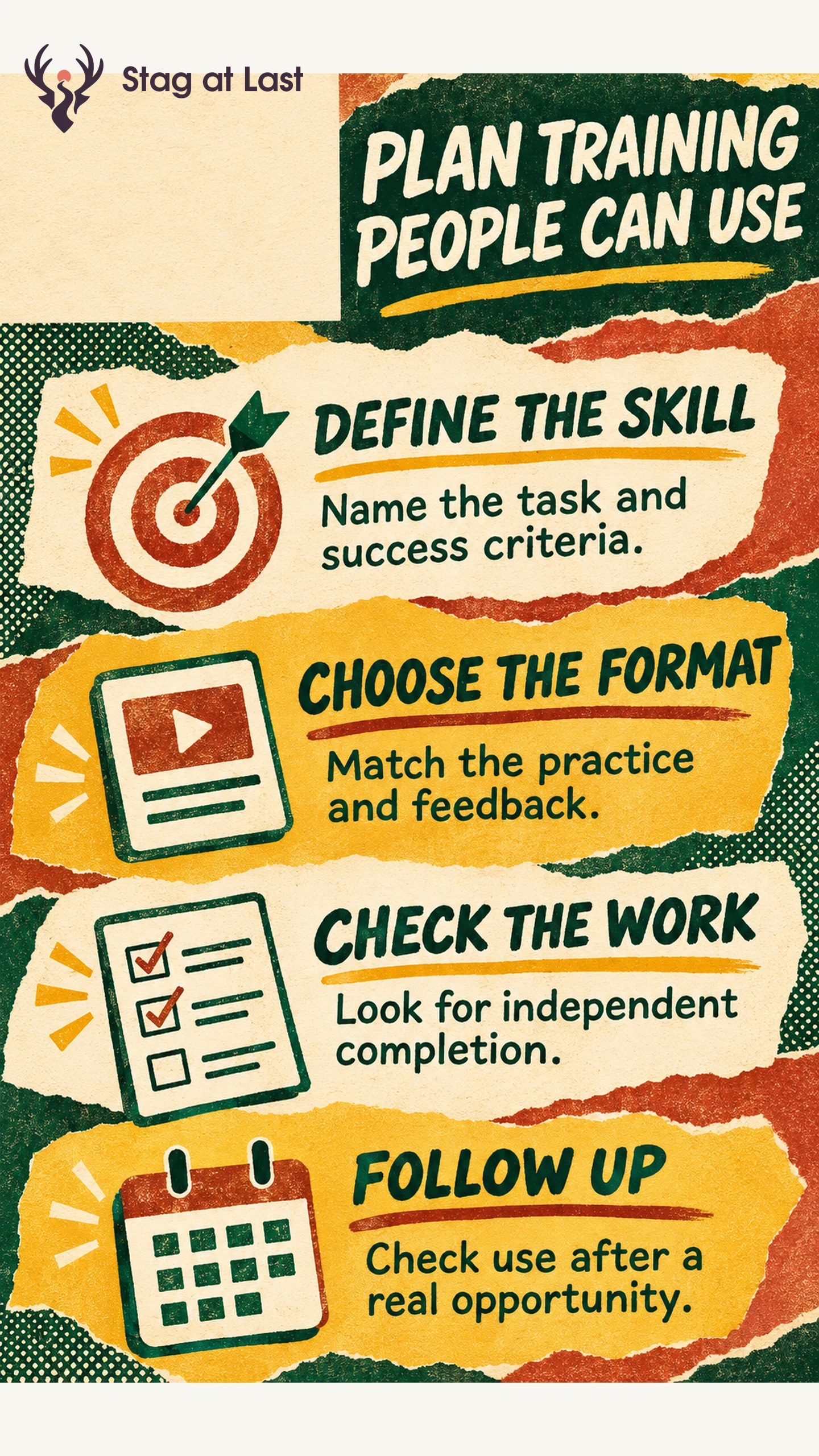
Choose a training format based on the task learners need to perform, the cost of a mistake and the feedback they need. Check whether they can complete a representative task, then follow up after they have a chance to use the skill.
- Set a performance goal. Describe the task, conditions and evidence of success.
- Choose the format. Use self-paced instruction, live practice or a blend according to the task.
- Check independent work. Use a realistic exercise and distinguish completed work from instructor help.
- Follow up. Find out whether learners had a chance to use the skill and what helped or blocked them.
Keep participation and application separate so the team can decide what to improve.
A customer can finish a training video and still be unable to produce the report they need. A training program should define what people will do, give them a chance to practice and show the team what changed in their work. Start with one skill that matters to the customer’s job.
Define a Skill the Learner Can Demonstrate
Write an objective with a role, a task, conditions and a result you can inspect. For a hypothetical finance tool, a billing administrator should export a monthly invoice file, check its totals against a sample ledger and identify a duplicate row. Use dummy records and specify whether learners can refer to the same job aid they would use at work.
Prepare the environment before enrollment. Check access, data and supported versions. Give learners a way to ask for help if they lack a prerequisite. If the need is a quick lookup during work, a guide may be enough. Use the broader customer education strategy to decide which jobs justify a structured program.
Choose the Format Based on Practice and Feedback
| Format | Good fit | Evidence to collect |
|---|---|---|
| Self-paced lesson | A stable task with a repeatable example and clear feedback | A completed exercise or checked output. |
| Live workshop | A complex task where learners need feedback on decisions | An observed attempt that records any help given. |
| Blended program | Shared fundamentals plus role-specific practice | An independent task after the guided practice. |
For the export scenario, a short self-paced lesson can show where to find the export and explain the file. A workshop can let learners diagnose an unexpected total in safe sample data. Use the product onboarding path to route people to the right module rather than asking every new user to take the full program.
Measure Learning Before Measuring Application
Separate attendance, skill and later use. Attendance tells you who reached the program. A practice result tells you what a learner could do under the assessment conditions. Give the same rubric to the instructor and learner. For the export, check the period, total and duplicate detection. Record whether the instructor provided the answer or helped with setup. When comparing formats, use the same independent task, rubric and allowed aids.
After learners have had a real chance to apply the skill, ask for evidence of use or look for a suitable product event. The CDC’s training evaluation guidance recommends delayed follow-up after learners have had time to apply what they learned. [1] For a monthly task, follow up after a normal billing close. If telemetry records only the export, verify reconciliation and duplicate detection separately. Identify people who lacked a chance to use the workflow or whose outcome is unknown.
Use Follow-Up to Improve the Program
Read each outcome against the barrier it exposes. If learners cannot complete the sample with the job aid, revise instruction or practice. If they pass in training but lack permissions at work, route the issue to the account owner. If they can export but cannot reconcile the result, inspect the product path and review the quality of the example.
Use learner feedback to improve the experience, with the question tied to the training task. Compare application only across similar roles and follow-up. A difference between voluntary attendees and people who did not attend can reflect selection. Document the observed barrier and the training or product change you will test next.
Check Training Materials Across Site Languages
If training materials live on a multilingual WordPress site, evaluate StagLingo on a lesson and practice guide. Check that learners in each language can find the exercise, criteria and support route.
FAQs About Customer Training Programs
When should you use a live workshop?
Use a workshop when learners need to try a task and get feedback on their decisions. If the main need is a short, stable explanation, a self-paced lesson may be easier to revisit.
Can you measure training with a certificate?
A certificate can record completion or demonstrated proficiency, depending on the assessment. Check what the learner actually did before treating it as proof of skill.
When should you follow up after a course?
Follow up after a typical opportunity to use the skill. Ask whether the person had the access and inputs they needed before interpreting the result.
Sources
[1] CDC Training Development. Evaluate Training: Measuring Effectiveness