
Quick Answer: How Do You Know a Loyalty Program Is Worth It?
A loyalty program is worth expanding when a benefit changes a valuable customer behavior enough to cover its cost. Start with one behavior, one reward and a comparison that includes eligible customers who never enroll.
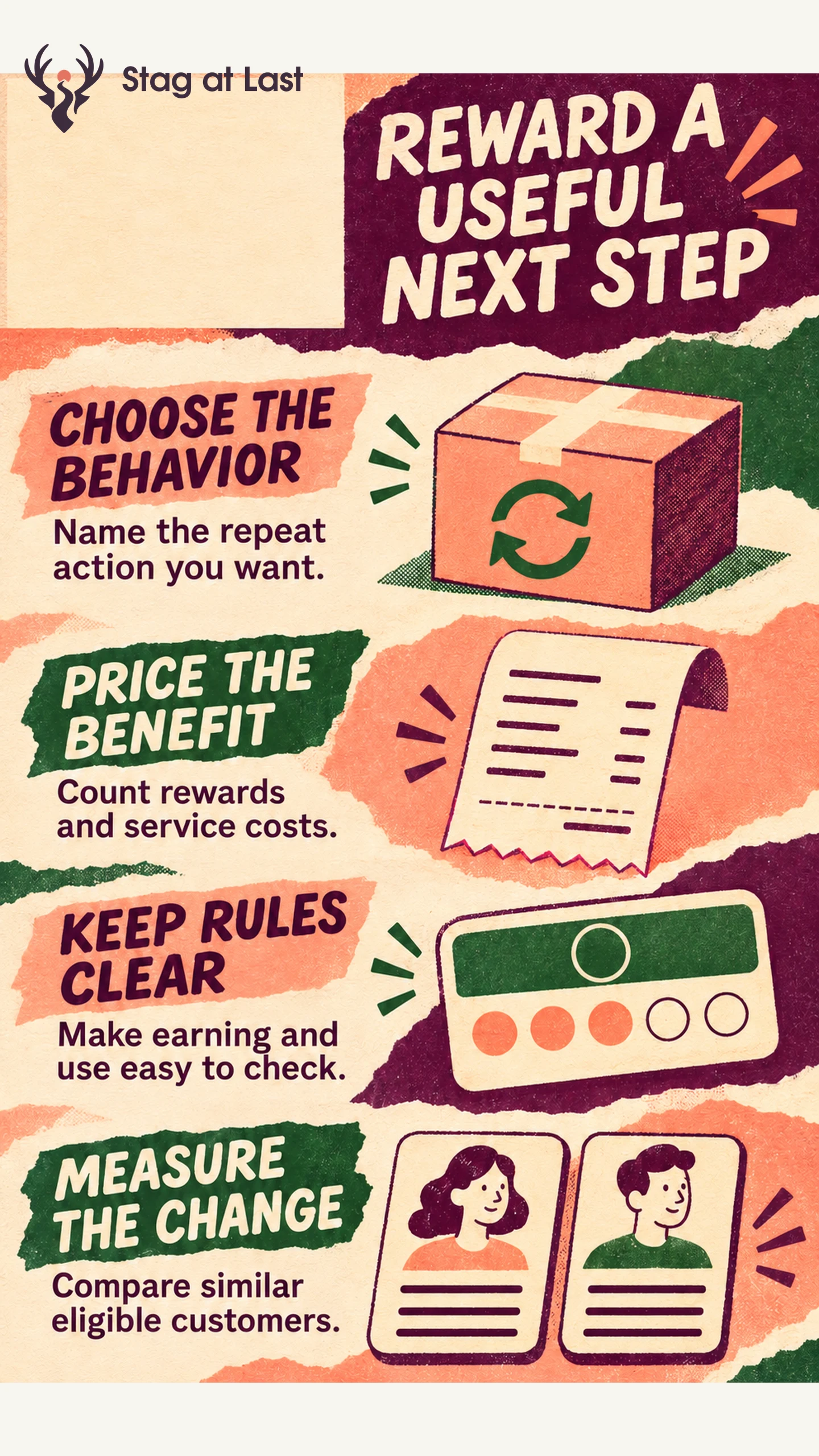
- Name the action, such as a second qualifying order within 60 days.
- Choose a benefit customers can understand and the store can fulfill.
- Estimate discounts, delivery, administration and support costs.
- Compare repeat behavior and contribution with a suitable control group.
Use signups and redemptions to diagnose the program. Use additional contribution to decide whether to expand it.
A store sells reusable pens and compatible ink refills. A points program could reward every order, while a simple refill benefit could help customers complete the one repeat purchase that matters. To choose between them, the store needs to know what buyers would do without the reward and how much the benefit costs.
Pick a Behavior and a Benefit That Fits It
Start with a defined action and window. For the pen store, the target might be a second qualifying purchase within 60 days of the first order. Check whether compatible refills are easy to find first. A reward will do little for a buyer who cannot tell which refill fits.
| Benefit | When it fits | Cost to check |
|---|---|---|
| Second-order credit | A relevant next purchase exists within a useful window | Discount on orders that would have happened anyway |
| Points | Customers make enough qualifying purchases to use the balance | Redemption, outstanding rewards and administration |
| Access or service perk | Customers value a specific experience or capability | Staff time, availability and fulfillment |
If the repeat task is predictable replenishment, consider customer-controlled subscriptions separately. If usage varies, a reminder or clear reorder link may be the better first test.
Price the Reward Before You Promise It
Start with how much the expected repeat order contributes after product, payment, shipping and return costs. Subtract the reward once. If it is a discount, account for it in net revenue. Include program and support costs when comparing groups, and estimate what could happen if redemption is higher than expected.
Suppose equal-sized groups each contain 500 eligible first-time buyers. Within 60 days, the regular group places 100 second orders worth $15 contribution each, or $1,500. The pilot group places 130 second orders and uses a $5 credit on 80 of them. At $15 per order, its contribution before rewards is $1,950. The pilot contributes $50 more after $400 in redeemed credits, before administration. These illustrative numbers exclude later orders and fixed overhead.
Keep the Rules Easy to Use
Show how customers earn and redeem the benefit, what it applies to and when it expires if there is a genuine expiry. Explain what happens after a return. Run test carts for an eligible member, an excluded product and a conflicting code. Check the reward balance and order records after a test refund. Assign an owner to handle exceptions.
Avoid introducing several tiers before you know customers value the first benefit. Use your promotion planning checks for clear terms, stacking rules and a stop condition.
Measure Change Across Eligible Customers
People who already buy often may be more likely to join. A study of Dutch grocery households by Leenheer and colleagues found a smaller estimated share-of-wallet effect after accounting for member self-selection. [1] Use that as a reason to design a comparison, without borrowing the study’s effect size for your store.
Where feasible, randomly assign eligible customers to the offer or the regular experience and follow both groups for the same window. For the 60-day repeat rate, count eligible first-time buyers who place a second qualifying order within 60 days. Divide by all assigned eligible first-time buyers who had the full 60 days, including people who never enroll or redeem. Define in advance how canceled and returned orders affect qualification. Compare repeat purchase, contribution per assigned customer and support workload. Use mature first-order cohorts when examining whether the next purchase changed. Record whether to keep, simplify or stop the program.
Make Program Rules Clear in Every Language
If you publish loyalty terms on multilingual WordPress, check how customers earn, redeem and lose eligibility in each language. Include a checkout test when evaluating a translation workflow.
FAQs About Customer Loyalty Programs
Do I need a points system?
No. Start with one benefit that serves a clear repeat task. Points can make sense if customers buy often enough to understand and use them.
Are redemptions a good loyalty metric?
They show that people used a reward. Compare repeat purchase and contribution across comparable groups to assess whether it changed behavior.
How should I compare members and nonmembers?
Member and nonmember comparisons can describe who enrolled. Use a randomized offer where feasible to estimate what offering the program changed.
Sources
[1] Leenheer and colleagues. Do loyalty programs really enhance behavioral loyalty?