
Quick Answer: What should a global brand standardize and what should it adapt locally?
Global standardization uses common rules, assets and product facts across markets. Local adaptation changes parts of the offer or its presentation to suit local customers, channels or requirements.
| Decision | Standardize | Adapt locally |
|---|---|---|
| Product and brand | Approved facts for the same variant, logo and visual standards | Market-specific variants, labels or packaging when required |
| Message and offer | Core positioning and the evidence behind claims | Language, examples, currency, price and promotions |
| Delivery and support | How teams verify the promise | Available delivery methods, return instructions and support hours |
Reuse shared elements where they fit the market. Change the parts that affect whether local customers can understand, buy or use the offer.
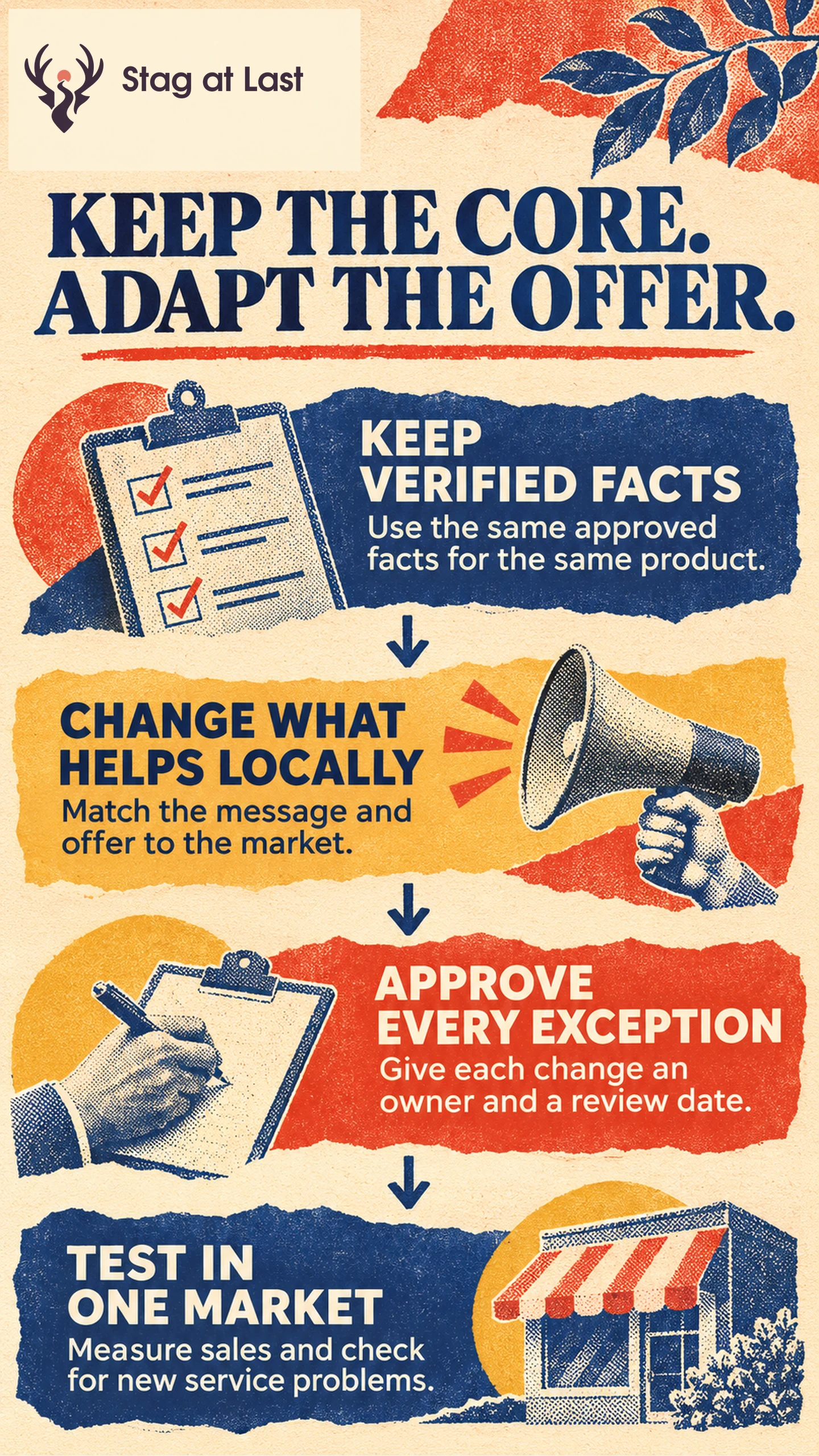
A brand can sell the same ceramic travel mug in two markets and show it in different settings. One campaign might focus on a commute, while another helps shoppers compare sizes for weekend travel. The mug’s capacity, material and care directions stay tied to the actual variant. The team chooses the message and offer that help local buyers decide.
Decide Which Parts of the Offer Can Change
Start with the audience and sales route in your international marketing strategy. OpenStax uses product, price, place and promotion to explain the scope of local adaptation. [1] Review each element separately so a change in one does not force you to rebuild everything.
Keep the mug’s approved material, volume and tested performance in the shared product record. A local page can show capacity in the units shoppers use. If a new lid changes the care instructions, treat it as a different variant and verify the claims for that variant before publication.
Allow regional teams to choose imagery and examples based on local buyer questions. Check the landed price and locally available payment and delivery options before advertising the offer. For store campaigns, confirm what participating shops can display, sell or fulfil. The shared brand assets can appear in both campaigns even when the offer varies.
Give Regional Teams an Approval Path
Write down what can change, who checks it and what happens if it is withdrawn. Give regional teams authority over approved copy, examples and placements. Send changes to product specifications or performance claims to the product owner. Have the team responsible for local operations verify price, availability, shipping and returns before launch. Route regulated claims and required labels to the appropriate specialists for that market.
For each exception, record the market, variant, proposed change, evidence, approver and review date. Keep a fallback that still makes a truthful offer. If one store stops supporting a promotional bundle, withdraw that store’s bundle from ads and checkout. Continue to show the standard mug only if it is still available there.
When an adaptation includes a new language version of a page, Google Search Central recommends a different URL for each language version and using hreflang to identify the alternatives. [2] Check that search visitors land on a page whose content and fulfilment terms match the market it serves.
Test Adaptations in the Market They Serve
Start with one change tied to an observed problem. If buyers struggle to judge mug size, test a new photo showing the mug beside a familiar object. Test clearer local measurement units separately if you want to isolate the effect of the units. Keep the variant, price and delivery promise the same during that test. Where feasible, randomly assign eligible shoppers in the same market to the old and new versions at the same time. Keep returning shoppers on their assigned version.
Choose a primary measure, such as orders per eligible product-page session, and watch size-related returns and support contacts. Compare size-related returns among orders with a complete return window in each group. Comparing different countries can mix the effects of message, price, competition and shipping. Expand the change when it improves the intended decision and the local team can maintain it.
Evaluate a Small Set of Localized Pages
If your global store runs on WordPress, try StagLingo on a small set of localized product pages. Verify that product facts and regional delivery terms remain accurate when you preview each version.
FAQs About Global Standardization and Local Adaptation
Is translating a campaign the same as adapting it?
Translation can be one part of adaptation. A local campaign may also need a different example, product variant, payment option or service promise.
Can a global brand adapt prices and keep a shared identity?
Yes. Visual identity and core positioning can stay consistent while pricing reflects local costs and demand. Check that displayed prices and terms match checkout in each market.
Who should approve a change to a product claim?
Route a new claim to the product or evidence owner and any specialist responsible for the market’s requirements. Let the regional team choose approved wording for that claim.
Sources
[1] OpenStax. Strategic Marketing: Standardization versus Adaptation
[2] Google Search Central. Managing multi-regional and multilingual sites