
Quick Answer: How should a business choose its first international market?
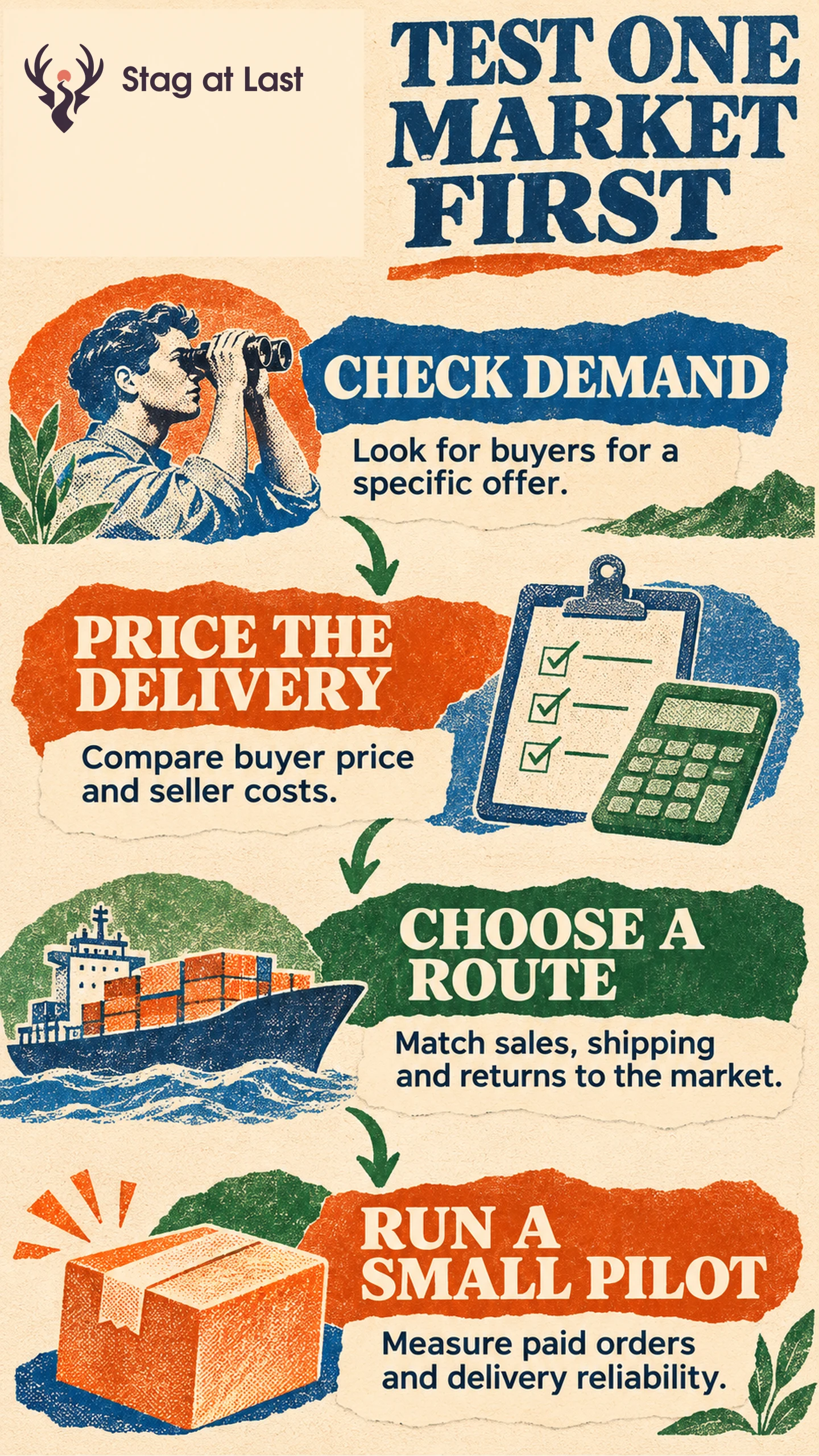
An international marketing strategy chooses a market, a customer group and an offer the business can deliver locally. Compare demand, the price customers pay and your cost to fulfil and support each order before committing to a launch.
- Look for demand for a specific product at a plausible local price.
- Price shipping, duties, payment costs, returns and support for each route.
- Test real orders in one market with a defined budget and a decision date.
Treat visits and enquiries as signals. Use completed orders and delivery results to decide whether to expand.
A homewares brand notices overseas visitors looking at a compact desk lamp. That traffic suggests a market to investigate. The buying opportunity depends on whether people will order at the delivered price and whether the business can handle payment, delivery and returns there. Start with one product and a defined customer group so the test can answer both questions.
Compare Demand for a Specific Offer
Shortlist markets using trade data, existing orders or enquiries, search interest and local competitor prices. The International Trade Administration recommends checking market size, competition and whether the product remains competitive at its landed cost. [1] Separate signals of general category demand from evidence that shoppers want your specific configuration.
In each market, identify who buys the product, what they compare and what might stop them. Read local retailer listings and reviews, and speak to potential buyers or local partners. For the lamp, check plug compatibility, local requirements and whether shoppers prefer a smaller fitting or a different price range. Use the research to define what to adapt for the market.
Calculate the Cost of Serving Each Market
Estimate the total price customers pay to receive the order, including relevant freight, duties, taxes and fees. Trade.gov’s export pricing guide explains the components of landed cost. [2] Confirm who pays each charge with the carrier or broker for the product and destination. Make any payable-on-delivery charges clear before checkout.
Separately estimate what the seller retains. Work in one currency and use quotes for the parcels you actually expect to send. For example, suppose the seller records $85 in order revenue after discounts and expected refunds, excluding taxes collected for remittance. Costs are $28 for the lamp, $14 for fulfilment and freight, $8 for duties and fees paid by the seller, $3 for payment and conversion costs and $7 in expected return-handling and support costs. That leaves $25 per order before acquisition and fixed costs. At $18 of acquisition cost per order, the illustrative contribution is $7 before fixed costs.
Test how contribution changes if freight rises or returns cost more. When comparing options, apply the same definitions to each market and allocate order-level costs once.
Choose How to Sell and Deliver Locally
Compare direct ecommerce, a marketplace and a distributor for the same customer and product. Ask who controls assortment and price, who handles customer messages, and where returns go. A marketplace may already have relevant buyers. A local distributor can help with store presence and returns, with partner margin built into the economics. A direct site gives the business control over its offer and obliges it to provide the purchase and service experience itself.
Pick one route for the pilot. Verify the applicable product, import and labeling requirements before accepting orders. For a store-led launch, verify the stock the partner can make available locally. For a direct launch, test a real checkout, a delivered parcel and a return. Verify the payment method, order messages and time window with customers in the pilot market.
Set Limits for the First Pilot
Set an order or spend cap, a minimum sample and a review date that allows for the return window. For delivery reliability, divide on-time deliveries by accepted orders whose original deadlines have passed, including seller-caused cancellations as misses. Track unexpected charges among deliveries with known outcomes and report the number still unknown. Calculate realized contribution after acquisition once the return window closes. Compare results against thresholds the business defined before the pilot.
Expand if paid demand, contribution and delivery can hold at the next volume. If shoppers buy but orders miss the delivery window, pause promotion and fix the route before increasing spend. Fix the offer or exit the pilot when customers need a price the business cannot serve profitably.
Evaluate the Market Pages Shoppers Will Use
If you plan to launch a localized WordPress store, try StagLingo on a few product and support pages. Check translated product details, delivery terms and return instructions against the offer in that market.
FAQs About International Marketing Strategy
Does international website traffic justify entering a market?
Traffic helps identify markets worth investigating. Look for demand at a plausible delivered price and verify that the orders can be fulfilled profitably.
Should a business start with a marketplace or its own store?
Choose based on where the customer shops and who can deliver and support the order. Compare channel fees, customer access, fulfillment costs and return responsibilities for the same offer.
What should a first international pilot measure?
Measure completed sales at the proposed price, actual delivery performance, returns and contribution after acquisition. Include enough time for most pilot returns to be observed.
Sources
[1] International Trade Administration. Conducting Market Research
[2] International Trade Administration. Determine Total Export Price