
Quick Answer: How Can You Test Demand Before Buying Inventory?
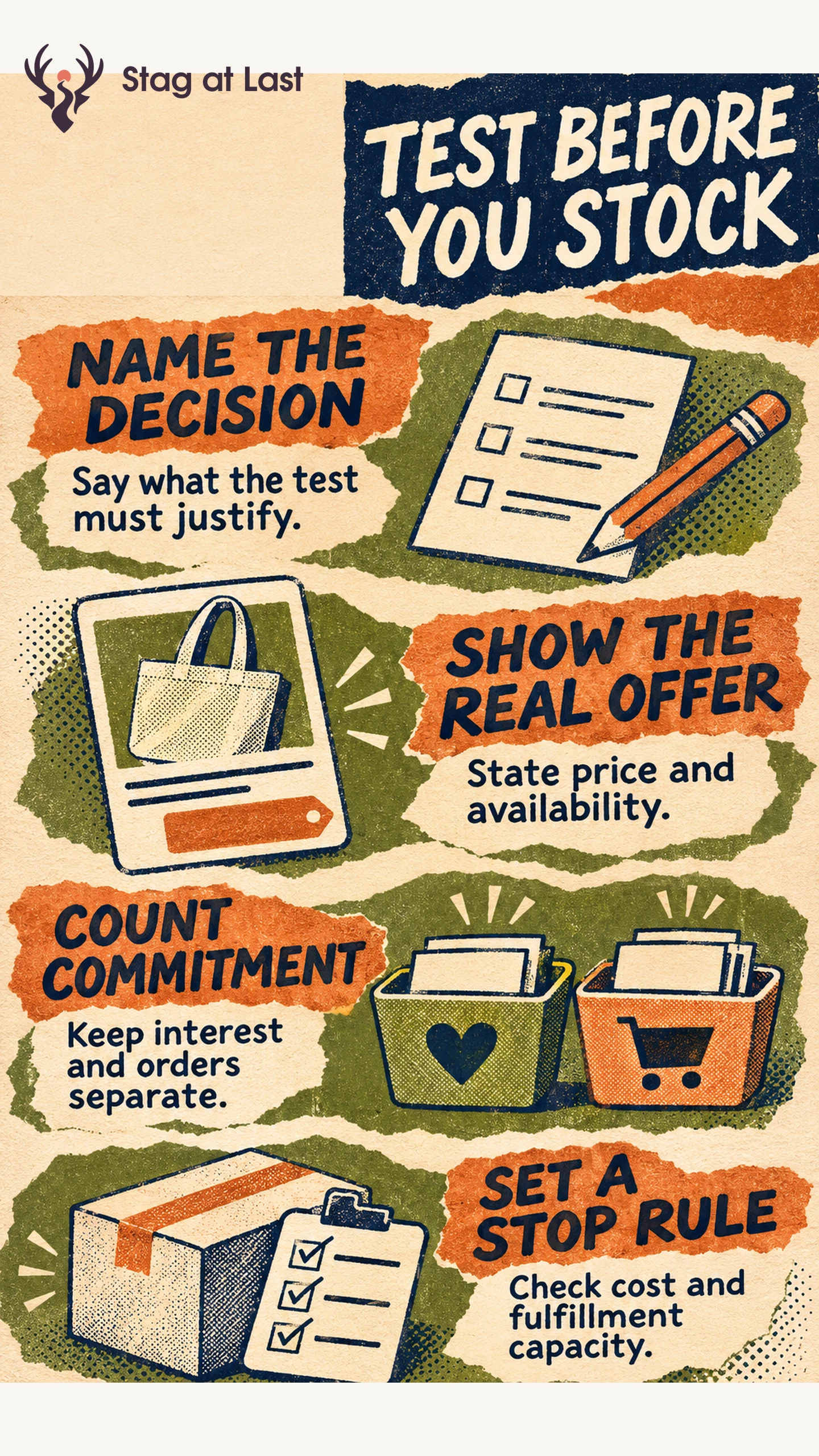
Test the smallest honest version of the offer that can inform your inventory decision. Show the price and availability customers would face, then measure an action that matches the size of the commitment you are considering.
- Write down the audience, product, price and decision you need to make.
- Choose a waitlist, a paid preorder or a small batch based on what you can fulfill.
- Set a spending cap, a test window and a rule for interpreting the result.
- Review cancellations, cost and buyer feedback before placing a larger order.
Clicks show attention. Use purchase evidence before drawing conclusions about willingness to pay.
Suppose you are considering a modular drawer organizer. Ten people say they like the idea after seeing a prototype. You still need to learn whether shoppers will choose it at a stated price, whether it fits the drawers they own and whether your team can ship enough orders to make the first production run worthwhile.
Write Down the Inventory Decision
Name the commitment the test can change. “Should we order the supplier’s first 150 units?” calls for stronger evidence than “Which organizers should we prototype?” Identify the customer, the use case, the likely selling price and the alternative they use today. If the alternative is unclear, start with customer interviews about recent purchases.
Estimate first-run costs and contribution under realistic price, delivery and returns assumptions. Check the minimum supplier quantity and the cash tied up in unsold stock. Decide the maximum loss you can accept and how many orders you can support. Use those facts to set the decision rule before traffic arrives.
Match the Test to the Strength of Evidence You Need
| Test | What the action tells you | What to check next |
|---|---|---|
| Product page with a waitlist | People asked to hear about the described offer | Whether they buy at the stated price |
| Paid preorder | Buyers committed money under specific terms | Cancellations and whether you can deliver |
| Small batch for sale | Buyers completed a purchase of available stock | Returns, costs and repeatability |
A preorder can have different payment terms. Shopify, for example, documents configurations that collect full, partial or no payment when a customer places a preorder. [1] Record which terms you tested, and count a signup, an unpaid reservation and a paid order separately. If you are considering taking payment, use the preorder fulfillment and communication checklist first.
Run a Small Test With an Honest Offer
Give shoppers the dimensions, price, delivery information and current availability before the action. State that the item is a prototype if that is what you are showing. Use a clear signup label for a waitlist and explain what messages will follow. Before taking a paid preorder, show the amount due now, when any balance is due, the expected dispatch window and the cancellation or refund terms. Take orders only when you can support those terms and stop at the available capacity.
Pick one audience and route to the page. Define eligible visitors, the conversion action and the observation window. For the organizer, that could mean unique people in the planned delivery region who saw the $36 offer over 14 days. Track whether traffic came from existing buyers, referrals or cold prospecting. Keep those groups visible when you compare results.
Decide What to Do With the Result
Imagine 400 eligible visitors see a small-batch offer. Twenty complete payment and two cancel before dispatch. That leaves 18 uncanceled orders, or 4.5% of eligible visitors at that point. If acquisition spend for those same 400 visitors was $180, that is $10 per uncanceled order before returns. Those outcomes help you compare the test with your target contribution and fulfillment capacity. They do not establish demand for 150 units under different terms.
If your minimum was 15 uncanceled orders and your acquisition ceiling was $9 per uncanceled order, the illustrative test clears the order threshold and misses the cost threshold. Inspect the source, margin and fit feedback before scaling. Record whether to try one change, negotiate a smaller run or stop. Feed the result into your assortment decision and keep the conditions attached to the number.
Check Test Offers Across Languages
If you are using a multilingual WordPress landing page, verify that price, availability and the signup purpose are clear in each language. Include that buyer-facing check when evaluating a translation workflow.
FAQs About Ecommerce Product Demand Tests
How many waitlist signups are enough?
Set a signup threshold based on the next decision. For an inventory commitment, look for actual orders or corroborating evidence because signup intent can fall away when the offer opens.
Can I validate demand without taking money?
Yes. Interviews and an explicitly labeled waitlist can help test relevance and identify concerns. A small batch can later show what happens at a real purchase decision.
Should I run the test with existing customers?
Yes, if repeat buyers are the intended audience. If you need evidence about first-time buyers, recruit a separate group and report their results independently.
Sources
[1] Shopify. Pre-orders