
Quick Answer: When Does DTC or Marketplace Selling Make Sense?
Use an owned direct-to-consumer store when control over the offer, checkout and post-purchase experience is central to the business. Use a marketplace when shoppers already compare products there and the product fits its listing, fee and fulfillment rules. Both can serve different jobs.
| What the channel needs to do | Where to start |
|---|---|
| Explain a product that requires a guided choice | Owned store with room for education and comparison |
| Reach shoppers comparing familiar products | Marketplace listing for a proven item |
| Support discovery and repeat purchase | Pilot a distinct role for each channel |
Compare contribution and operating workload on equivalent orders before expanding.
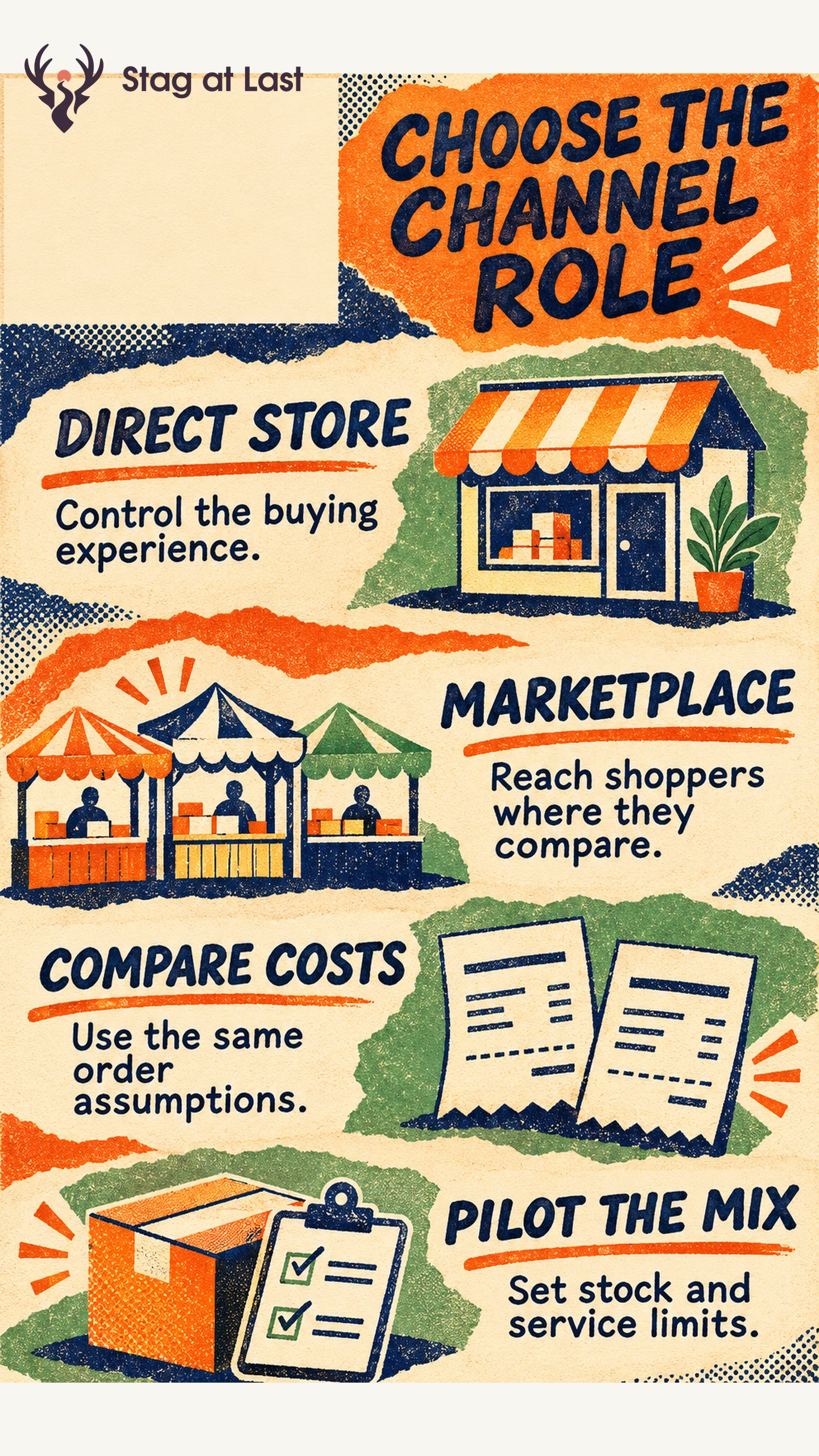
A brand selling refillable notebooks might use its own store to explain cover sizes and refill compatibility, and list a popular starter set on a marketplace. That split only works when each listing answers the buyer’s questions and the business can reliably fulfill both. Start by deciding which problem the new channel is supposed to solve.
Compare the Work Each Channel Takes On
| Factor | Owned DTC store | Third-party marketplace |
|---|---|---|
| Discovery | You build or buy the route to your store | Buyers may already search the category on the platform |
| Product and checkout | You choose the presentation and manage the store workflow | The platform sets the listing and checkout environment |
| Costs | Payment, platform, traffic and order operations | Selling fees, fulfillment, possible ads and order operations |
| Service | You arrange support, delivery and returns | Responsibilities depend on the platform and fulfillment model |
Audit the acquisition and conversion plan before assuming a direct store can replace the marketplace’s discovery role. On US Amazon, the published pricing page separates standard selling fees, Fulfillment by Amazon costs and optional services. [1] Build your own estimate for the product, country and fulfillment route you plan to use.
Decide What Customer Relationship You Need
If buyers need setup instructions or compatible refills, plan where they will get help before choosing the channel. An owned store can give your team more control over those instructions and communication preferences. For example, WooCommerce documents how merchants can view order details in their store admin. [2] Access to a customer record and permission to use it for promotional contact are separate questions. Check the platform terms and requirements that apply to your market and contact method.
A marketplace listing should stand on its own. State dimensions, compatibility and what ships without sending buyers elsewhere to complete the decision. Use the Amazon listing content checklist for a marketplace example. If the buyer needs a product-family comparison, see whether approved content options such as Amazon brand content support it.
Calculate Contribution on Comparable Orders
Suppose the same item brings in $60 in both channels after discounts and expected refunds, excluding sales tax. Product cost is $20, fulfillment costs $9 and expected return handling is $3 for each channel. On the direct store, assume $2 in payment fees and $14 in acquisition spend per order. On the marketplace, assume $9 in selling fees and $6 in ad spend per order. These illustrative orders contribute $12 and $13 respectively before fixed overhead.
This comparison can reverse when marketplace fees change, direct orders come from repeat buyers or fulfillment costs differ. Include the costs each channel actually incurs and avoid counting the same ad or fee twice. Compare the first order separately from repeat orders when customer histories are observable.
Pilot One Role for Each Channel
Choose a small group of variants you can keep available. Agree on who updates stock, handles returns and stops the pilot if service deteriorates. Use the same period for both channels and track eligible orders, contribution per order and late dispatches by channel. A channel can have fewer orders and still serve a valuable role if it reliably reaches a different buyer.
Review whether the marketplace brought new demand or shifted orders from the existing store. Use comparable periods or a staged rollout when feasible, and note stock or price changes that make the comparison unreliable. Let the results guide your channel-specific assortment before you add more products.
Check the Direct Store Experience Across Languages
If your direct store runs on multilingual WordPress, review delivery and return information alongside the product detail page in each supported language. Include those checks when evaluating a translation workflow.
FAQs About DTC and Marketplace Selling
Is DTC always more profitable?
Contribution depends on traffic costs, fulfillment, fees and the order mix. Compare like-for-like orders and include operating costs specific to each channel.
Can the same product work in both channels?
Yes, if the item can be presented accurately in each channel and the team can coordinate stock and service. Give each channel a clear customer task.
What should I measure in a marketplace pilot?
Track contribution per order, stock availability and service outcomes alongside sales. Decide in advance what would justify expanding or stopping.
Sources
[1] Amazon. How much does it cost to sell on Amazon?
[2] WooCommerce. Single Order Page and Manually Adding an Order