
Quick Answer: How Should You Promote an Open-Source Project?
Promote an open-source project by showing the work it helps someone do, giving them a reliable first try and making participation easy to understand. Match outreach to the time maintainers have to support new users.
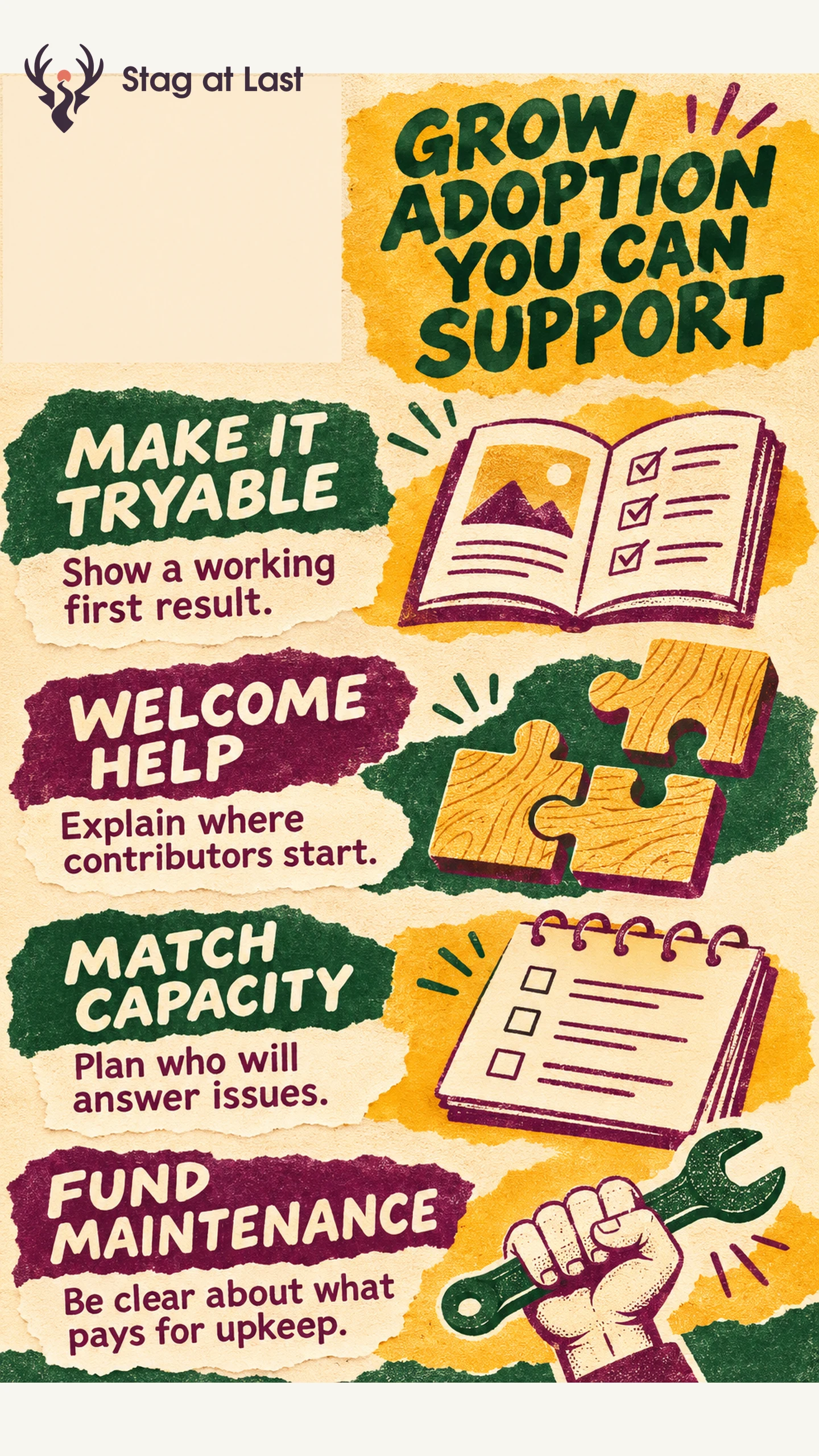
- Show a working result. Start the README with the use case, requirements and a short example.
- Explain how to participate. Point users to support and contributors to appropriately scoped work.
- Choose an audience with a current need. Share a useful example where that problem comes up.
- Budget for maintenance. Decide who will triage questions and what resources can fund upkeep.
Pick one outcome for the first campaign and write down how you will recognize it before posting.
Imagine a maintainer releasing a command-line tool that checks broken references in documentation. A successful announcement brings people who can try it on an appropriate project, tell whether the output helps and report a problem with enough detail to investigate. That takes work before and after the announcement.
Make the Project Easy to Try
Explain the task and the project’s fit in the first screen of the README or landing page. For the link checker, show an example report with synthetic files. Say which file types it understands, where it runs and what it can check offline. Put installation requirements beside the quickstart and tell the reader what success looks like. The developer onboarding checklist can help you verify that path with a new user.
Make the license and release status easy to find. The Open Source Initiative’s definition considers distribution terms beyond source-code access. [1] If the hosted product and the repository differ, describe what each contains and point readers to the applicable license and service terms.
Give Users and Contributors Separate Paths
| Person | Path to provide | Check that it works |
|---|---|---|
| First-time user | Quickstart and support route | They can run the example and interpret its output |
| Bug reporter | Issue guidance and minimal reproduction | They know which details to include safely |
| Prospective contributor | Contribution guide and scoped issue | They can find requirements and a reviewer |
| Prospective sponsor | Funding priorities and contact | They can see what their support would fund |
A contribution can be a tested installation note, a translation or a confirmed bug report. Before inviting contributors, mark which tasks are ready and who has time to review them. Define how decisions are made and how people can get help. Separate project feedback from optional commercial outreach using clear community handoffs.
Choose Promotion the Maintainers Can Support
Pick a place where users already discuss the problem. For the link checker, a reproducible example in a documentation community could help people evaluate it against their current review process. Follow the community’s posting rules and disclose your connection. Include the expected output and one important limit so readers can judge relevance.
Plan a small release window with an owner for triage. If setup questions outpace your ability to respond, clarify the quickstart and pause additional promotion until the team catches up. Keep a short record of questions the next release should address.
Connect Adoption to Sustainable Maintenance
Separate discovery, trial and continued use. Repository attention and downloads can help show reach, but a download may be a CI job or a repeated install. For voluntary reports of active use, keep the date and what the adopter confirmed. Mark adoption as unknown when you cannot observe it. CHAOSS considers adoption and contribution activity among indicators of project viability. [3]
Compare the work the campaign generated with maintainer capacity. Track unresolved issues awaiting a first useful response and review obligations for accepted contributions. Funding can take forms such as sponsorship, grants or paid time through an employer. [2] Explain what funding pays for and where the project’s public commitments are documented. For a commercial companion, keep the difference visible in your developer marketing and technical proof.
Keep Project Information Consistent Across Languages
If your project website runs on multilingual WordPress, keep supported versions, release links and community contacts consistent across languages. Include those pages in a translation workflow evaluation.
FAQs About Open-Source Project Marketing
Do GitHub stars show how many people use a project?
Stars indicate attention or interest. They cannot tell you how many distinct teams tried the project, whether a deployment succeeded or which teams continue to use it.
Should a project launch a community chat immediately?
Open one when there is a real need and somebody can respond and moderate. A documented issue or discussion route may be enough for an early project.
Can open-source projects offer paid services?
Paid services can fund ongoing maintenance. Explain the difference between the open-source distribution and any separately priced hosting, support or training.
Sources
[1] Open Source Initiative. The Open Source Definition
[2] Open Source Guides. Getting Paid for Open Source Work
[3] CHAOSS. Practitioner Guide: Assessing Viability