
Quick Answer: How Do You Make Usage-Based Pricing Predictable?
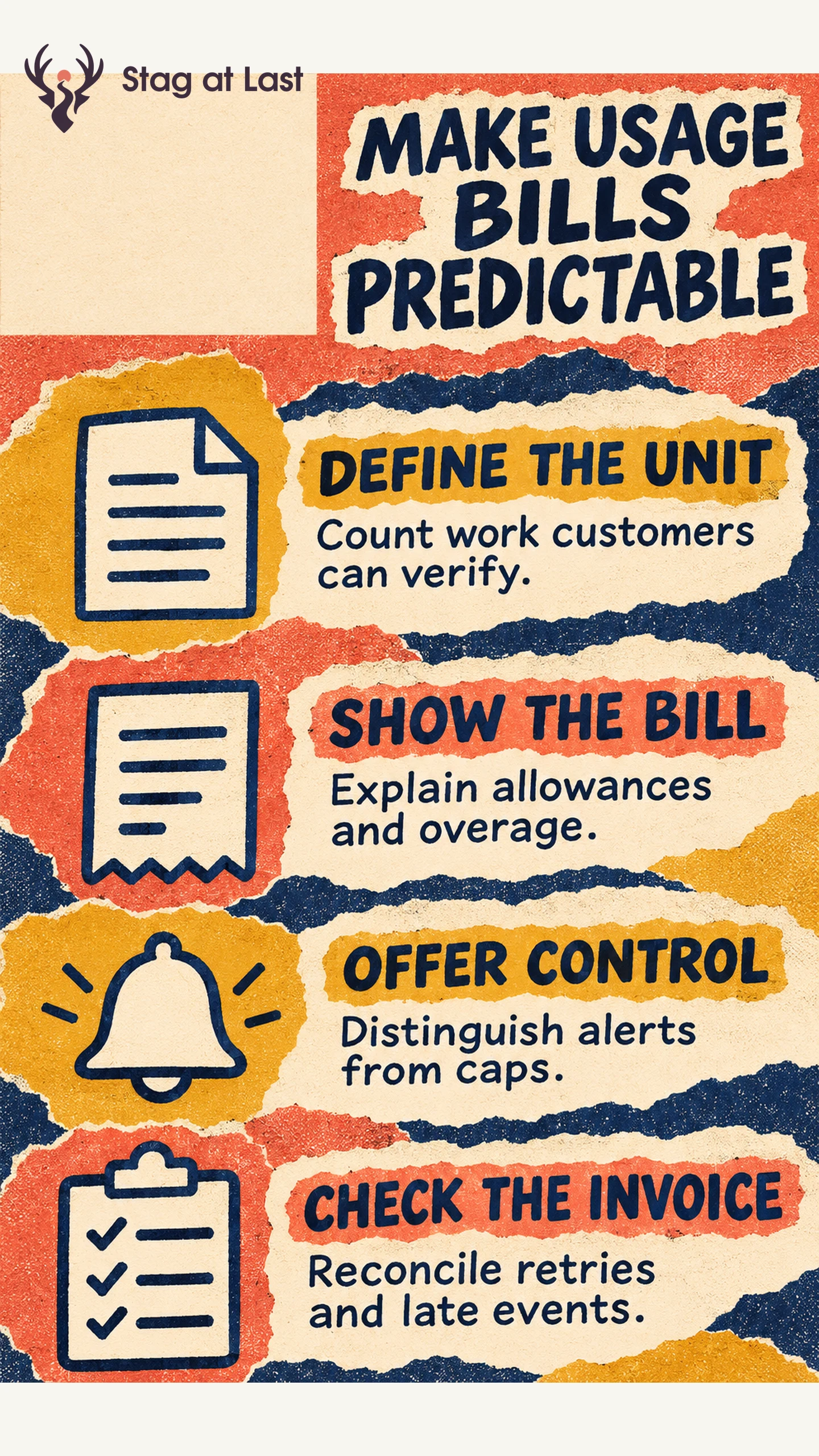
Usage-based pricing works when customers can understand, verify and manage what they are charged for. Define the unit and billing period, show bills for different volumes and explain what happens at a threshold.
- Choose a useful unit. Count an event the customer recognizes and can audit.
- Show the calculation. Explain any base fee, allowance, overage rate and reset.
- Give control. Distinguish spend estimates, alerts and enforced limits.
- Reconcile invoices. Check duplicates, late events and corrections against the customer-facing count.
Test a busy period before launching. A clear unit is only useful if customers can predict what a spike will cost.
A customer can accept a variable bill and still need a budget they can approve. The price needs to explain which activity creates charges, how far the bill can move and what the customer can do about it. Start with the meaning of the billable event.
Pick a Unit the Customer Can Verify
Choose a unit related to work the customer values and can observe. A document-processing service might count successfully processed pages. Counting each uploaded file could hide major differences between a one-page upload and a hundred-page report. Counting every internal attempt could make a technical retry look like extra work the customer ordered.
Write the billable unit, inclusion and exclusion rules, customer scope and billing period. Stripe’s meter documentation distinguishes summing reported values from counting usage events. [1] One event for a ten-page document might represent ten pages or one event depending on the aggregation. Verify that the meter and published usage limits count the same thing.
Explain How the Bill Changes With Usage
Pure usage pricing charges for metered units. A hybrid plan can include a base fee and an allowance, then charge for extra units. If you use tiers, make clear whether a different rate applies only to units within a tier or to the entire volume after crossing a threshold.
In a hypothetical monthly plan, US$40 includes up to 1,000 successfully processed pages per account. Additional pages are US$0.04 each. The allowance resets each billing month and unused pages do not carry over. The examples exclude tax and credits.
| Monthly pages | Extra billable pages | Monthly charge |
|---|---|---|
| 600 | 0 | US$40 |
| 1,000 | 0 | US$40 |
| 1,250 | 250 | US$50 |
A customer can see that 250 extra pages add US$10. Show a higher-volume example if real usage is seasonal. Check that expected revenue still supports service costs at low and high volumes when you evaluate the wider pricing strategy.
Give Customers Ways to Manage the Bill
Show usage to date, what period it covers and how recently it was updated. A forecast should state its assumptions, such as whether it extends the current pace to the end of the month. Let an administrator see which workspaces or jobs consume usage when that detail is available and appropriate.
An alert warns someone. An enforced cap stops the defined charge or activity at its stated boundary. Throttling slows work and can still allow charges to accrue. Explain whether the cap applies to the billed amount, measured units or a particular feature. Describe what happens to jobs in flight and when an administrator can approve additional usage. If buyers value a budget that scales with team size, compare per-seat pricing against measured consumption with the same workload.
Reconcile Meter, Forecast and Invoice
Before charging, generate example invoices in a permitted test environment. Include a duplicate event, a failure, a billing cutoff and a late event. Check which source record explains each charge and how a correction would appear. If you promise a hard cap, test concurrent and in-flight jobs at the boundary. Preserve the expected total for each test case.
Pilot with a segment that can understand the unit and see its own count. Ask buyers to estimate their next bill from representative usage, then compare the estimate and actual charges when the period closes. Investigate discrepancies before widening access. Give support a way to explain the count and correct a genuine mistake.
Verify Billing Explanations Across Languages
If usage pricing is explained on a multilingual WordPress site, evaluate StagLingo on the price page and worked examples. Check the usage unit, billing period and threshold behavior in each language.
FAQs About Usage-Based Pricing
Can usage pricing include a base fee?
Yes. A base fee can cover access or include an allowance. Show what is included, the rate for extra usage and when the allowance resets.
Is a threshold alert a spending cap?
No. An alert can reach a customer while usage continues. If you promise a cap, define where it is enforced and how the product behaves at the boundary.
How should failed or repeated events be counted?
Use the rule you publish for the billable unit. If the unit is a successfully processed page, a failed attempt adds nothing and duplicate reports of the same completed page should not increase the bill.
Sources
[1] Stripe Documentation. Create and Configure a Meter