
Quick Answer: How Do You Set a Product Pricing Strategy?
Start with a buyer segment and a complete offer. Use the buyer’s alternatives to shape a plausible price range, check unit contribution and expected volume, and test what customers actually choose.
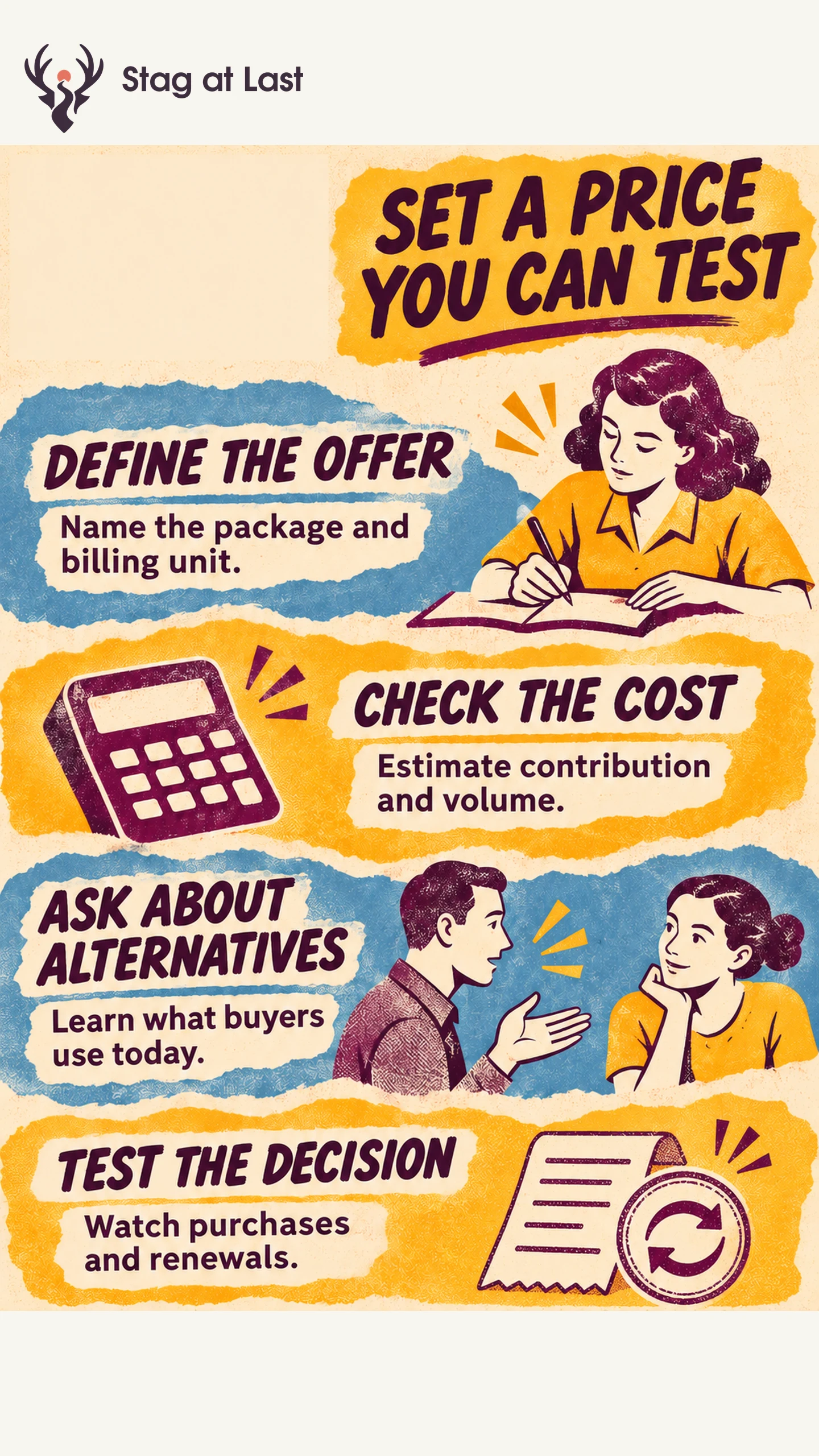
- Define the offer. Specify the outcome, package, billing unit and purchase terms.
- Model the costs. Check contribution and break-even volume under realistic conditions.
- Research alternatives. Learn what customers use, pay for and need to change.
- Test a decision. Observe purchases and renewals at comparable terms and track the cost to serve.
Treat any starting price as a hypothesis until it has buying and cost evidence.
A price is only meaningful next to what it buys. A low sticker price can become expensive after required add-ons, and a high price can be reasonable for a buyer who avoids a costly workaround. Start by deciding which offer and customer you are pricing.
Define What the Buyer Is Paying For
Describe the buyer, the job and the deliverable. Decide whether you are selling a unit, a subscription, capacity or an outcome you can measure and bill reliably. Make package limits explicit so the same price can be evaluated against the same scope.
Separate three choices in your notes. The price level is how much the buyer pays. The billing unit says what the payment scales with. The package says what the buyer can do. If you change all three together, the results tell you how the combined offer performed. They give limited evidence about which part drove the change.
Use Costs to Test Whether an Offer Can Work
List variable costs that change with each sale, including fulfillment, per-sale fees and expected return handling where appropriate. Use expected net selling price after routine discounts. Price minus variable cost gives contribution per unit under those assumptions. Compare it with the fixed costs the product needs to cover over the same period.
The U.S. Small Business Administration’s calculator estimates break-even units by dividing fixed costs by the contribution per unit. [1] In a hypothetical single-product business, a US$50 selling price and US$20 variable cost leave US$30 per unit. With US$2,400 in monthly fixed costs, 80 units cover those modeled costs. If variable cost rises to US$26 with the same price and fixed costs, the business needs 100 units.
Break-even is a cost and volume relationship. It gives you a way to assess the offer when you have a credible volume estimate. If the expected net price is at or below the variable cost, additional volume by itself cannot cover positive fixed costs under this model.
Research the Buyer’s Real Alternatives
Ask how the buyer last solved the problem, what they paid, who approved it and what made the change worth doing. Include staying with the current tool or doing the work manually. Compare alternatives on the same scope and period. A published monthly price tells you little about required onboarding, limits or switching effort without those details.
With value-based research, look for a useful outcome and the buyer’s evidence for it. Estimate the benefit with a range and record which assumptions the buyer confirmed. A large potential saving does not show what a budget owner will pay. A quote request, paid pilot or actual renewal gives different evidence from a survey response.
Test a Complete Offer and Recheck the Economics
Write a few plausible offers with clear terms. Hold scope constant if you want to learn about price level. Compare prospects from the same segment and track purchase decisions, reasons for declining, discounts and the costs incurred. Where an experiment is appropriate, give comparable groups the same follow-up and honor every offer shown.
Review contribution and customer outcomes together. A price that increases paid starts may bring a different mix of buyers and support needs. For a recurring product, include what happens at renewal when you have enough follow-up. Record the assumptions and a threshold for revisiting them. Use a separate customer notice plan if you change terms for existing customers.
Check the Offer Across Site Languages
If your pricing pages run on a multilingual WordPress site, evaluate StagLingo on a representative price and plan page. Check the billing unit, terms and included capabilities in each language.
FAQs About Product Pricing Strategy
Should you match a competitor’s price?
Use comparable offers as a reference. Adjust for scope, required add-ons, service, switching effort and how buyers evaluate the outcome.
What if customers say the price is too high?
Ask what they compare it with and what holds up approval. The issue could be budget, a poor package fit, weak proof or inconvenient payment terms.
How often should a team review pricing?
Review when important inputs change, such as costs, customer mix, alternatives or renewal behavior. Use a consistent review period so a short-lived campaign does not drive the whole decision.
Sources
[1] U.S. Small Business Administration. Calculate Your Break-Even Point