
Quick Answer: When Does Product-Led Growth Make Sense?
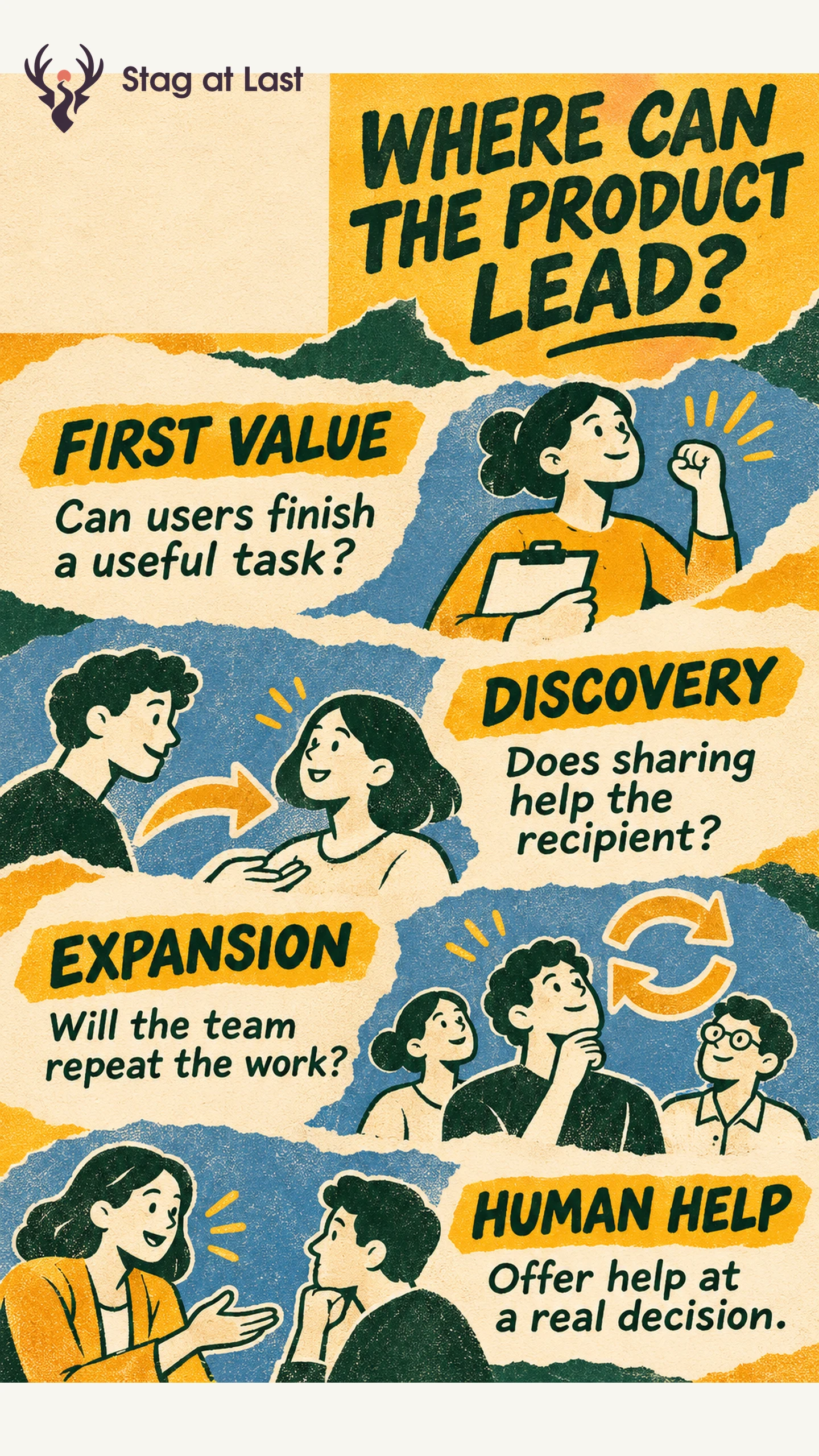
Product-led growth fits when people can experience useful value in the product and that experience gives them a reason to return, share or expand. Test each handoff separately. A product can support self-serve evaluation while sales or support helps with procurement and rollout.
- Find the first result. Choose an outcome the target user can reach with the access and data they already have.
- Check discovery. Trace how new users find the product and whether sharing helps them do a real job.
- Test expansion. Look for repeated use and a reason to add people, capacity or features.
- Place human help. Offer assistance where a user needs a decision, approval or complex setup.
Choose the path for one segment before changing how every customer enters the product.
Opening a free sign-up page gives people an entry point. Product-led growth depends on what they can do after entering and whether that experience helps acquire or retain more customers. A founder can test those conditions before committing to a new plan or staffing model.
Identify the Growth Job the Product Can Do
Atlassian’s product-led growth guide distinguishes a product-experience-led approach from acquisition through sales conversations or marketing programs. [1] In practice, different parts of the same customer journey can have different owners. Search or a campaign may bring the first user in. A useful shared result may introduce the product to teammates. Procurement may still require a conversation.
Map the handoff you want to improve. If acquisition depends on a shared artifact, give a recipient a way to understand what it is and who sent it. If expansion depends on more workspaces or collaborators, look for a reason the account would use them repeatedly. Track where new users came from and what they did after arriving. A shared link by itself says little about whether the recipient can benefit.
Check Whether Users Can Reach Useful Value
Ask what a user needs before a first result is possible. They might need a file, a colleague, admin rights or an integration that can take weeks to approve. A representative sample can demonstrate the flow, but a demo result is a different milestone from progress with the user’s own work. Define what counts as activation before testing the route.
For example, imagine a report builder that lets an analyst import a sample and make a chart. That first run is safe to offer self-serve. Automating a finance team’s weekly reports may require a protected data connection and admin review. Test the sample route for basic evaluation, then offer an assisted pilot for teams that need production access. Improve time to value within each path rather than combining their timing.
Distinguish Healthy Expansion From Forced Upgrades
Look for a recurring task that justifies more capacity. In the report builder, an analyst can share a report with a teammate who needs to review it. An upgrade can make sense when the team wants scheduled delivery or shared ownership. Invitations and payment are separate signals. Count how many invited teammates take a useful action and whether the account continues to use the added capability.
When users upgrade after hitting a limit, check what happens next. Look for retained usage, cancellations and requests to undo the change. Accounts that paid to finish one task may have a different expansion pattern from accounts that built the feature into recurring work. Choose a free plan or trial only after you know which experience should be available at entry and what it costs to support.
Choose Where Human Help Belongs
| What the user can do | Sensible route | What to verify |
|---|---|---|
| Try a representative task with low setup | Self-serve evaluation | Users finish the task at the expected support level. |
| Show a useful result but need approval to use it at work | Self-serve entry with optional help | The buyer can understand permissions, costs and rollout steps. |
| Need approval or expert setup before a meaningful result | Assisted evaluation | The guided pilot covers the actual workflow and its constraints. |
Use product-led sales when observed behavior helps someone offer timely help. A support request should go to the team that can solve it. Treat buying intent as a separate question, especially when many users share an account.
Test One Route Before Expanding the Model
Choose a segment, a first result and one follow-on behavior, such as completing a second report or inviting a reviewer who uses it. Agree on the time window and expected support load. Observe a cohort and record the number who reached the milestone, the reasons people stalled and the help they needed. Separate assisted completions so the team can judge what the product handled.
Expand the self-serve route when users in that segment can reach and repeat the intended result with support the team can sustain. If an approval or integration repeatedly blocks them, keep that handoff assisted while you improve the earlier experience.
Evaluate the Self-Serve Entry Pages in Each Language
If users start a self-serve journey on a multilingual WordPress site, evaluate StagLingo on the entry page and supporting guide. Check that visitors in each language can understand the offer and take the same intended next step.
FAQs About Product-Led Growth
Does product-led growth require a free plan?
No. A trial, a sample workflow or a paid self-serve entry can give customers enough experience to judge the product. Choose an entry model based on the work users need to try and the costs of providing access.
Can a product-led company still use sales?
Yes. Sales can help with procurement, security review and rollout. Observe which actions users can handle independently and which decisions need a person.
What shows that a sharing loop is useful?
Look for recipients who have a reason to receive the shared item and who can take a useful next action. Track continued use and give people control over whom they invite and what those people can see.
Sources
[1] Atlassian. What Is Product-Led Growth?