
Quick Answer: What Should Count as Product Activation?
Product activation is the first observable result that shows a new customer has made useful progress. Define the unit, the evidence and the time allowed before you publish an activation rate.
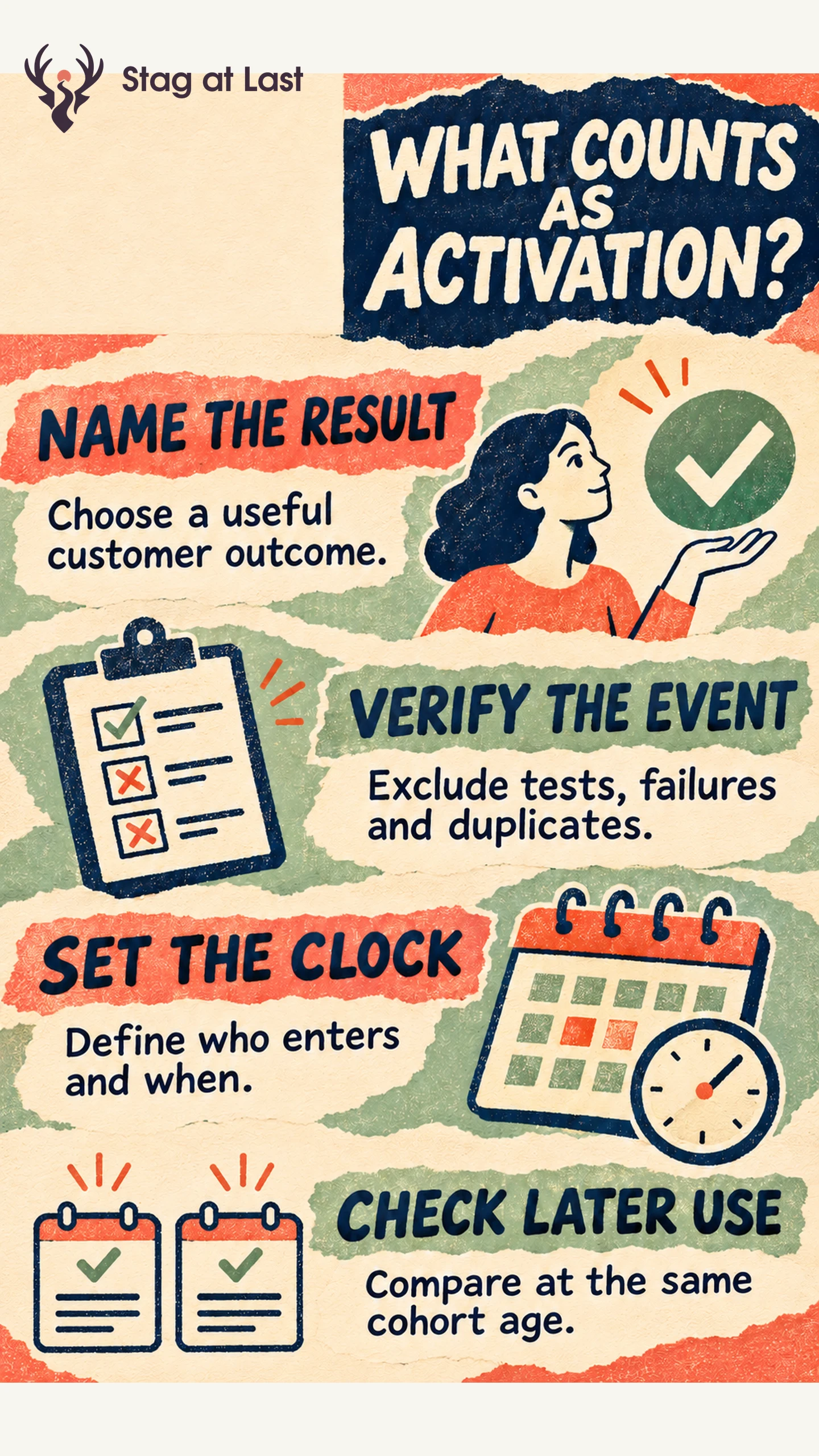
- Name the customer result. Choose the first useful outcome for the segment.
- Specify the evidence. Record success, with clear exclusions for tests, errors and duplicates.
- Set the cohort and clock. Define who can activate, when the window starts and when it ends.
- Check later use. See whether the signal relates to a later result you care about.
Keep access and setup measures visible so a low rate can be traced to the right problem.
A user can finish a tour, connect a calendar and leave without receiving a single booking. Those steps explain how far the person got. An activation definition should identify the first result that lets the customer do useful work.
Start With the Result the Customer Wants
Describe the outcome in the customer’s words, then choose observable evidence. Amplitude’s engagement playbook distinguishes onboarding, an aha moment and the first value exchange. [1] A user might understand the idea during a demo, complete configuration later and receive a real result days after that. Choose which point the metric represents.
For a hypothetical booking tool, a salon owner wants clients to reserve a real appointment without calling the front desk. Calendar connection is a prerequisite. The first confirmed booking from a client is a candidate activation event. A solo appointment app might count each provider, while a salon with a shared booking calendar might count each workspace.
Write the Event So It Can Be Verified
Record the event when the relevant system confirms success. Give engineering and analytics a few examples that should count and a few that should fail. If the event comes from a webhook or asynchronous job, check how retries and duplicate notifications are handled.
| Candidate | Count as salon activation? | Reason |
|---|---|---|
| Booking page published | No | The workspace can accept bookings, but a client has yet to use it. |
| Staff member submits a test appointment | No | A setup check, tracked separately. |
| Client starts checkout but confirmation fails | No | The reservation did not succeed. |
| First real client booking is confirmed | Yes | The workspace accepted a reservation through the intended workflow. |
| Duplicate notification for the same booking | No additional count | The booking and workspace are already counted. |
If the business outcome requires attendance, track that as a later outcome. An appointment can be confirmed and later canceled. Define whether your measure is initial progress or retained value before making cancellation part of the calculation.
Fix the Unit, Denominator and Window
Define an eligible cohort from a specific start event, such as when each new salon workspace receives access to the booking feature. Keep the eligibility rule independent of the outcome. A workspace that got access but never published its booking page belongs in the denominator if the metric starts at access.
For example, over 14 days from first access, 32 of 80 eligible workspaces recorded a first confirmed client booking. The illustrative workspace activation rate is 40%. Include only cohorts with all 14 days observed when reporting a completed-window rate. Separately track people who were admitted but could not get access. To diagnose why some workspaces stalled, break down the activation funnel or compare time to value.
Check Whether the Signal Holds Up
Check a sample of counted events against the underlying bookings. Exclude tests and verify that a successful retry counts once for the underlying booking. Classify workspaces at the end of the 14-day activation window. Compare the share in each group that records at least one confirmed client booking during the following 30 days, using workspaces with complete follow-up. Look at segments with different traffic, configuration support or business size. These differences can explain why activated workspaces return more often.
If the event is easy to inflate or misses a meaningful customer path, revise the definition. Version the change and report the old and new definitions separately until you can recompute a comparable history. Write the event, unit, start, window and exclusions in one metric record before using it in launch reporting.
Check the First Useful Step Across Site Languages
If product onboarding starts on a multilingual WordPress site, evaluate StagLingo on the entry page and first task instructions. Check that users in each language can find the same task and understand what success looks like.
FAQs About Product Activation
Can one product have multiple activation events?
Yes. Distinct customer tasks can need separate success events. Keep them separate when the workflows or eligibility rules differ, and document the denominator for each.
Should a demo or test event count?
Track demo success separately when it is useful evidence of learning. If the metric is intended to show progress on real work, keep test events out of that count.
What if activation increases and retention stays flat?
Check whether the new events reflect real progress, whether cohort composition changed and whether the later outcome had time to occur. A higher early rate can coexist with a later barrier.
Sources
[1] Amplitude. Mastering Engagement Playbook