
Quick Answer: How Do You Set a Free Shipping Threshold?
Choose a threshold by checking which baskets already qualify, which shoppers might add a useful item and which orders become expensive to ship. Then verify that the rule shoppers read matches the rule checkout applies.
- Inspect order subtotals by product mix and shipping zone.
- Model the waived shipping charge and any added product or delivery cost.
- State the qualifying subtotal, method and exclusions early.
- Compare contribution per assigned eligible shopper with the existing offer.
Treat average order value as one input. The basket distribution and contribution tell you more about where to set the threshold.
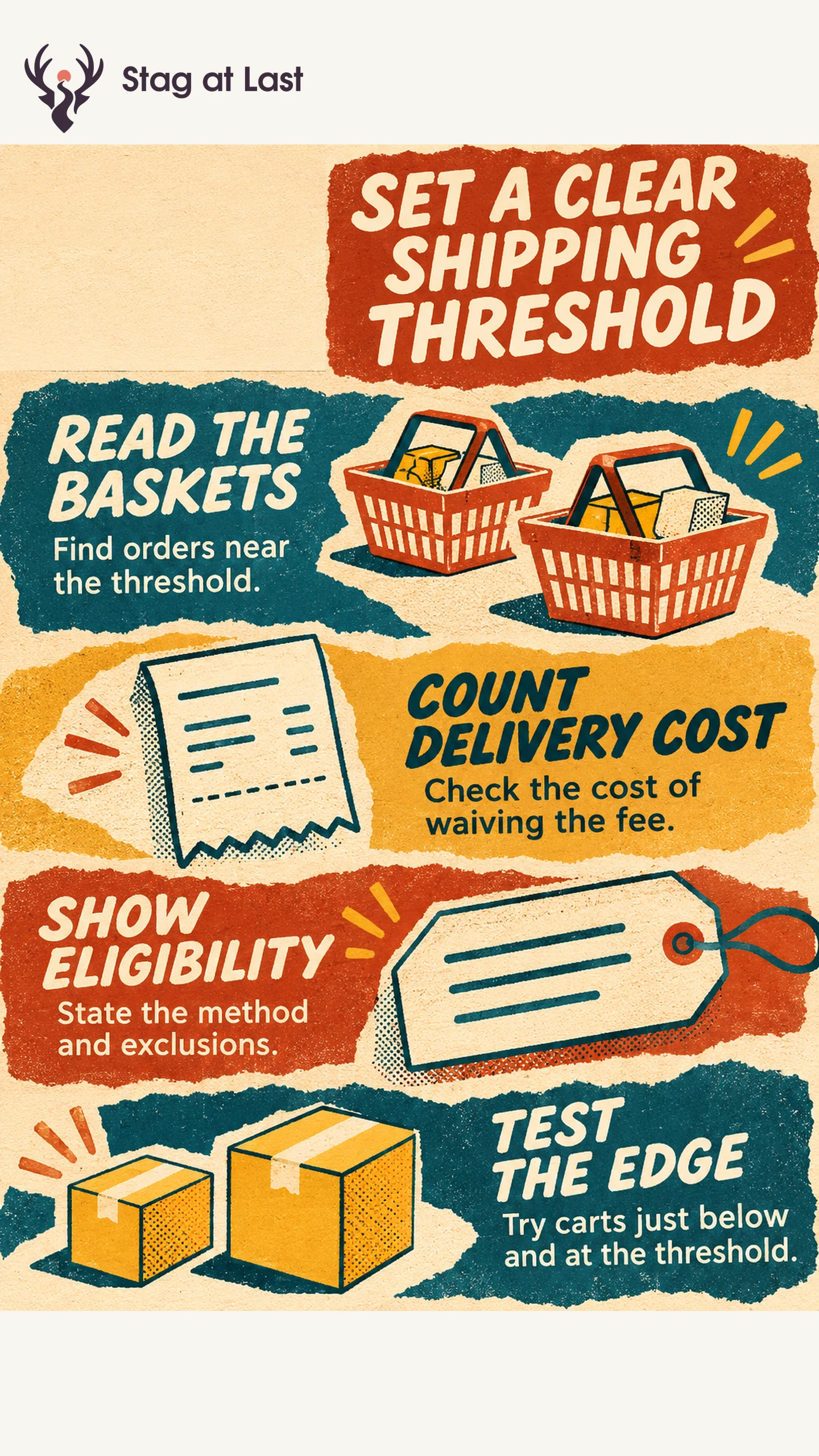
A customer with a $48 basket may add a $12 product to reach free standard shipping at $60. Another customer was already planning a $70 basket and gets the waived fee automatically. Both qualify, but their orders have different effects on your store’s economics.
Start With the Baskets People Actually Buy
Use a recent period that resembles the planned test. Group orders by qualifying merchandise subtotal, delivery zone, weight and service. Count how many already meet or exceed each candidate threshold and how many fall just below. Check whether there is a useful add-on near the gap and whether it changes packaging or shipping costs.
Choose two plausible thresholds from the distribution. If many orders already qualify at the lower option, estimate how much existing shipping revenue you would give up. If few can qualify at the higher option, inspect whether the rule will be meaningful for the buyer. Look at your order value and product mix before choosing what to test.
Calculate What the Store Gives Up
Separate what the buyer pays for shipping from what the carrier charges. You can waive the first amount and still incur the second. Also count any increase in item cost, packing, payment fees or expected return handling caused by a larger basket.
In an illustrative comparison, a $48 basket with $6 shipping charged to the buyer produces $54 in revenue before tax. Its variable costs are $23 for items, packing and payment, plus $7 for delivery. It contributes $24. Add a $12 item that adds $5 in non-delivery variable costs, keep the carrier cost at $7, and waive the $6 charge. The $60 basket contributes $25. A $1 increase in delivery cost erases the gain. A larger increase makes this order less profitable than the original basket. For a $70 basket that would have shipped with the same fee and costs anyway, waiving the fee reduces contribution by $6.
Explain Who Qualifies Before Checkout
State the rule in a form a shopper can check. An example is “Free standard shipping on eligible orders of $60 or more after discounts, before tax, to eligible addresses.” Show which zones, services or items are excluded. Only use that wording if the checkout calculation matches it. Shopify documents a minimum purchase amount for its free shipping discounts. [1]
Show an estimated paid shipping cost or explain how it is calculated when the buyer does not qualify. Baymard’s testing describes how shoppers use shipping estimates to evaluate free shipping thresholds. [2] In the cart, update the remaining amount when coupons, quantity or delivery location change. With qualifying items and an eligible address, test for paid shipping just below $60 and free standard shipping at $60. Confirm that an excluded address stays ineligible.
Test the Threshold on Comparable Shoppers
Compare eligible groups over the same time window, with random assignment where feasible. Track total contribution per assigned eligible shopper, including shoppers who place no order. Also track completed orders, order value and shipping cost. Record whether buyers added a useful item or whether the store mostly waived fees on purchases that were already large. Check split shipments, returns and support contacts after the initial test.
If the threshold grows order value and lowers contribution per shopper, compare a narrower delivery region or a different threshold. Use the promotion test plan to set the comparison and stop rule. If the buyer needs a specific combination anyway, consider whether a compatible bundle addresses that task more clearly.
Keep Shipping Terms Clear in Every Language
If your store uses multilingual WordPress, verify the threshold currency, eligible delivery method and exclusions in each translated offer. Include a threshold-edge cart when evaluating a translation workflow.
FAQs About Free Shipping Thresholds
Should I set the threshold just above average order value?
Use the distribution of actual subtotals alongside the average. Check the number of orders that would receive a subsidy and the useful items shoppers can add near the threshold.
Should coupons count toward the threshold?
Define the subtotal your checkout actually uses. If discounts lower the qualifying subtotal, explain that in the offer and test a coupon that takes a cart below the threshold.
Does a higher order value mean free shipping worked?
Order value can rise while contribution falls. Check waived fees, added costs, completed orders and total contribution per assigned eligible shopper.
Sources
[1] Shopify. Free shipping discounts
[2] Baymard Institute. Product Pages Need to Show Estimated Shipping Costs