
Quick Answer: Should You Offer a Discount or a Bundle?
Use a discount when buyers want the item and price is the main barrier. Use a bundle when compatible products solve one task together and buying them separately adds effort. Compare both against the basket the buyer would otherwise choose.
| Buying situation | Offer worth testing |
|---|---|
| Shopper wants one product but pauses at the price | A limited discount on that product |
| Shopper needs several items to get started | A compatible starter bundle |
| Shopper cannot tell whether the product fits | Clearer product evidence before changing the offer |
Choose a test that protects contribution and lets you estimate how many purchases the offer added.
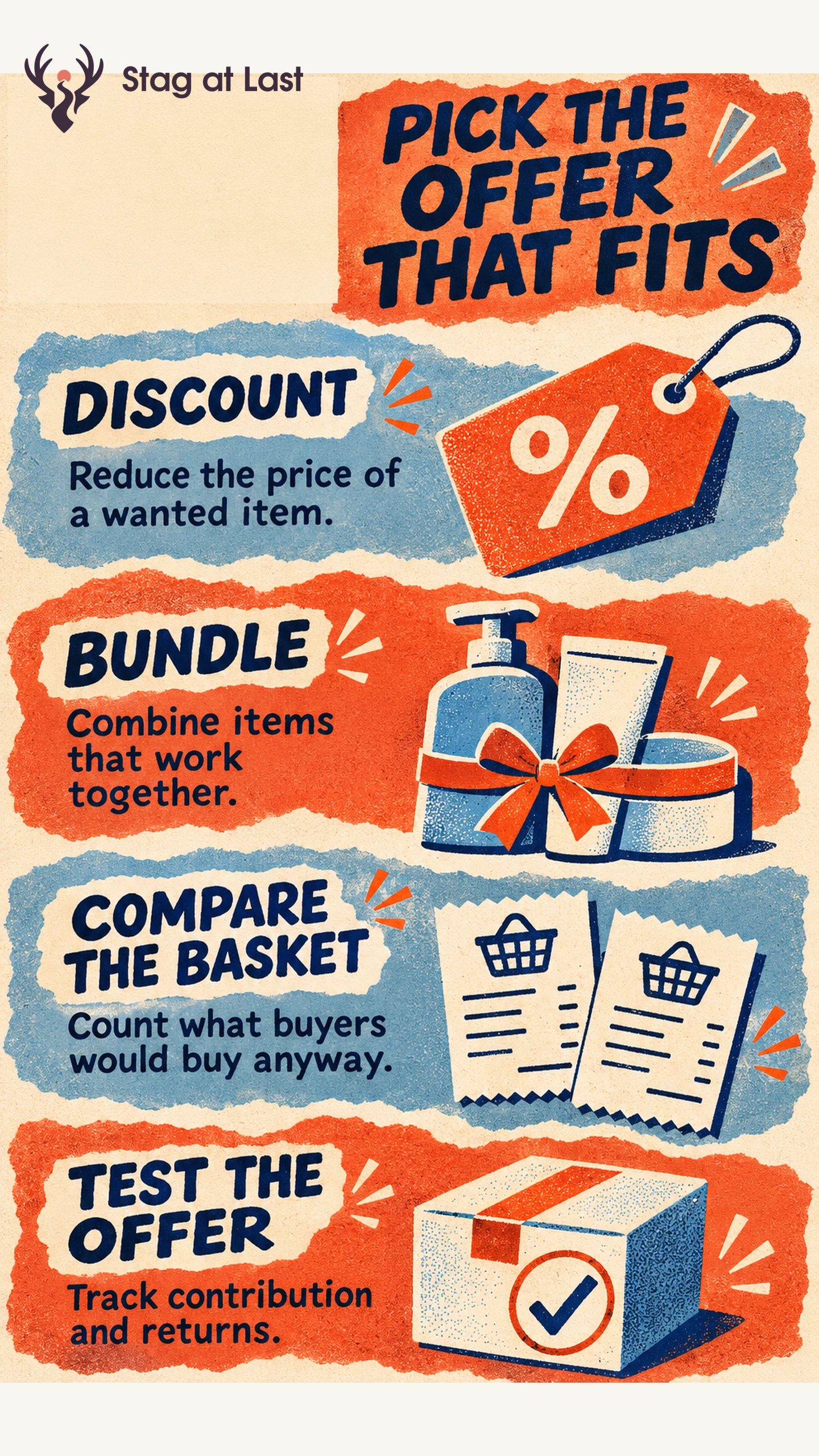
A travel tumbler store could take money off the tumbler or pair it with a cleaning brush. The discount helps a buyer who wants just the tumbler. A clearly explained kit could help someone setting up a new daily routine. For a customer who already has a brush, the bundle may add cost and clutter.
Start With the Buyer’s Reason for Hesitating
Read product questions, abandoned cart feedback and support conversations. Determine whether the shopper already chose the product, still needs a compatible part or cannot confirm fit. A price reduction may do little for someone who doubts the lid will seal. A bundle may simplify choice when the customer would otherwise need to find two verified matches.
Define the smallest useful change. Offer a discount on a specific item or build a bundle with a clear shared use case. If the cost of delivery is the obstacle, compare a shipping threshold separately so you can see which mechanism addresses it.
Compare Contribution on the Baskets Buyers Would Choose
Suppose a tumbler sells for $32 and its matching brush for $8. The regular solo tumbler contributes $16 after variable costs. With a $4 discount and unchanged costs, it contributes $12. A $36 kit contributes $17 with $19 in combined variable costs. Buying both items at the regular $40 contributes $21 if the same combined costs apply. All values are illustrative and exclude fixed overhead and acquisition.
| Basket | Revenue | Variable costs | Contribution |
|---|---|---|---|
| Regular tumbler | $32 | $16 | $16 |
| Discounted tumbler | $28 | $16 | $12 |
| Tumbler and brush kit | $36 | $19 | $17 |
| Both items at regular prices | $40 | $19 | $21 |
The kit contributes $1 more when it replaces a regular solo order, and $4 less when it replaces a regular two-item order. The impact depends on which baskets change and how many additional buyers order. Use actual packaging, payment, shipping and return costs before approving either offer.
Check Eligibility and Operational Cost
For a discount, verify eligible variants, minimum spend, start and end dates and which codes combine. Shopify, for example, documents different rules for combining discount classes and notes that store setup matters. [1] Run a cart that should qualify and a cart that should fail. Test an existing code with the proposed offer so an unexpected combination does not erase margin.
For a bundle, show exactly what ships, how the parts fit and how returns work. Confirm stock and packing for every component. Decide whether the solo item remains available and what the buyer sees when one component sells out.
Run a Fair Test of the Offer
Use comparable groups and a shared time window. Where feasible, randomly assign eligible shoppers to the regular offer, the discount or the kit. To measure the effect of adding a kit, keep the regular solo and separate-item options available to the kit group. Count contribution per assigned shopper, including those who buy nothing. Watch product mix, partial returns and substitution. Record stockouts or differences in exposure that affect the comparison.
Use your promotion test plan to decide when to stop or expand. If the kit grows order value but leaves contribution per assigned shopper flat, check whether it replaced full-price baskets before repeating the campaign.
Review Offer Terms Across Languages
If your offers appear on multilingual WordPress pages, check that the discount applies to the described items and every bundle component is named clearly. Use those checks when evaluating a translation workflow.
FAQs About Discounts and Bundles
Can a bundle work without a discount?
Yes. It can save search time or make compatibility easier to verify. Show the combined task and the included items clearly.
Should I compare offers using average order value?
Use order value alongside contribution and purchase rate. A bigger basket can cost more to assemble or fulfill and can replace a more profitable purchase.
Can I run a bundle and a discount at the same time?
Yes, when your checkout supports the combination and the terms are clear. Test the exact cart and check the combined cost before publishing it.
Sources
[1] Shopify. Combining discounts