
Quick Answer: What makes social proof credible on a landing page?
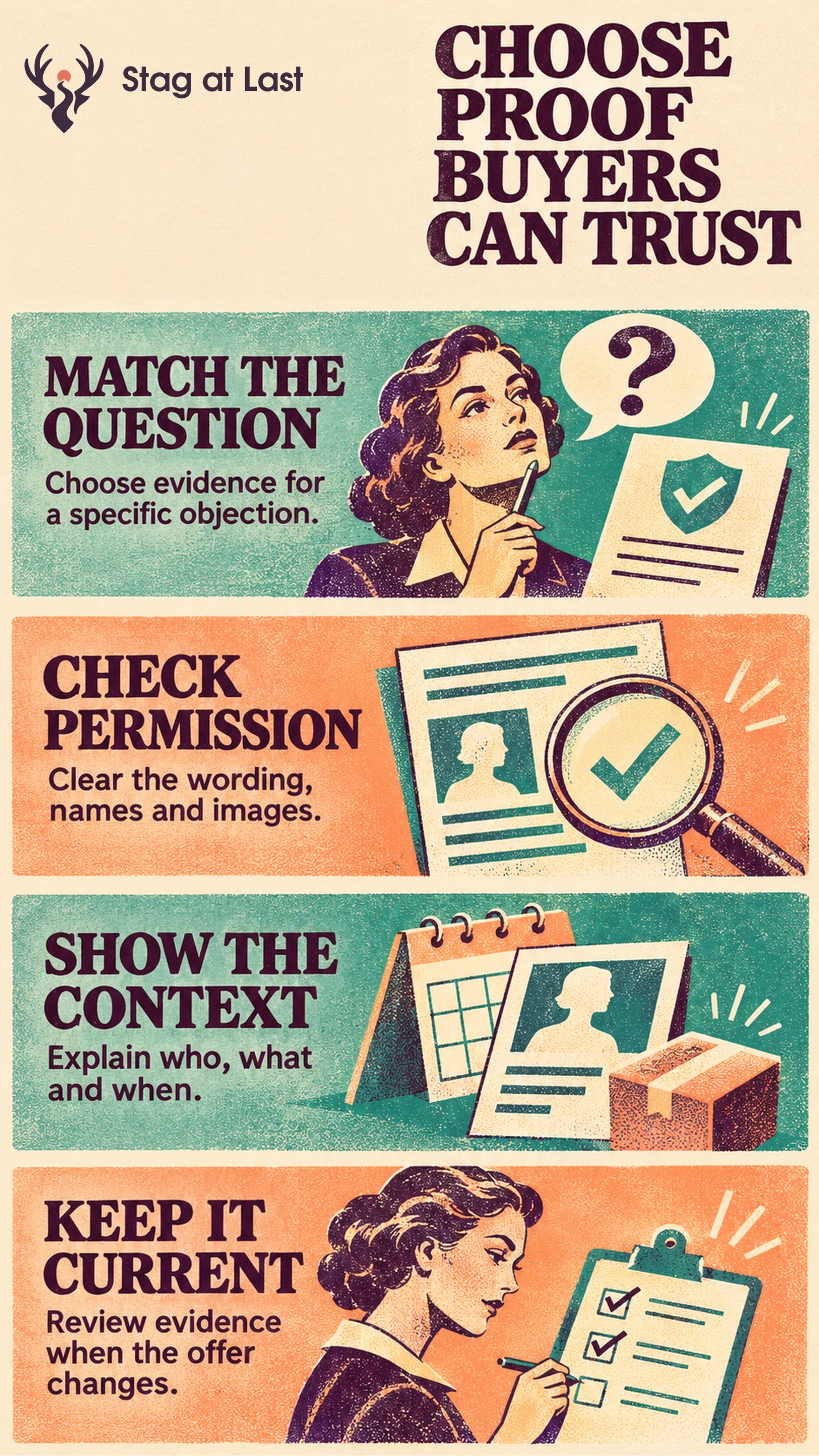
Credible social proof connects a real buyer’s question to genuine customer evidence. Choose the smallest piece of evidence that answers the question and preserve the context that gives it meaning.
- Identify the objection someone has before acting.
- Verify the source and obtain approval for the intended use.
- Display the evidence beside the relevant offer, claim or action.
- Recheck it when the offer or relationship changes.
Keep the approved version and a record of where it appears.
A landing page asking buyers to switch systems can answer a specific fear with a customer story about bringing over existing records. A row of familiar logos may establish recognition, but it gives the visitor little information about that migration. The buyer’s question should guide the choice of proof.
Start With the Buyer’s Objection
Read sales notes, support tickets and feedback for questions people ask before buying. A question about fit calls for evidence from a customer with similar circumstances. A question about installation calls for a description of what the installation involved. A performance question may require a verifiable source or method beyond an endorsement.
Suppose a hypothetical scheduling service serves clinics. Its buyers ask whether they can bring over recurring appointments. A short customer quote can confirm that one clinic did so. A linked case study can explain how its staff checked records and which appointments required manual work. The quote and case study should distinguish that clinic’s experience from the scope offered to the reader.
Clear the Asset Before Publishing
Ask for approval of the exact excerpt, attribution and placement before using a testimonial in a campaign. Identify the name, role, photo and company logo separately. Confirm who can approve each item, where it can appear, whether it can be translated and when the approval expires. Keep the source alongside the approved version.
Check the platform’s reuse terms for reviews collected elsewhere. In US advertising, the Federal Trade Commission distinguishes consumer reviews from testimonials and explains when a review featured in marketing becomes a testimonial. [1] Verify the applicable rights and requirements for the intended use.
Confirm that an excerpt preserves the original meaning. Check whether an incentive, employment relationship or other unexpected connection needs disclosure. The FTC’s US guidance explains material connections and when exceptional-result testimonials require information about generally expected outcomes. [2] If a testimonial implies a result buyers should expect, substantiate it as typical or clearly disclose what buyers generally achieve in the circumstances shown. Explain an unexpected material connection beside the endorsement where readers will notice it.
Show the Context at the Point of Decision
Use a short testimonial near the paragraph or action where it answers a question. Include the approved name or attribution, product or service context, and a link to the full account where possible. If the testimonial depends on a particular version or market, identify it in the visible copy.
Put a complex claim near the evidence needed to assess it. In a landing page hero, a short supporting detail can help frame the offer. Move a long case study into a later section and make it easy to reach. Keep the quote and disclosure legible on mobile and available as text.
Test Placement and Keep the Evidence Current
Start with three questions for a reader. What claim does this evidence support? Whose experience was it? What does it leave uncertain? Fix the wording if readers infer a guarantee or believe an old result applies to a different product.
To test placement, move the same approved quote, attribution and disclosure together. Hold the offer and action steady and use the same eligible audience and primary outcome definitions for both variants. Track downstream lead quality or returns where relevant. Assign an owner to recheck proof when an offer, attribution or permission changes. List each placement so that owner can remove or replace a stale claim across the campaign.
Review Proof Across Language Versions
If you are localizing a WordPress landing page, try StagLingo on a few pages. Check that the testimonial wording, attribution and disclosure still match what was approved in each version.
FAQs About Landing Page Social Proof
Can you put a public customer review on a landing page?
Check the platform’s terms, permission for the intended use and local advertising rules first. Preserve the review’s meaning, context and any relevant disclosure.
When should you use a case study instead of a short quote?
Use a case study when the result depends on method, starting conditions or implementation details. A short quote can introduce it where the buyer first encounters the question.
What if a new business has no testimonials yet?
Use other evidence you can substantiate, such as a product demonstration, sample output or clear service terms. Add customer evidence after you can verify and clear it.
Sources
[1] Federal Trade Commission. The Consumer Reviews and Testimonials Rule: Questions and Answers
[2] Federal Trade Commission. FTC’s Endorsement Guides: What People Are Asking