
Quick Answer: When Should You Use NPS, CSAT or CES?
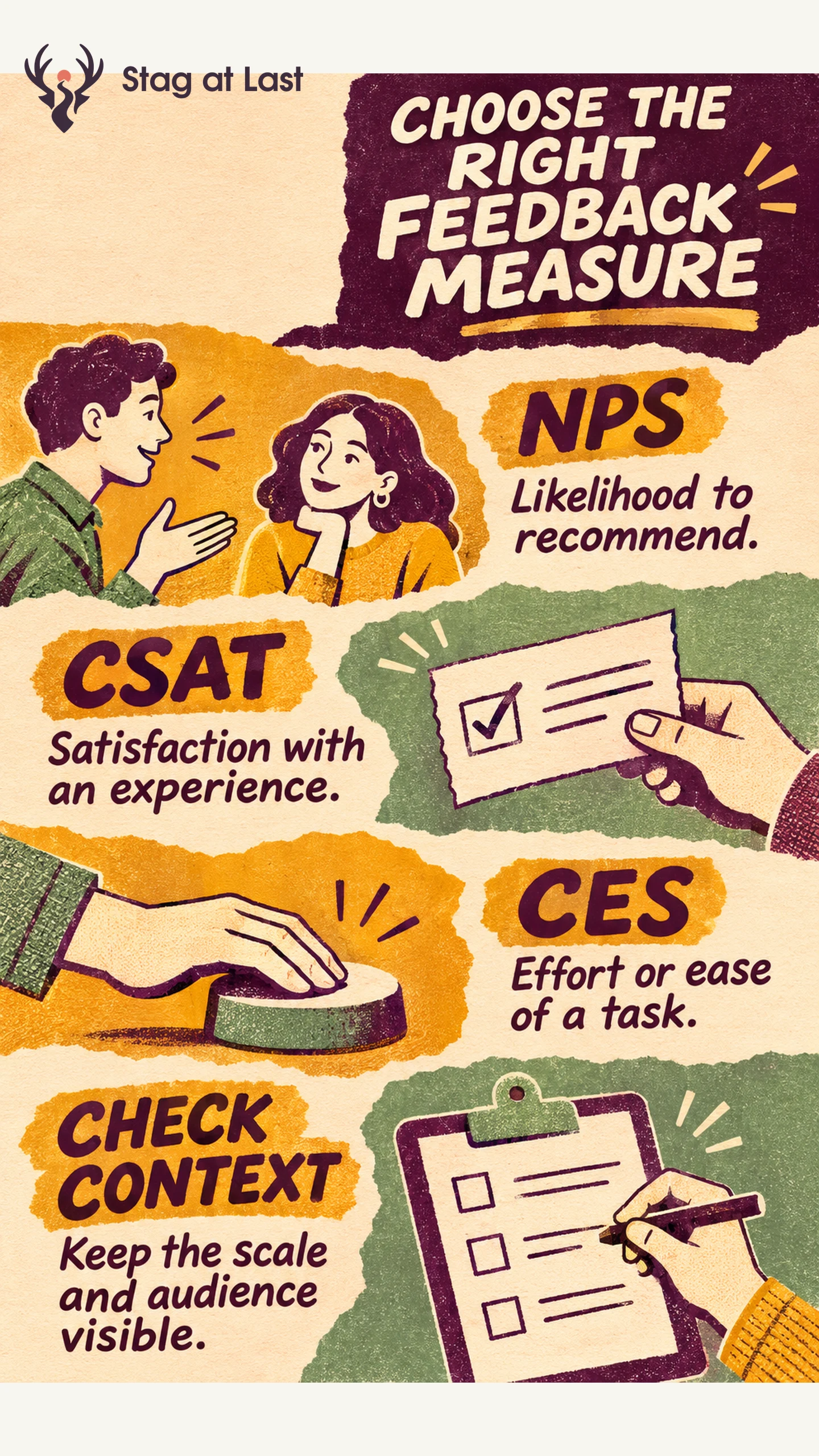
Use Net Promoter Score (NPS) for likelihood to recommend, Customer Satisfaction Score (CSAT) for satisfaction and Customer Effort Score (CES) for perceived effort or ease. Pick the measure that answers the decision you need to make.
| Measure | Question it answers | Good moment to ask |
|---|---|---|
| NPS | How likely are customers to recommend us? | A consistent relationship survey point. |
| CSAT | How satisfied were they with this experience? | After a defined interaction. |
| CES | How easy or difficult was this task? | After an attempt, where you can reach the user. |
Keep question wording, scale, trigger and scoring consistent when comparing groups or periods.
A customer can be satisfied with a support agent and still find the refund process difficult. Someone can also recommend a product while disliking a specific workflow. A feedback score is useful when the question identifies which decision the team can make.
Choose the Question That Matches the Decision
Use NPS when you want a consistent recommendation measure for a product or relationship. Use CSAT when you need feedback on a named experience, such as a resolved support interaction. Use CES when you need to understand the effort of a task, such as updating billing details. Keep the wording focused on one experience at a time.
For a hypothetical invoicing product, the team wants to know whether people can correct an invoice. An ease question about that task gives a clearer signal than a general recommendation question. Pair it with correction errors and successful completions. If the question is whether people liked the help they received, use satisfaction with that interaction instead.
Calculate Each Score on Its Own Scale
Bain’s NPS method uses a 0 to 10 recommendation scale. Subtract the percentage of valid respondents scoring 0 to 6 from the percentage scoring 9 or 10. [1] Responses of 7 or 8 stay in the denominator as passives. In a hypothetical wave with 100 valid responses, 50 promoters and 20 detractors give an NPS of 30. Report it as a score from -100 to 100, without a percent sign.
A common 1 to 5 CSAT method counts ratings of 4 or 5 and divides by all valid answers to that question. [2] If 42 of 60 valid responses are positive, the illustrative CSAT is 70%. Identify the scoring rule because a mean satisfaction rating is a different summary.
Qualtrics describes a CES method based on the mean response. [2] On a hypothetical 1 to 7 scale from very difficult to very easy, a total of 135 across 30 valid answers gives a mean of 4.5 out of 7. With those labels, a higher score indicates greater ease. A scale where higher means more effort points in the opposite direction.
Keep the Respondent Population Visible
Store the question, response labels, trigger, period, eligibility and scoring rule with the result. Report valid answers and the number invited if known. Identify the unit. Ten responses from one company do not represent ten independent accounts. If you need an account-level view, decide how to handle multiple responses before collecting them.
A post-success prompt may miss people who failed or left early. Compare who could answer with who actually did. Where appropriate, offer a short follow-up to people with failed attempts and report that group separately. Compare equivalent groups and response conditions before interpreting a score change.
Decide What to Do With the Feedback
Ask one optional follow-up question about the reason for the answer. Group comments by task and check them against observed outcomes. In the invoice example, separate permission problems from unclear labels. Give the finding to the owner who can test a fix, using the marketing and success handoff when the issue affects a particular account.
Use churn interviews for deeper evidence about a departure. Keep advocacy participation separate from feedback collection. A strong recommendation score alone gives no approval to quote someone or use their identity.
Check Survey Language on Your Site
If feedback starts on a multilingual WordPress site, evaluate StagLingo on a representative invitation or help page. Check the question and scale labels in each language before comparing responses.
FAQs About NPS, CSAT and CES
Can you combine the three scores?
Keep separate scores with their own definitions. You can report shared themes across them, but a combined number can hide which experience changed.
Is a high CES always good?
Check the labels. A high rating can mean a task was easier on an ease scale, or harder on an effort scale. State the direction alongside the score.
Should you survey only people who completed a task?
A completion-only survey can describe people who finished. If the decision concerns barriers, find a suitable way to hear from people who failed or abandoned the task and report that coverage.
Sources
[1] Bain & Company. Measuring Your Net Promoter Score
[2] Qualtrics. Customer Experience Benchmarking