
Quick Answer: How Do You Research Value-Based Pricing?
Research value-based pricing by comparing your offer with what a specific buyer would do instead. Estimate the difference in outcomes, then test what the buyer will commit to for a defined package.
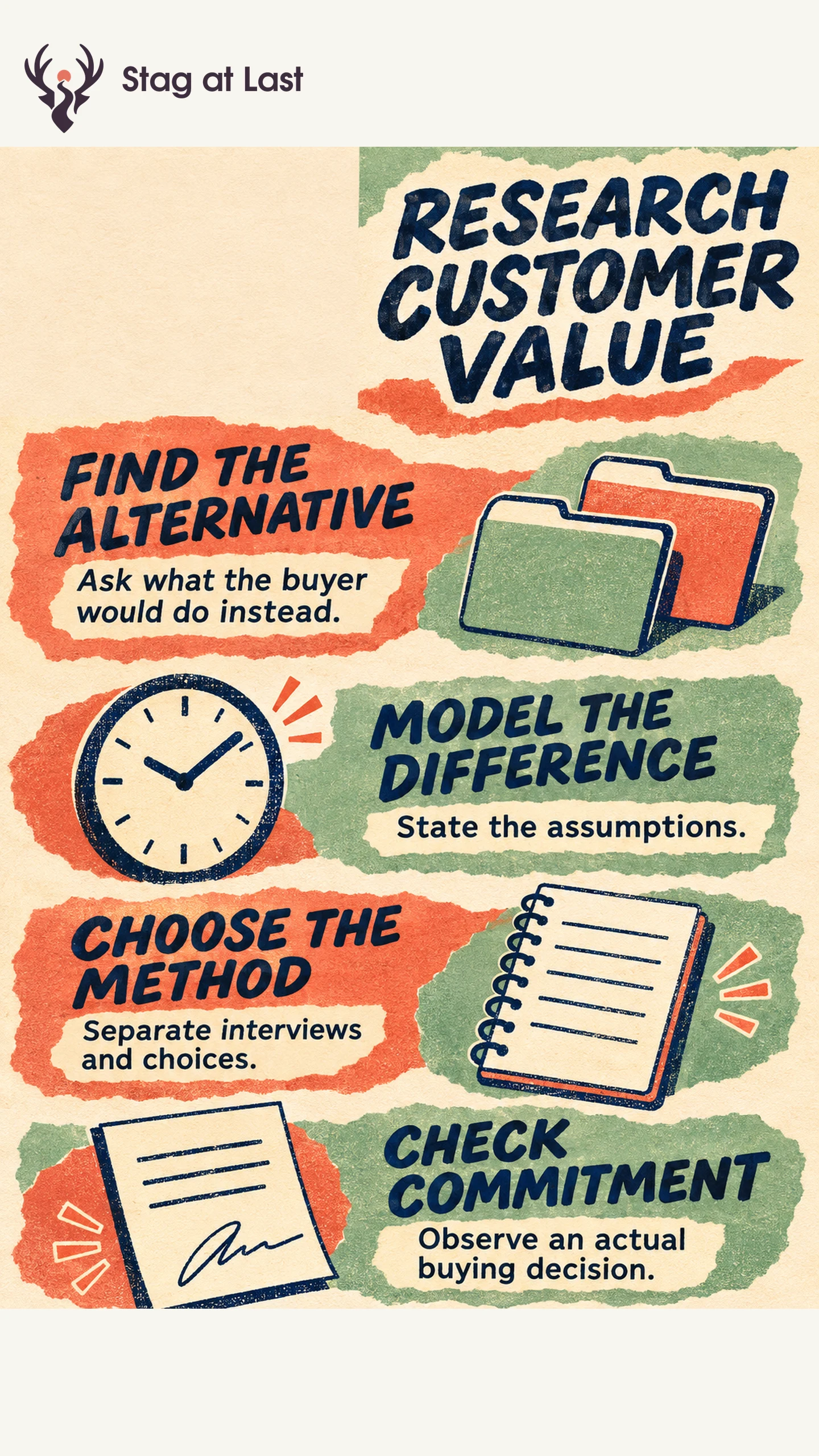
- Find the alternative. Ask about the last purchase or the workaround the buyer uses now.
- Model the difference. Compare costs and outcomes over the same period, including implementation effort.
- Match the method. Use interviews for context and structured choices for tradeoffs.
- Check commitment. Bring a concrete offer to the budget owner and record what they accept or decline.
Keep observed spending, modeled value and stated willingness to pay in separate fields.
A buyer can save time with a product and still decline its price. They may have a cheaper alternative, no budget this quarter or little confidence that the savings will carry over. Good value research makes each of those explanations visible.
Find the Alternative the Buyer Would Choose
Interview people who recently solved the problem, considered buying or decided to do nothing. Include the person who uses the product and the person who approves the spend when they differ. Ask what triggered the decision, which options made the shortlist and what they paid or spent in effort. Use the most plausible substitute for that buyer, even when it is a spreadsheet or an existing supplier.
Andreas Hinterhuber’s economic-value framework combines the price of the customer’s best alternative with the value of differences between offers. [1] Use that structure to compare the same outcome over the same period. Add advantages the buyer values and subtract disadvantages such as switching work or an extra service contract.
Model the Difference With Explicit Assumptions
Keep a record for each segment. For every benefit, write the source, the assumptions and what would make the estimate smaller. Separate a cost the buyer could actually remove from capacity that becomes available for other tasks.
Consider a hypothetical document approval tool. A buyer estimates four hours per month for approval follow-ups and review today. At the same workload, the new process is expected to take one hour per month for those tasks. The estimate is three hours saved per month. At an assumed US$35 per hour, that represents US$105 of monthly staff capacity before implementation costs. It is a model of capacity, and may leave payroll unchanged. The buyer’s willingness to pay also depends on whether they can use those hours elsewhere, what alternatives cost and who owns the budget.
Match the Research Method to the Decision
| Question | Evidence to collect | Limit to keep in view |
|---|---|---|
| What makes the outcome valuable? | Recent buyer interviews and task examples | A small sample may miss important segments. |
| Which features justify a tradeoff? | Structured choices between comparable packages | Stated choices depend on the scenarios presented. |
| Will someone approve the offer? | A buyer’s response to a real quote, an agreed paid pilot or a completed purchase | A single deal may reflect special terms or timing. |
SurveyMonkey describes conjoint analysis as a method for weighing price against other product features. [2] Use a choice study when buyers can understand the options and the decision is about packaging tradeoffs. Keep a credible outside option when people could keep their current approach. Avoid interpreting a hypothetical choice as an order.
Test the Offer With the Person Who Can Buy
Write a realistic offer with the outcome, scope, price, billing unit and what onboarding requires. Ask the buyer what approval would be needed, which alternative they would give up and what would make them decline. An agreed paid trial provides evidence that this buyer accepts the trial terms. Check whether they are also willing to buy the ongoing offer.
Build a value record with four fields before choosing a test price. Include the alternative, the evidence behind the difference, the uncertainty and the next buying decision you can observe. Check your unit contribution and required volume separately. If the price the segment accepts cannot support the offer, revisit scope, delivery cost or the segment.
Check the Value Proposition Across Languages
If you present the offer on a multilingual WordPress site, evaluate StagLingo on one offer page and its supporting example. Verify that limits, units and assumptions remain clear in each language.
FAQs About Value-Based Pricing
Is customer value the same as willingness to pay?
No. Value is the benefit the customer receives relative to an alternative. Willingness to pay depends on their budget, preferences, confidence and available options.
What if the benefit is hard to put in dollars?
Describe the effect in units the buyer recognizes, such as review time, fewer handoffs or faster approval. Leave it in those units if conversion to money would require weak assumptions.
Do you still need to check your own costs?
Yes. Customer research helps explain the offer the market might accept. Use your cost and capacity estimates to check whether you can deliver it sustainably.
Sources
[1] Andreas Hinterhuber. Towards Value-Based Pricing
[2] SurveyMonkey. How to Use Pricing Surveys