
Quick Answer: Should You Offer Freemium or a Free Trial?
Choose freemium when an ongoing free workflow is useful and affordable to support. Choose a free trial when users can evaluate the paid workflow within a clear window. For either model, explain what users keep and what changes when free access ends or hits a limit.
| Entry model | Good fit | Check first |
|---|---|---|
| Freemium | A useful repeatable task fits in a limited free plan. | Free usage cost and a genuine reason to upgrade. |
| Free trial | Users need temporary access to a paid workflow. | Whether they can reach the intended result before expiry. |
Compare the two on paid outcomes and cost over the same follow-up period, with signup conversion tracked separately.
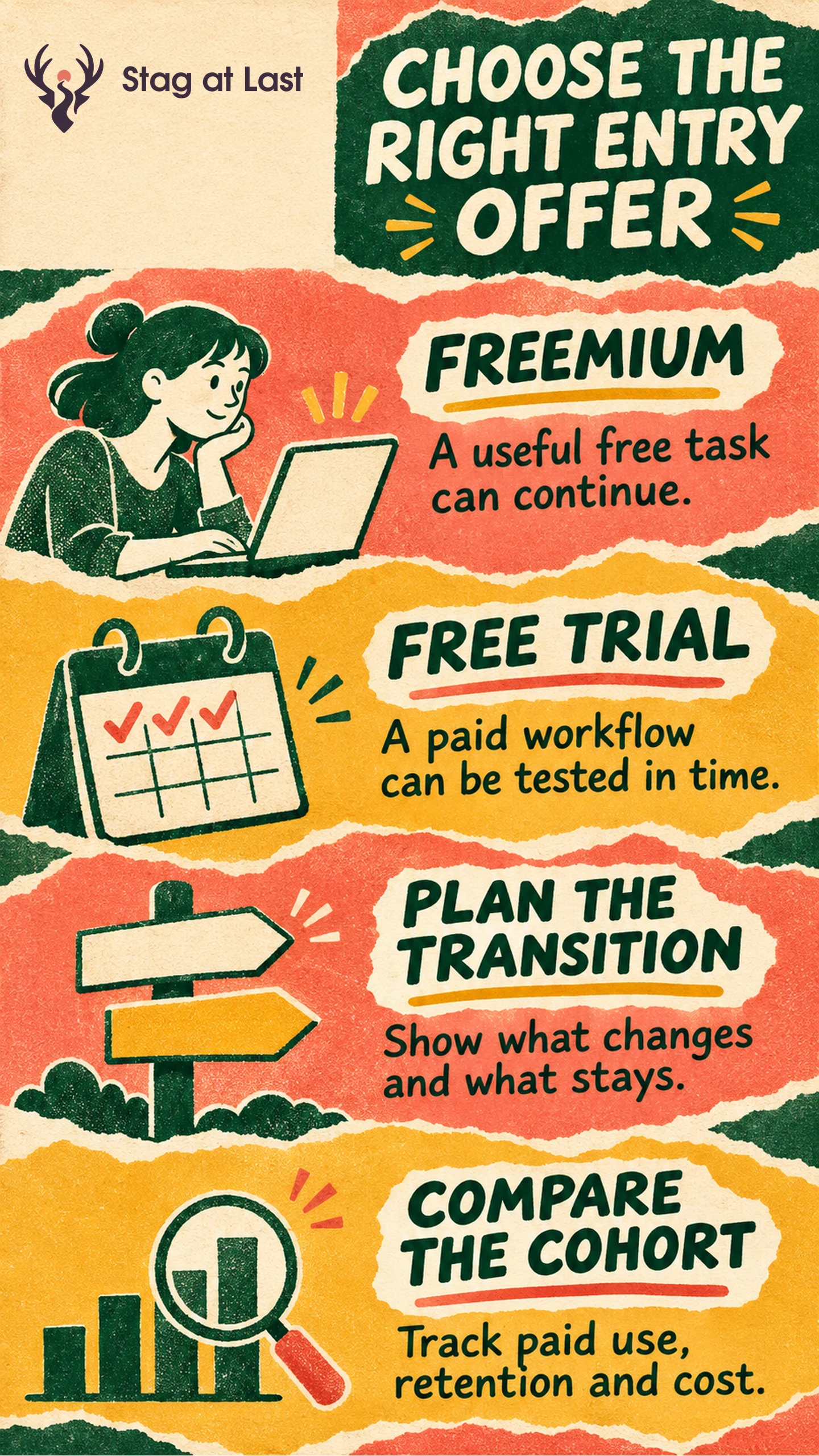
The entry offer shapes what someone learns before buying. A free design workspace can let a team complete smaller jobs for months. A trial can let a buyer test a costly premium workflow for a limited time. Start with the task you need the customer to evaluate, then decide how long and how much of it to provide.
Define What the User Can Finish Before Paying
Freemium provides an ongoing free tier with limits on features, capacity or usage. A free trial provides time-limited access to a specified feature set. Either can coexist with a paid plan. The quality of the evaluation depends on what the user can finish with the access available.
Imagine a design tool where people can create and download a small number of proofs each month. That is a complete task for an occasional user. A team might upgrade for shared libraries or advanced export. If free users are costly to serve and buyers mainly need to evaluate high-resolution rendering, a bounded trial of that workflow may fit better. Confirm that the trial output lets buyers judge the product using their own requirements.
Compare Evaluation Time and Cost to Serve
Map the earliest useful outcome and the prerequisites for getting there. A trial can work well when users arrive with a live task and can complete it before expiry. When reviews require an admin, sample files or a colleague, observe where that time goes. An assisted demo or sandbox can be more practical if those dependencies make self-serve evaluation unrealistic. Use time to value to separate setup delay from the real task.
For freemium, estimate ongoing storage, compute, support and abuse handling at the expected usage mix. For a trial, include onboarding and support during evaluation and the cost of any data retained after expiry. Set the free limit where the user’s task still works and your serving cost remains manageable. Put sustained collaboration or higher capacity in paid packaging when those capabilities solve a distinct need.
Design the Transition Out of Free Access
Tell users what will happen before they commit. For a free tier, explain what counts against a limit and what happens when they reach it. For a trial, show the end date, paid terms if applicable, the cancellation or downgrade route and what happens to data. If the trial falls back to a free tier, show which assets remain usable and which premium actions stop.
Stripe’s embeddable pricing table documentation describes a trial option that can start without collecting a payment method. [1] Payment collection is a separate design choice from the feature set and duration. Verify the actual billing and access behavior in an approved test environment. Walk through signup, early cancellation, expiry and the return path for a user who later upgrades.
Test the Entry Offer on a Comparable Cohort
Start with one comparable audience. Define the first useful result and give signups the same follow-up period from first access. If the entry offers appear before signup, compare all eligible visitors by assigned offer over the same period from assignment, including people who never sign up. The signup view helps diagnose onboarding. The visitor view includes changes in willingness to sign up.
Record paid accounts, recurring use, cancellations and the variable costs of serving each cohort. Give the trial cohort enough time to reach expiry. For a separate descriptive view of retention among payers, compare accounts at the same age since paid access started. Where feasible, assign offers randomly at the level that prevents the same team receiving two different terms. If the results favor a higher-converting offer with higher costs or shorter paid retention, review contribution before expanding.
Check Entry Terms in Each Site Language
If your offer lives on a multilingual WordPress site, evaluate StagLingo on the pricing and trial terms pages. Check that the limits, end date and next action read consistently in each language.
FAQs About Freemium and Free Trials
Can a free trial lead into a free plan?
Yes. A trial can start with temporary premium access and then fall back to an ongoing free tier. Explain the fallback and test which features and existing work remain available.
Should a trial collect payment details upfront?
Consider how payment collection affects who starts the trial and what happens when it ends. Make the terms visible and test both the enrollment and exit paths before comparing outcomes.
How long should a free trial last?
Give the intended user enough time to complete a representative workflow, including normal setup or approvals. Use observed delays and repeat use to choose a window rather than copying a standard number of days.
Sources
[1] Stripe Documentation. Embeddable Pricing Table for Subscriptions