
Quick Answer: What should a low-traffic website do before running an A/B test?
A low-traffic website can improve conversion by verifying its measurements, watching real customers attempt a task and fixing problems it can reproduce. Use an A/B test when enough eligible traffic can answer the decision within a useful period.
- Check that accepted orders or enquiries are recorded correctly.
- Look for barriers in real visits, support questions and task sessions.
- Fix known failures and retest the whole journey.
- Estimate the traffic required before comparing uncertain alternatives.
Treat before-and-after results as observations when traffic and conditions can change.
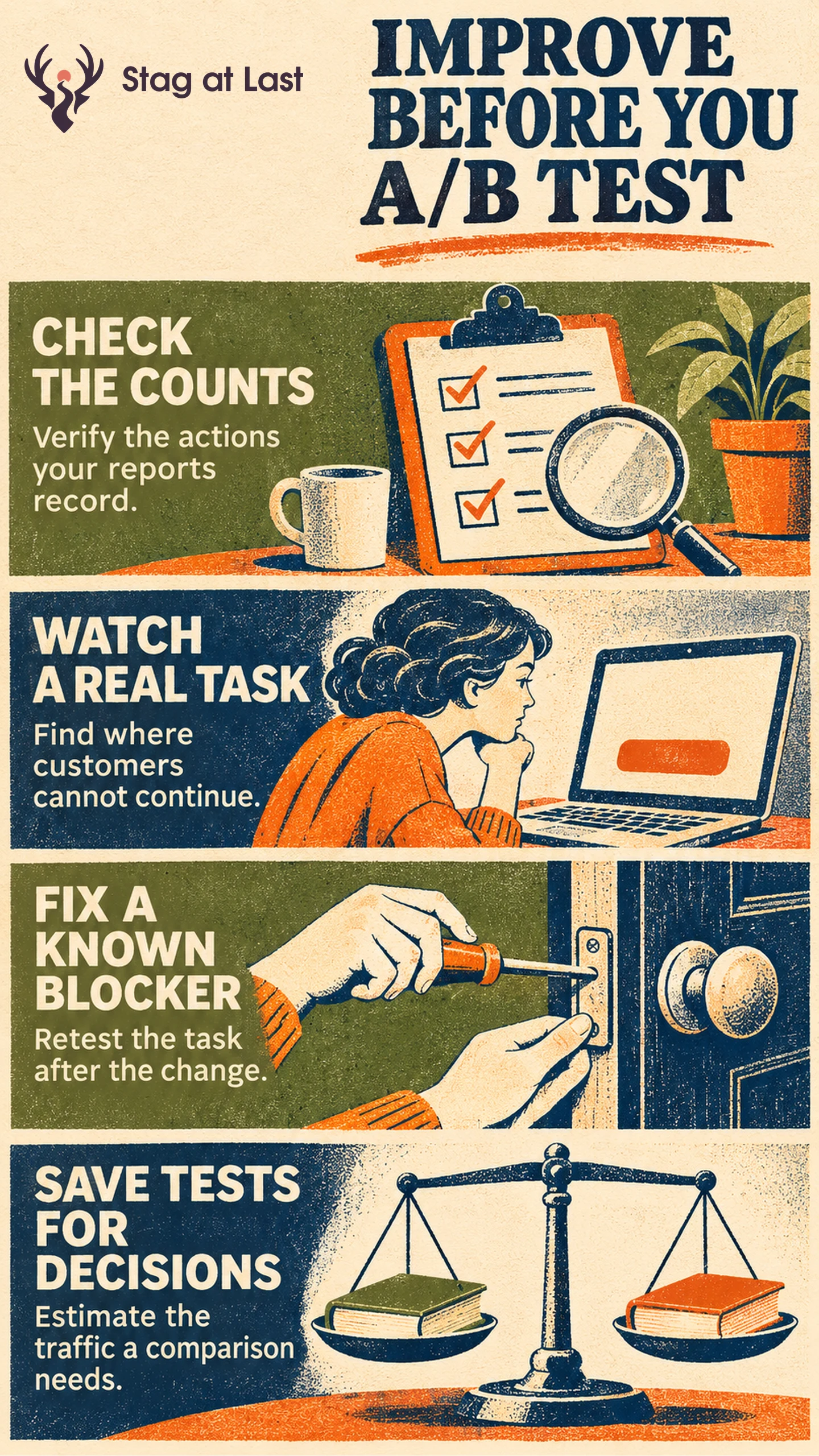
Conversion rate optimization (CRO) can start with a broken quote form or unclear service terms. A small website does not need a randomized experiment to confirm that a specific browser cannot submit a valid request. It does need a reproducible check to distinguish that failure from a weak offer or a reporting problem.
Verify the Outcome You Are Counting
Name the result the site needs, such as an accepted booking, completed purchase or qualified enquiry. Submit a representative test and trace it into the business record and reporting system. If analytics counts every confirmation page refresh, repair the count before comparing rates.
Check eligible traffic by page, device and source. A small number of different visitors can make percentages jump. Review counts and eligibility definitions alongside rates. Changing a reporting filter or business definition can look like a conversion change even if the website behavior stays the same.
Observe a Real Task and Classify the Problem
Ask likely customers to attempt the task with typical information and a realistic goal. The GOV.UK Service Manual recommends designing credible moderated usability tasks without revealing the answer. [1] Note what participants tried, where they stopped and whether the issue reproduced in the real flow.
In a hypothetical case, a mobile visitor enters a valid postcode but receives an error because a space is rejected. On the affected browser, test both supported forms of a valid postcode and one invalid value. Verify that valid requests reach the receiving system and the invalid value produces a useful correction. Record the cases and browsers covered by the retest. If shoppers instead hesitate because the site gives no delivery date, record what information they need and test a prototype that explains it. The first case needs a repair. The second may involve a design choice.
Fix Confirmed Defects and Retest
Prioritize blockers you can verify and changes with a clear expected state. Improve error recovery or correct an incorrect price before debating copy variants. Keep a dated record of what changed, what was checked and how to reverse the change if needed.
Retest the full path and check that the customer receives the correct result. Read sales and support outcomes after the release and note shifts in traffic, availability or promotions. Use those observations to decide where to investigate. A higher rate after a release does not show how much of the change the release caused.
Run an Experiment When It Can Resolve a Decision
For competing designs, estimate a sample size using the baseline, decision threshold and eligible traffic. Estimate enrollment from eligible units you can assign each week, then add time for the last group to complete its outcome window. If assignment happens before the action, keep all eligible assigned units in the analysis. If the required time is too long, narrow the decision or choose a reversible change informed by task research. Document the uncertainty that remains.
When a change is large enough to measure and the site can run a concurrent comparison, use a planned A/B test with valid assignment and a business outcome. Save thin traffic for choices where extra evidence could change what you do.
Check a Localized Journey Before Testing
If you are improving a multilingual WordPress site, evaluate StagLingo on a small set of pages. Run the same enquiry or purchase task in each language so you can see where visitors get stuck.
FAQs About CRO for Low-Traffic Websites
How much traffic is too little for an A/B test?
There is no universal cutoff. Use your baseline, smallest worthwhile effect, historical variance and eligible traffic to estimate time and sample requirements.
Can you learn from a before-and-after comparison?
Yes. Compare similar periods and note other changes. Use the result to identify questions or problems for follow-up. Treat it as observational evidence.
Should you test a proven technical defect before fixing it?
Repair a confirmed defect and verify the previously failing task. Use a test when deciding between viable designs and the evidence could change your choice.
Sources
[1] GOV.UK Service Manual. Using moderated usability testing