
Quick Answer: How Do You Run Clearance Without Damaging Trust?
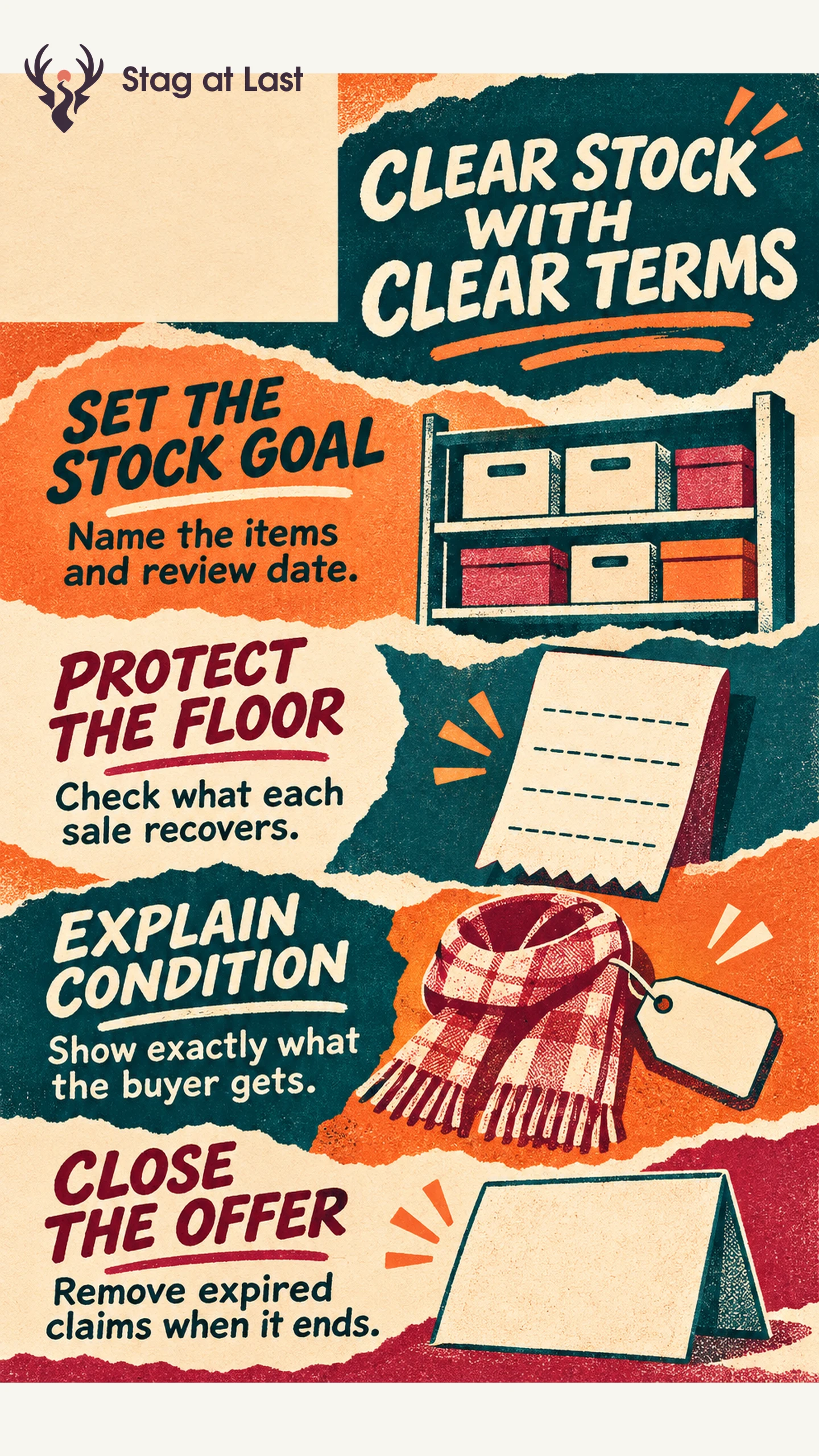
Run clearance around a defined stock goal. Select the affected variants, set a minimum acceptable recovery and explain the real reason and terms. End the offer when the allocated stock or campaign window is exhausted.
- Record sellable units, exclusions and the inventory target.
- Choose an opening price, a floor and a review date.
- Explain condition, contents and return terms before purchase.
- Track net units moved and retire expired messaging.
Use truthful price references and let shoppers see which items the offer actually covers.
A store has boxes of a previous-season scarf color. The product is new, and the current colors are still selling normally. A specific clearance offer can move the older color without making buyers wonder whether the entire collection is discounted or whether the scarf has a defect.
Define Which Stock Needs to Move
Write down the affected variants, available quantity and reason for clearing them. An end-of-season color, an older model and an open-box product need different descriptions. Use a quantity that has been released for sale after returns, inspections and other channel allocations. Keep the rest of the active assortment out of the offer if it serves a different purpose.
Set the goal in units and time. A hypothetical store starts with 120 sellable scarves and wants no more than 30 left after two weeks. With no replenishment or transfers, it needs to sell 90 units net of returns to saleable stock. If some stock is moved or written off, record those separately from sales.
Set a Price Floor and a Review Date
Compare what a sale would recover after discounts, shipping, fees and expected returns with the realistic alternatives, such as holding the stock or moving it to another channel. For already purchased inventory, make the treatment of acquisition cost explicit. If the purchase cost is already paid and the decision cannot change it, keep it out of the future cash-flow comparison. Show the accounting impact separately.
Set the first markdown and review it against the stock goal at a preselected time. If sell-through is slow, check product exposure and availability before cutting the price further. If the price reaches the floor, use the agreed alternative instead of extending the offer by default. Your promotion plan can record the margin boundary and change owner.
Explain Why the Item Is in Clearance
Use a factual reason buyers can understand, such as “previous-season colors” or “open box with all listed accessories included,” when that is accurate. Show the exact variant, condition and included items. State any return limits near the buying action and verify they are compatible with the rules that apply to the buyer and product.
Use a time limit only when the offer genuinely ends then. The U.S. FTC’s report on dark patterns identifies countdown timers for offers without a real time limit as misleading design. [1] Use stock statements you can support, and check any former-price claim against the actual offer history. Give shoppers the current price and eligible items in the same message.
Close the Campaign and Record What It Changed
Track net sellable units remaining, cash recovery after variable sale costs and customer contacts about condition or terms. In the scarf example, selling 84 net units leaves 36. If your target is 30, review the remaining six-unit gap and compare the cost of another markdown with the planned alternative.
End the campaign at the stated time or when the allocation sells through. Retire expired ads and banners. Update the collection and any destination linked from emails already sent so shoppers see current availability. Use the seasonal calendar to schedule the final inventory check and apply the results to next season’s order.
Check Clearance Details Across Languages
If the clearance collection runs on multilingual WordPress, verify item condition, included parts and return terms in each version. Include those checks when evaluating a translation workflow.
FAQs About Clearance Marketing
Does clearance always mean a product is discontinued?
No. A retailer might clear a color, an older version or excess stock while continuing to sell other variants. Explain the actual reason and which items qualify.
Can I mark clearance items as final sale?
Use final-sale language only if it accurately describes the applicable terms and respects any rights that apply. Show the conditions before payment and verify that support can explain them.
Should I keep a clearance page after the items sell out?
Keep the page if it still helps visitors, with an accurate stock message and suitable alternatives where relevant. Remove any promotion that implies a sold-out item is available.
Sources
[1] U.S. Federal Trade Commission. FTC Report Shows Rise in Sophisticated Dark Patterns