
Quick Answer: How Do You Run a Customer Churn Interview?
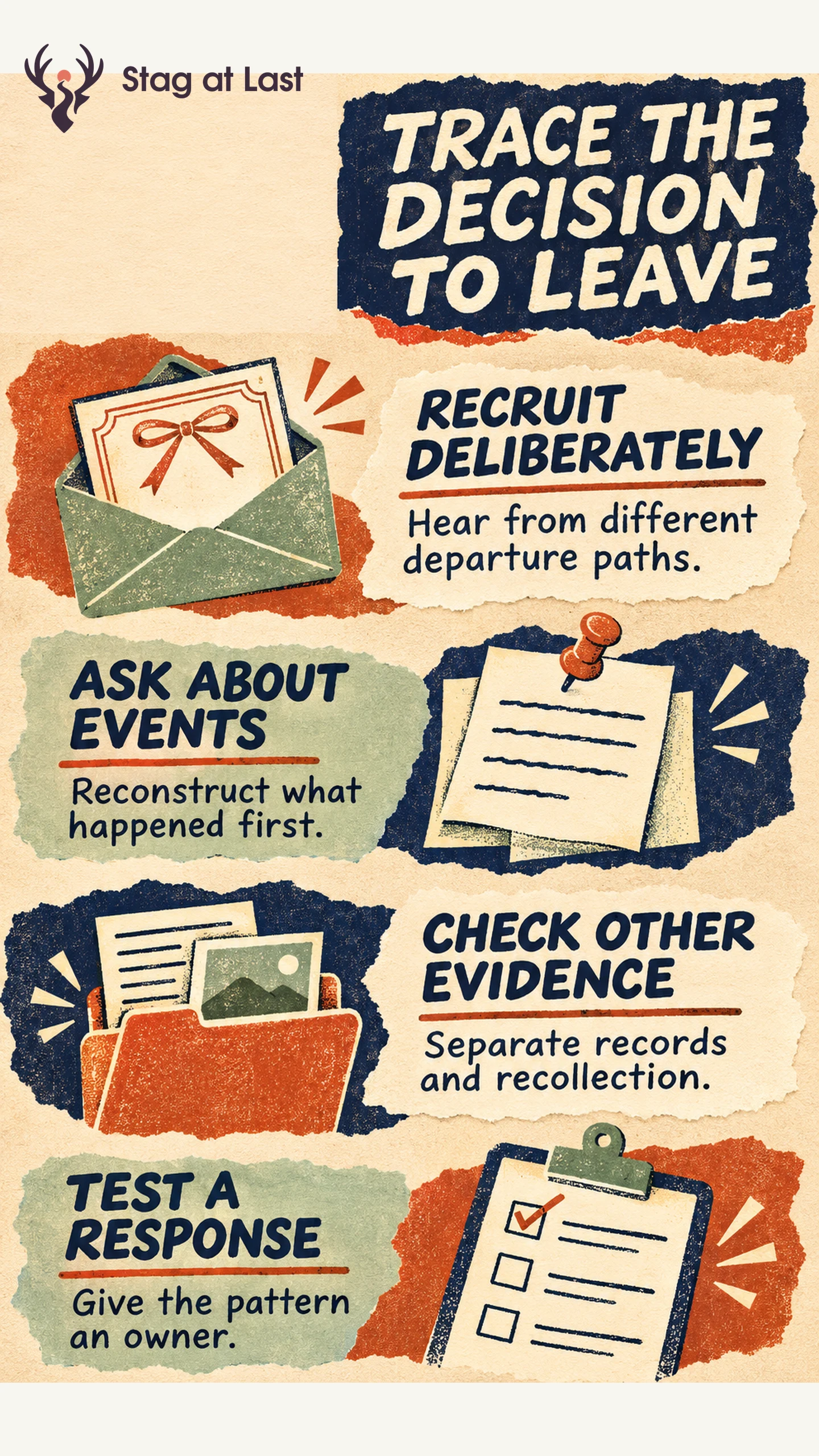
Use a churn interview to reconstruct the decision to leave. Ask about the original job, the first problem, what the customer tried and what finally changed. Compare the account story with records before choosing a fix.
- Recruit deliberately. Include former customers with different tenure, use and departure paths.
- Ask about events. Use neutral questions about a specific period and decision.
- Check other evidence. Separate what the customer recalls from what records confirm.
- Test a response. Assign the most actionable pattern to an owner and choose a result to check.
Keep participation optional and make sure the research does not delay cancellation or support.
A cancellation form says “too expensive.” That can mean the customer lost budget, never reached the expected result or switched to an offer with a better fit. An interview helps distinguish those paths by tracing the work, the alternatives and the final decision.
Recruit for the Decision You Need to Understand
Define whether you are studying voluntary cancellation, failed renewal, downgrade or another departure. Keep involuntary payment failures distinct when they involve a different decision. Choose a period, then recruit across relevant plans, tenure and product usage. If the person who used the tool differs from the person who canceled it, consider interviewing both with their agreement.
Describe the session’s purpose and expected time. Explain how notes and recordings will be used and who can access them. Obtain agreement before collecting either, and let participants decline recording separately. Keep the interviewer focused on learning. Route any account request to the right owner separately. Use survey results and cancellation tags to help select whom to interview, while tracking who declines or cannot be reached.
Reconstruct the Timeline Before Asking for Causes
The GOV.UK Service Manual recommends open, neutral questions and a focus on actual stories and examples in in-depth interviews. [1] Ask the participant to describe a recent instance of the task before suggesting explanations.
- Original job. What were you trying to do when you first chose the product?
- First signal. Can you walk me through the first time you considered leaving?
- Attempted recovery. What did you try next, and what happened?
- Decision. Who made the final decision, and what alternatives did they consider?
- Afterward. How are you doing that work now, if you still do it?
When someone cites price, ask what they were comparing and when the cost became difficult to justify. Avoid turning a specific incident into a leading question about price, product quality or service.
Compare the Account Story With Other Evidence
Write a timeline with reported events, supporting records and open questions. In a hypothetical example, a team selects price on the form. In the interview, it says its manager questioned renewal because monthly reports kept failing. If product records confirm failed reports and a support ticket predates renewal, the team has a stronger reason to examine delivery than the form alone provided. A budget change could still be part of the decision.
Where permitted, use relevant records to check dates and events. Missing telemetry can mean an untracked route or a recording gap. Give the customer’s explanation its own field rather than overwriting it with a system observation.
Turn the Findings Into a Follow-Up Test
Group interviews by mechanism, such as missing approval, delivery failure or a budget change. Record the number interviewed and relevant groups you did not reach. Interview themes are leads for investigation. Estimating how common a cause is needs data with suitable coverage.
Assign one pattern to the team that can test it. If delivery repeatedly failed, verify the failure path and test the change against successful deliveries and support requests. If the renewal notice was unclear, check the billing communication and actual invoice before changing the offer. Use the handoff between customer marketing and success to resolve individual cases without treating a research invitation as a sales prompt.
Check the Research Invitation Across Languages
If participants read study information on a multilingual WordPress site, evaluate StagLingo on the invitation and participation pages. Check that purpose, choices and contact details are clear in each language.
FAQs About Customer Churn Interviews
When should you interview former customers?
Reach out while the events are reasonably fresh and the customer can participate without pressure. Set a consistent window for the study and respect contact preferences.
Who should conduct the interview?
Use a trained interviewer who can ask neutral questions and listen without defending the product. Where possible, separate the interview from account negotiation or a renewal conversation.
What if only a few former customers respond?
Report who responded and what you heard, then compare the themes with other evidence. Treat a small, self-selected sample as a way to find hypotheses rather than estimate rates.
Sources
[1] GOV.UK Service Manual. Using In-Depth Interviews