Public release number
Numbers such as 1.1.3 identify the installed plugin release. Use this number
when checking compatibility, reporting an issue, or confirming an update.

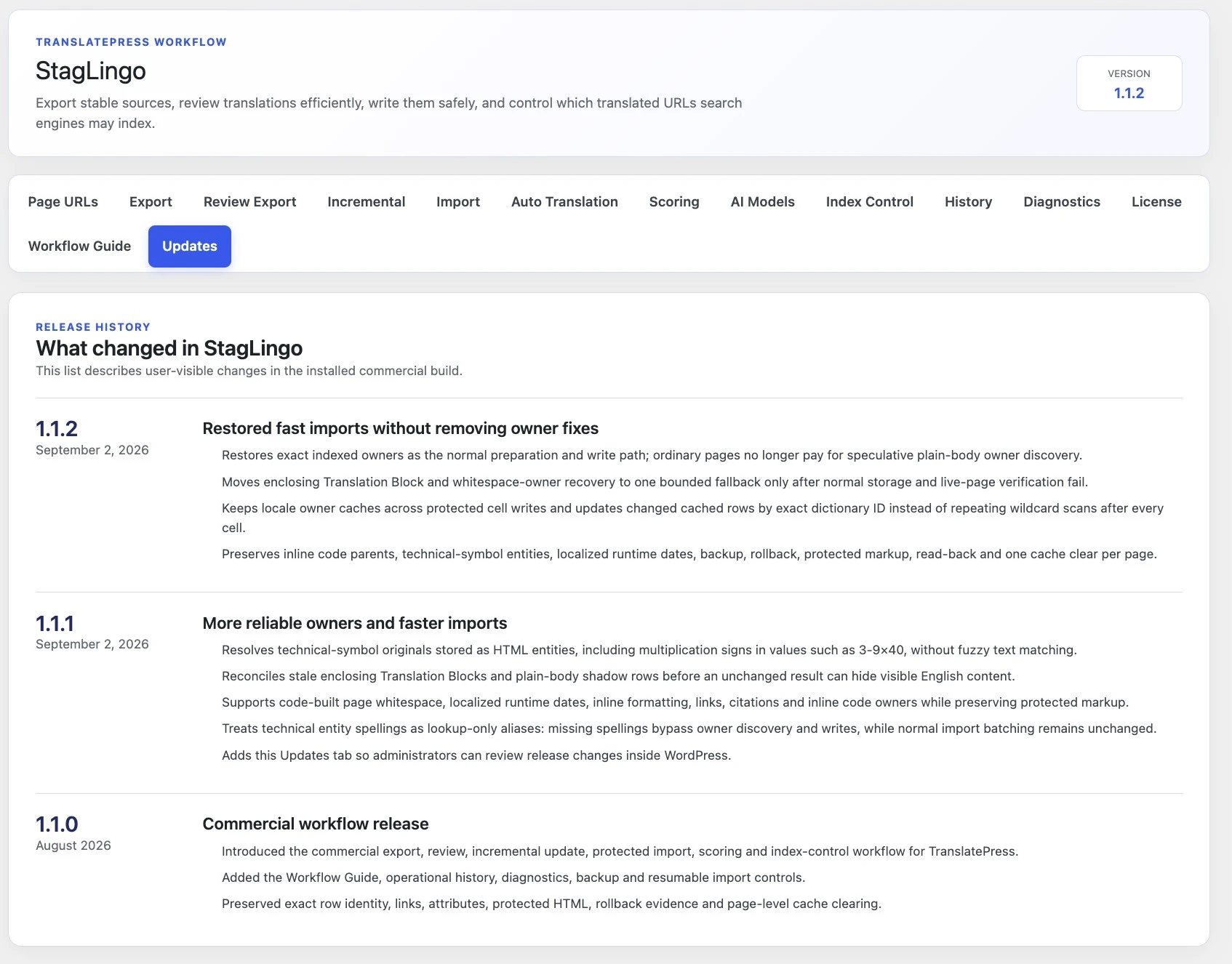
Follow changes to import reliability, export and review packages, translation workflows, indexing controls, AI integrations, licensing, and the safeguards used when StagLingo writes reviewed content into TranslatePress.
Package filenames may include internal build or review labels. The semantic version shown on the Plugins screen and inside StagLingo is the version to compare with these notes.
Numbers such as 1.1.3 identify the installed plugin release. Use this number
when checking compatibility, reporting an issue, or confirming an update.
Labels such as r5 or a descriptive fix name can identify a submitted or tested
package. They do not replace the plugin version declared in WordPress.
Check Plugins → Installed Plugins or the StagLingo interface. Premium customers should download current packages and manage licenses through My Account.
Resumable import recovery for cached older browser assets.
Durable job creation and smaller preparation phases before protected writes begin.
Introduced in-product workflow guidance without changing translation runtime behavior.
The first public StagLingo release under the Stag at Last product identity.
These releases established automatic translation, package layouts, page-level index control, automatic Incremental discovery, and the protected runtime later carried into version 1.0.
This period focused on resumable and serial imports, protected package transport, storage verification, performance, dynamic content owners, Review Export, and AI-ready work packages.
0.34.0–0.34.12 and 0.34.34–0.34.69. The packaged changelog contains the individual owner-resolution and verification fixes for every patch.
Earlier versions established the rendered-page extraction model, exact source identity, protected two-stage imports, Review Export, dynamic TranslatePress ownership, and live verification.
Added multiple export layouts, file-level History, TXT/DOCX Review Export, protected parent HTML for inline links and dynamic titles, and repairs for runtime-generated owners.
Introduced cell-level quarantine and transactions, targeted attribute ownership, runtime Translation Block materialization, post metadata handling, content presets, and stable TOC anchors.
Improved dynamic title and attribute ownership, case-sensitive source matching, stale-source collision detection, exact DOM verification, source-language isolation, and page-region selection.
Separated validation from live writes, added complete rendered-body extraction, broadened content-region controls, synchronized active blocks and Gettext records, and required storage read-back.
Established visible-page extraction, translatable attributes and SEO metadata, protected CSV commits, slug handling, compact reference columns, article-container safeguards, and the first administrative entry points.
readme.txt changelog for individual
pre-1.0 patch releases. This public page groups those patches by user-visible capability so the
archive remains usable instead of becoming a wall of implementation notes.
Updates are designed to preserve existing TranslatePress content and StagLingo data, but a normal WordPress/database backup remains the correct starting point for production sites.
Keep a recoverable copy before changing plugin code on a live multilingual site.
Allow running imports to finish. If a job is interrupted, keep its staged state and consult the recovery guide before deleting anything.
Premium customers can use WordPress update delivery or the current package available in My Account.
Check Diagnostics, run a representative workflow, and inspect the real translated front end before continuing at scale.
Return to the StagLingo documentation hub for installation, export, import, review, publishing controls, troubleshooting, account management, and data-handling guidance.